In 1981–1987, the Leningrad Branch of the Institute of Archaeology organized an expedition to the Tarkhankut Peninsula. They discovered a Chersonese estate near the Bolshoi Kastel Bay on the coast of the Karkinit Bay. The estate arose around the last third of the 4th century BCE, was partially destroyed in the first third of the 3rd century BCE and then restored. No later than the middle of the 2nd century BCE, it was destroyed and burned during a siege by the Scythians.
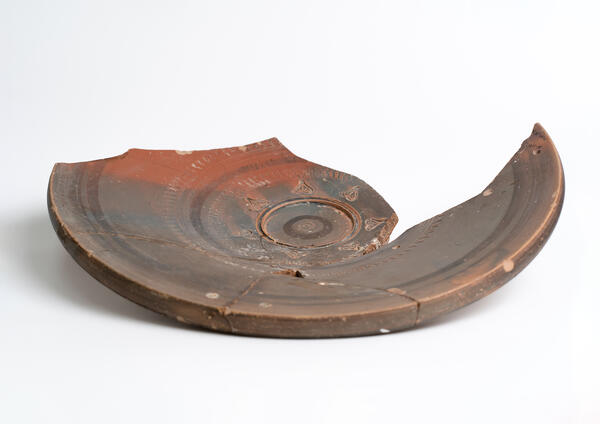
During the excavations of the estate, a fragment of a plate with darkened fire traces was found. As follows from the publication “Ancient States of the Northern Black Sea Region”, red lacquer ceramic items are among the most common finds across all ancient monuments. Most of such artifacts were brought to the Northern Black Sea region from cities in Asia Minor. However, some products were made locally. Determining the centers of production of red lacquer ceramics is associated with a number of difficulties.
A better-researched group of Western ceramics, produced in Italy and the provinces of the Roman Empire during the first centuries of the common era, is only represented in Olbia and Chersonesus. With regard to red lacquer pottery that appeared in the Northern Black Sea region, no traces of its production have been found so far, and the criteria for its attribution are unclear. Local products were made in imitation of imported ones, which are assumed to have been manufactured in the Bosporus area.
On ceramic plates, there are often traces of repairs made in ancient times using metal fasteners. For example, the displayed plate has drilled holes with remnants of metal. The bottom of the plate is decorated with a stamped ivy pattern. An ivy leaf, resembling a heart, was associated with the most revered god in ancient Greece — Dionysus. He was the patron god of winemaking, and his image can be found in many ancient Greek mosaics and on ceramic objects. The priests of Dionysus often wore wreaths made of ivy leaves. These wreaths were often given to brides and grooms on their wedding day. They were also used to decorate the graves of those who had lost loved ones. Ivy is known for its ability to wrap around other plants, symbolizing a strong bond between two people.