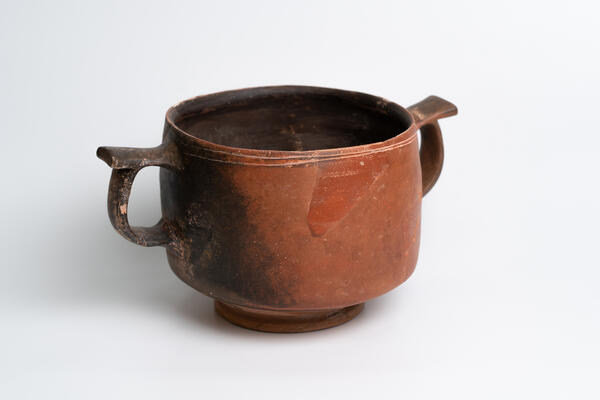
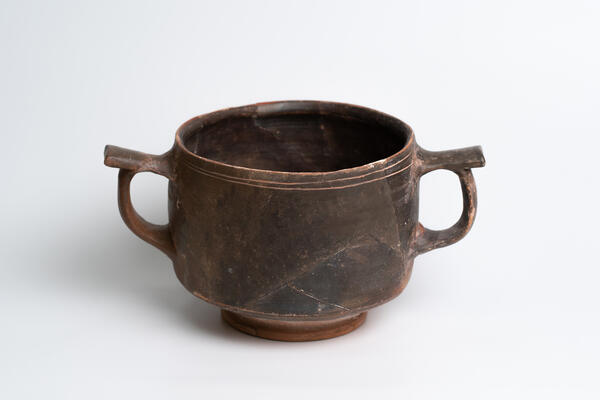
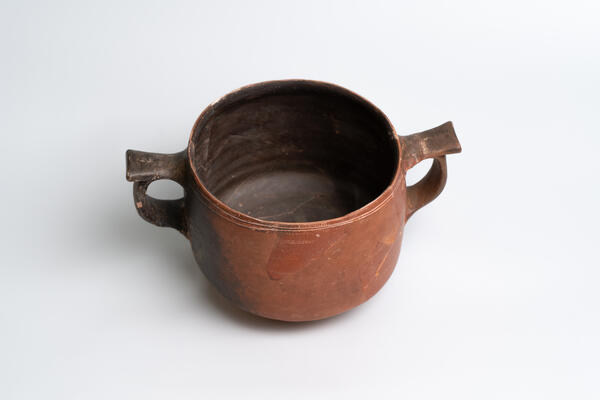
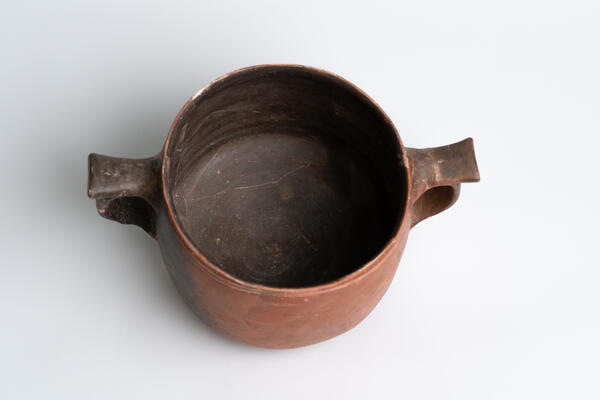
During archaeological excavations in 2007, the Donuzlav expedition led by Sergey Lantsov discovered a brown lacquer kantharos at the Kulchuk settlement. The kantharos has been fully restored. It has straight vertical sides and a circular base. There is also a repair hole on the vessel. On the surface of the kantharos, there is a decorative pattern with two cut-in lines along the edge. The lower part of the vessel above the base is fluted. Potters have used two types of lacquer since the times of ancient Greece — black and red.
Ash, as well as iron or clay oxide, were often used as the basis for preparing this type of lacquer. Depending on the temperature of the firing, the lacquer can become red (more than 4000 degrees Celsius) or black (less than 400 degrees Celsius). The quality of clay used is crucial for the quality of the resulting pottery. The rock must be weathered. The raw material was often soaked at the point of extraction and mixed with other additives to give the clay the desired color after firing. Before processing, the clay was cleaned. To do this, it was soaked or washed in a large container in a pottery studio. At the same time, larger particles of alumina sank to the bottom and the remaining organic impurities rose to the surface.
The clay mass was then transferred to a second container, where excess water was removed. Next, the clay was left wet for a long period of time. During this process, the clay matured and became more flexible. If clay was excessively oily, it was mixed with sand or ceramic powder to reduce the oil content and make the material more durable. After achieving the desired consistency, the clay was kneaded thoroughly with feet and divided into smaller pieces. The pieces were placed on a potter’s wheel and carefully centered to prevent any vibrations during rotation. Once centered, the body of the vessel was created by shaping the clay. If the vessel’s height exceeded the potter’s arm length, it was assembled from multiple elements. The final pieces were carefully cut from the wheel using a string.
The legs and handles of the vessels, as well as the
overlay decorative elements, were sculpted separately and then attached to the
body using liquid clay. After they were finished, the vessels were placed in a
dry and dark place to slowly dry in natural conditions, in order to avoid
cracks.