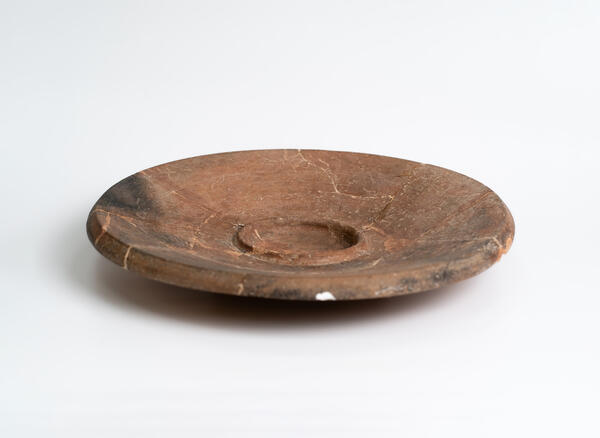
In ancient Greece, fish plates had a very distinctive shape. The food was arranged on a wide, slightly sloping surface. In the center, there was a small, round cup designed to hold sauce. The rim of the plate was bent outward almost vertically and covered a short and thick leg. The sauce poured into the cup was called garum. The writer Pliny the Elder and the poet Martial dedicated epigrams to this sauce. Garum is thought to have been made in ancient Greece. The Greeks may have adopted it, along with the technique of salting fish, from the Phoenicians and passed it on to the Romans.
It took a lot of time to make garum. Parts of fish were mixed with salt and placed in stone pots. These were seasoned in the sun for approximately two months. A transparent liquid that formed at the top was called garum. After it was ladled off the top of the mixture, the remains of the fermented fish, called “allec”, were also used as a cheaper condiment. The collection of ceramic finds from the Masliny settlement is represented by a group of gray-glazed ceramics. The displayed fish plate also belongs to this group.
The fish plate from Masliny has a diameter of 28 centimeters. It has an outward-bent rim and a highlighted bottom. Black-lacquered and gray-glazed products from Masliny were manufactured around the same time. However, while the former are typically associated with the Attic Greek production, the latter were produced in the Northern Black Sea region. In the settlements of the Northwestern Crimea, these types of products date back to the first half of the 4th century BCE to the first half of the 3rd century BCE. Nowadays, the origin of these pottery items remains a matter of debate.
The archaeologist V.A. Latysheva suggested that such artifacts may have come to Masliny from Chersonesus. However, further research into the settlements of the agricultural lands of Chersonesus and Olbia has led to a number of other ideas on this topic. The archaeologists Sergey Buyskikh and Valentina Krapivina analyzed the production of gray-glazed tableware in Olbia. They noted that it was a popular group of ceramic products and was probably manufactured locally from the end of the 6th century BCE. Such pottery could have reached Masliny either directly from Olbia or through Chersonesus. However, at this point, the idea that gray-glazed tableware was brought to Masliny from Olbia is merely a suggestion.