The tea ceremony in China is akin to a religious ritual that reflects the peculiarities of Chinese mentality and philosophy. It is a unique phenomenon in world culture.
Cha pan is the foundation of the tea ceremony. “Cha” is Chinese for tea, while “ban” or “pan” means “a board, a tray”. In the Chinese tradition of brewing tea, it is customary to warm up the dishes before serving tea in them, as well as to warm up tea leaves before brewing. A lot of water can be wasted during a tea ceremony. That is why the Chinese came up with a surprisingly functional object — a tea tray, or cha pan (also called in English a gongfu tea tray).
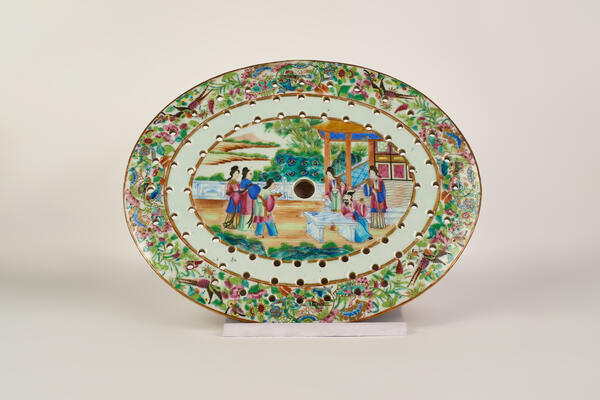
Tea trays come in different shapes and can be made of various types of wood or porcelain. But they do have a common feature: they allow to drain water during the tea ceremony. A popular option is a cha pan with a pan inside. The pan can be made of metal, ceramic or porcelain. In some trays, structurally the pan serves as the base of the tea tray. There are more complicated designs, for example, with an internal drainage hole and a hose that stretches to a special bucket for draining wastewater. Such cha pans are most often made of expensive wood or porcelain and can be very big.
The first mention of a cha pan is found in the work of a Taoist monk named Shuang Wang. He used a large flat stone, which became the prototype of modern tea trays. Initially, the ritual of tea drinking was widespread in Buddhist monasteries, and only later it was taken up by the imperial palace.
The main shapes of cha pan trays are called Zu Xing (rectangular), Yang Xing (round), Touyan Xing (oval), and Ping Fan (square).