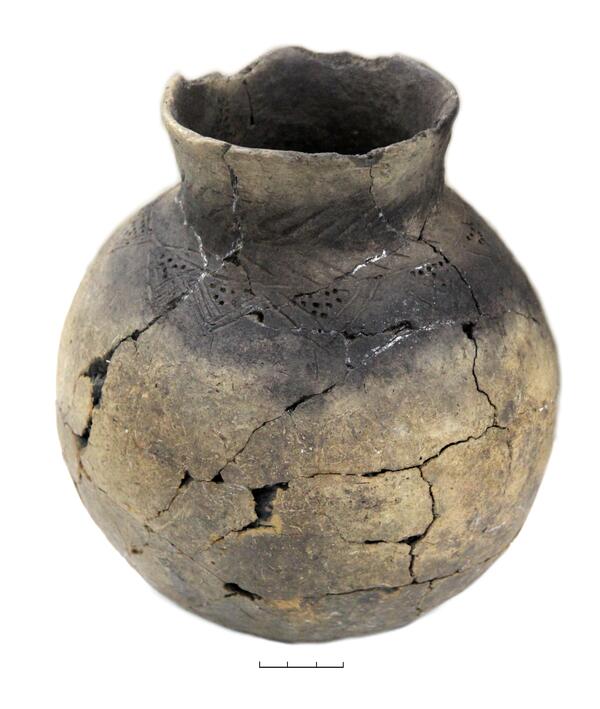
At the end of the 1980s, archaeologists investigated the Isakovka-I burial ground in the Irtysh region. It was left by representatives of the Sargat culture — nomads, whose habitat covered the lands from the Ob River to the main tributary of the Irtysh — Tobol. In one of the mounds, an unearthed burial with a large set of accompanying grave goods was found, which included gold and silver jewelry, weapons and military equipment, as well as ritual utensils, to which the vessel presented in the museum’s collection belongs.
The appearance of the vessel can be characterized as follows: inflated rounded body, round bottom, straight neck. In the transition zone from the neck to the shoulders, a chevron pattern is applied, on the shoulders there are flowing “festoons” (triangular decorative compositions). The last feature is the most characteristic of Sargat ceramics. For archaeologists, ceramics is one of the signs necessary for the identification of archaeological culture. If the culture develops gradually, the stability of ceramic traditions can be traced, but if some global events occur (for example, the conquest of one people by another), then the appearance of ceramics can change dramatically.
The existence and development of the Sargat culture
was quite steady. For a long time, researchers had at their disposal material
mainly on the developed period from the 4th century BCE to the 2nd century CE. Consequentially finds like this vessel have become all the more valuable and
made it possible to characterize the development of Sargat ceramics at the
final stage of the existence of this culture. While the vessel preserves common
elements, patterns and techniques, it also has the following features that are
characteristic of the dishes of the late Sargat monuments of the Irtysh region:
simplification of patterns and reduction of the decorated space. During this
period, the proportion of vessels in which only the shoulders and/or neck are
decorated also increases, as in this case. The number of dishes combining
several decorative elements is decreasing. The dishes are gradually becoming
more squat and stable.