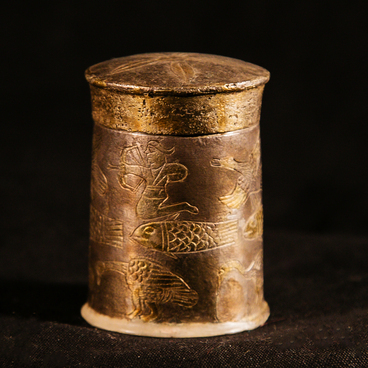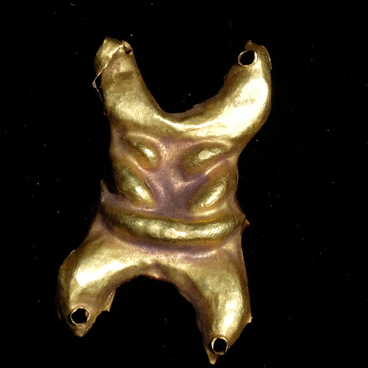
The sewn-on appliqué was found in the BEra mound near the KOsika village in the YenotAyevsky District. The burial was opened and destroyed in 1984 in the course of laying of a water supply trench.
This item is attributed to the era of the Sarmatians. The Sarmatian ancient people represented nomadic Iranian-speaking tribes that inhabited the Earasian steppe area stretched from the Danube to the Aral Sea from the 4th century BC to the first centuries of our era.
The Sarmatian women decorated their clothes with sewn-on appliqués. Their clothing was very diverse. To dye fabrics, they mainly used three colours: red, white and blue. These three colours were attributed to the three zones of the universe (upper, middle and lower ones) and, accordingly, to the three main classes of the Indo-Iranians (warriors, priests and workers).
Not only dresses but also burial covers were decorated with sewn-on appliqués. That’s why, batches of appliqués of various shapes may be found at once in the rich burial mounds of the Sarmatian culture. Researchers believe that such appliqués were sewn onto fabric in a specific order: to design various decorative compositions.
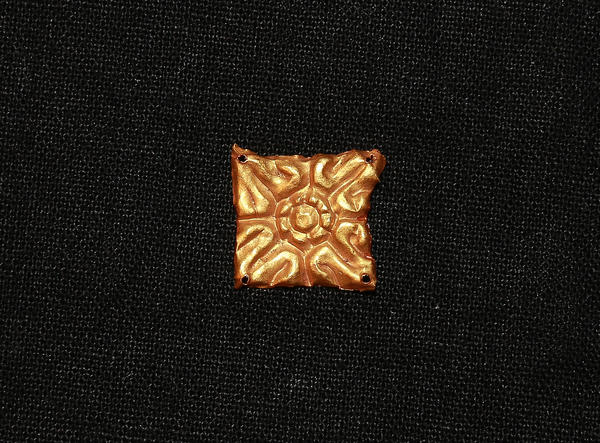
The square sewn-on appliqué from our collection is decorated with rosettes in the middle and styled ram heads in the corners. There are also holes in the corners to sew the appliqué onto fabric. Such appliqués with geometric patterns or zoomorphic motifs such as animal ornaments were especially popular. Our item combines a number of decor details: a geometric square shape, a zoomorphic motif, heads of rams, and a plant that is a vortex rosette in the middle. The rosette personifies the ‘world tree’. The ram was intepreted as ‘a symbol of heavenly grace’ in the Sarmatian times.
In general, the Sarmatian women thoughtfully and carefully decorated their clothes. For example, archaeologists never find clothes items with the same patterns. As a rule, appliqués were used to adorn hems, sleeves, and necks of dresses. Sometimes they were positioned close one another. There are items where appliqués were sewn almost without spacing, which gives an illusion of a solid metal strip.
In 2005, the appliqué and other items were exhibited at the Astrakhan Steppe Treasures show at the National Museum of the Palazzo Venezia in Rome.
This item is attributed to the era of the Sarmatians. The Sarmatian ancient people represented nomadic Iranian-speaking tribes that inhabited the Earasian steppe area stretched from the Danube to the Aral Sea from the 4th century BC to the first centuries of our era.
The Sarmatian women decorated their clothes with sewn-on appliqués. Their clothing was very diverse. To dye fabrics, they mainly used three colours: red, white and blue. These three colours were attributed to the three zones of the universe (upper, middle and lower ones) and, accordingly, to the three main classes of the Indo-Iranians (warriors, priests and workers).
Not only dresses but also burial covers were decorated with sewn-on appliqués. That’s why, batches of appliqués of various shapes may be found at once in the rich burial mounds of the Sarmatian culture. Researchers believe that such appliqués were sewn onto fabric in a specific order: to design various decorative compositions.
The square sewn-on appliqué from our collection is decorated with rosettes in the middle and styled ram heads in the corners. There are also holes in the corners to sew the appliqué onto fabric. Such appliqués with geometric patterns or zoomorphic motifs such as animal ornaments were especially popular. Our item combines a number of decor details: a geometric square shape, a zoomorphic motif, heads of rams, and a plant that is a vortex rosette in the middle. The rosette personifies the ‘world tree’. The ram was intepreted as ‘a symbol of heavenly grace’ in the Sarmatian times.
In general, the Sarmatian women thoughtfully and carefully decorated their clothes. For example, archaeologists never find clothes items with the same patterns. As a rule, appliqués were used to adorn hems, sleeves, and necks of dresses. Sometimes they were positioned close one another. There are items where appliqués were sewn almost without spacing, which gives an illusion of a solid metal strip.
In 2005, the appliqué and other items were exhibited at the Astrakhan Steppe Treasures show at the National Museum of the Palazzo Venezia in Rome.