Woolly mammoths appeared about 250,000 years ago, and lived in Europe, Asia, and North America. About 15,000 years ago, this species began to gradually go extinct. The last population of small woolly mammoths existed on Wrangel Island, and completely disappeared 4,000 years ago. According to one version of events, people are to blame for their disappearance: they overhunted them because of their valuable meat, hide, and bones.
Unlike the massive steppe mammoths, woolly mammoths were small, about the size of modern elephants: they could reach 3.4 meters at the withers, and weigh 6 tons. Thick wool coats up to 90 centimeters long protected the mammoths from severe frosts.
Depending on the time of death and the environmental conditions, the remains of these extinct animals survive today preserved to varying degrees. They are best preserved in conditions where permafrost is present, which distributed throughout the area of Yugra in a very localized manner, in contrast to the territory of Yamal or Yakutia, where whole carcasses with soft tissues can be found.
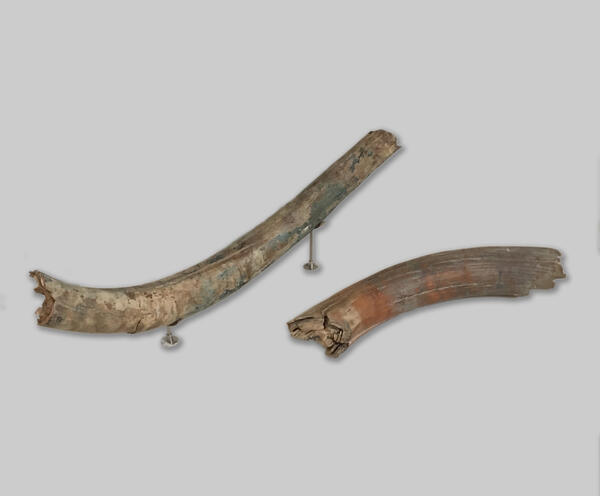
The tusks and teeth are the heaviest part of a mammoth’s skull. Tusks are sometimes mistaken for extremely long canines. In reality, fangs do not develop on elephants, and tusks are enlarged incisors. Mammoths were born with temporary “baby” tusks 3-4 cm long. At the age of one year, these elephants changed their teeth, and baby tusks were replaced by permanent ones. The tusks of large adult male woolly mammoths bent in a steep arc, and reached 4 meters in length.
Mammoth tusks are in high demand for bone carving and jewelry production because their physical qualities are unique: they are both tough and malleable. Carvers manage to make jewelry out of them with the finest elaboration of detail, even creating the illusion of soft draperies and naturally cascading clothes.
Modern-day production engineers are trying to find the formula for a synthetic material with similar characteristics, but have not achieved success yet. That is why jewelers use natural mammoth tusks: according to rough estimates, there are about 200,000 of them in Russia in the depths of the Earth.
Currently, a number of scientists in different countries are working on cloning mammoths: the genome of these ancient animals was completely decoded in 2016, including due to finds discovered in Yakutia.
Unlike the massive steppe mammoths, woolly mammoths were small, about the size of modern elephants: they could reach 3.4 meters at the withers, and weigh 6 tons. Thick wool coats up to 90 centimeters long protected the mammoths from severe frosts.
Depending on the time of death and the environmental conditions, the remains of these extinct animals survive today preserved to varying degrees. They are best preserved in conditions where permafrost is present, which distributed throughout the area of Yugra in a very localized manner, in contrast to the territory of Yamal or Yakutia, where whole carcasses with soft tissues can be found.
The tusks and teeth are the heaviest part of a mammoth’s skull. Tusks are sometimes mistaken for extremely long canines. In reality, fangs do not develop on elephants, and tusks are enlarged incisors. Mammoths were born with temporary “baby” tusks 3-4 cm long. At the age of one year, these elephants changed their teeth, and baby tusks were replaced by permanent ones. The tusks of large adult male woolly mammoths bent in a steep arc, and reached 4 meters in length.
Mammoth tusks are in high demand for bone carving and jewelry production because their physical qualities are unique: they are both tough and malleable. Carvers manage to make jewelry out of them with the finest elaboration of detail, even creating the illusion of soft draperies and naturally cascading clothes.
Modern-day production engineers are trying to find the formula for a synthetic material with similar characteristics, but have not achieved success yet. That is why jewelers use natural mammoth tusks: according to rough estimates, there are about 200,000 of them in Russia in the depths of the Earth.
Currently, a number of scientists in different countries are working on cloning mammoths: the genome of these ancient animals was completely decoded in 2016, including due to finds discovered in Yakutia.