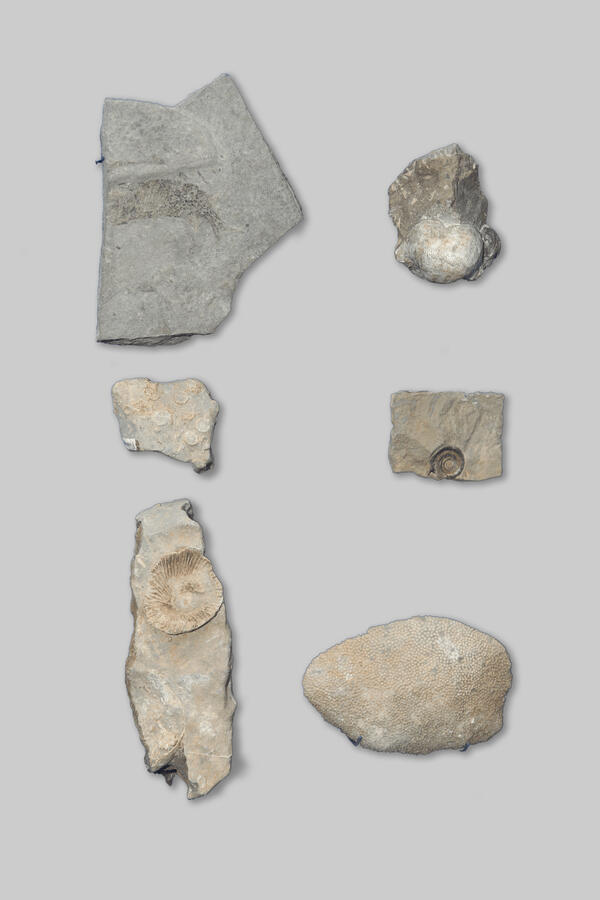
The first gastropods or snails, appeared about 570 million years ago and depending on the species and habitat, could grow up to 70 cm. The flourishing of gastropods began after the disappearance of large mollusks about 65 million years ago. Today they inhabit salt and fresh waters and also live on land.
Brachiopods are marine invertebrates that arose about 550 million years ago. They had a soft body with a wide mantle and a shell with two valves up to 40 cm in diameter. They lived both singly and in colonies, preferred shallow waters, attached their feet to rocks, opened their shells and ate plankton. Despite the almost exact external resemblance to bivalve molluscs, brachiopods are not molluscs. The main difference is that brachiopods have a so-called manual apparatus with a calcareous skeleton, on which villi are located, creating a flow of water to the mouth. These animals are also found in modern warm seas.
Corals, or coral polyps, appeared in the oceans 535 million years ago. They have a lot in common with their closest relatives - jellyfish. One of the unifying qualities is the ability to sting the victim with the help of special stinging cells. But unlike jellyfish, corals were still able to build external calcareous skeletons. Corals flourished until the Great Permian Extinction, which occurred about 250 million years ago, when 96% of all marine fauna on the planet disappeared. Many of the coral species are now extinct, but some still exist.
The four-beam coral, or rugoses, is an extinct species. Rugoses could lead a solitary lifestyle or create colonies. They grew 2–12 cm in length and resembled horns with a wrinkled surface. This is how the scientific name of this creature arose: rugosa in translation from the Latin language - ‘wrinkled’. Corals created their skeleton exclusively during daylight hours - unevenly throughout the year. This is how the skeleton of the coral became a ‘record of light.’ Their study helped to prove that the Earth used to rotate on its axis faster than today.
Another extinct group of colonial corals - tabulatomorphic corals - were contemporaries of rugoses, but grew up to 0.5–4 mm. Their calcareous skeletons resembled a chaotically constructed honeycomb, but still with a consistent pattern.
About 359 million years ago, paleonisk fish appeared in the ocean. They were distinguished by a wide variety of shapes and sizes, although on average they did not exceed 40 cm in length, and their body was covered with rows of diamond-shaped bone scales. Paleonisks were the first ray-finned fish - the structure of their fins resembled rays diverging from one point. They are also the ancestral group for many modern fish - scientists attribute 95% of all species living today to ray-finned fish. About 145 million years ago, the paleonisks became extinct, but remained in history in the form of fossils and imprints in solidified silt.
Brachiopods are marine invertebrates that arose about 550 million years ago. They had a soft body with a wide mantle and a shell with two valves up to 40 cm in diameter. They lived both singly and in colonies, preferred shallow waters, attached their feet to rocks, opened their shells and ate plankton. Despite the almost exact external resemblance to bivalve molluscs, brachiopods are not molluscs. The main difference is that brachiopods have a so-called manual apparatus with a calcareous skeleton, on which villi are located, creating a flow of water to the mouth. These animals are also found in modern warm seas.
Corals, or coral polyps, appeared in the oceans 535 million years ago. They have a lot in common with their closest relatives - jellyfish. One of the unifying qualities is the ability to sting the victim with the help of special stinging cells. But unlike jellyfish, corals were still able to build external calcareous skeletons. Corals flourished until the Great Permian Extinction, which occurred about 250 million years ago, when 96% of all marine fauna on the planet disappeared. Many of the coral species are now extinct, but some still exist.
The four-beam coral, or rugoses, is an extinct species. Rugoses could lead a solitary lifestyle or create colonies. They grew 2–12 cm in length and resembled horns with a wrinkled surface. This is how the scientific name of this creature arose: rugosa in translation from the Latin language - ‘wrinkled’. Corals created their skeleton exclusively during daylight hours - unevenly throughout the year. This is how the skeleton of the coral became a ‘record of light.’ Their study helped to prove that the Earth used to rotate on its axis faster than today.
Another extinct group of colonial corals - tabulatomorphic corals - were contemporaries of rugoses, but grew up to 0.5–4 mm. Their calcareous skeletons resembled a chaotically constructed honeycomb, but still with a consistent pattern.
About 359 million years ago, paleonisk fish appeared in the ocean. They were distinguished by a wide variety of shapes and sizes, although on average they did not exceed 40 cm in length, and their body was covered with rows of diamond-shaped bone scales. Paleonisks were the first ray-finned fish - the structure of their fins resembled rays diverging from one point. They are also the ancestral group for many modern fish - scientists attribute 95% of all species living today to ray-finned fish. About 145 million years ago, the paleonisks became extinct, but remained in history in the form of fossils and imprints in solidified silt.