

Ammonites are ancient cephalopods. They appeared in the Devonian period about 400 million years ago, and died out along with the dinosaurs at the end of the Cretaceous period, about 65 million years ago. During their existence, ammonites inhabited almost all the seas and oceans from the North to the South Pole, and were not only found in fresh waters.
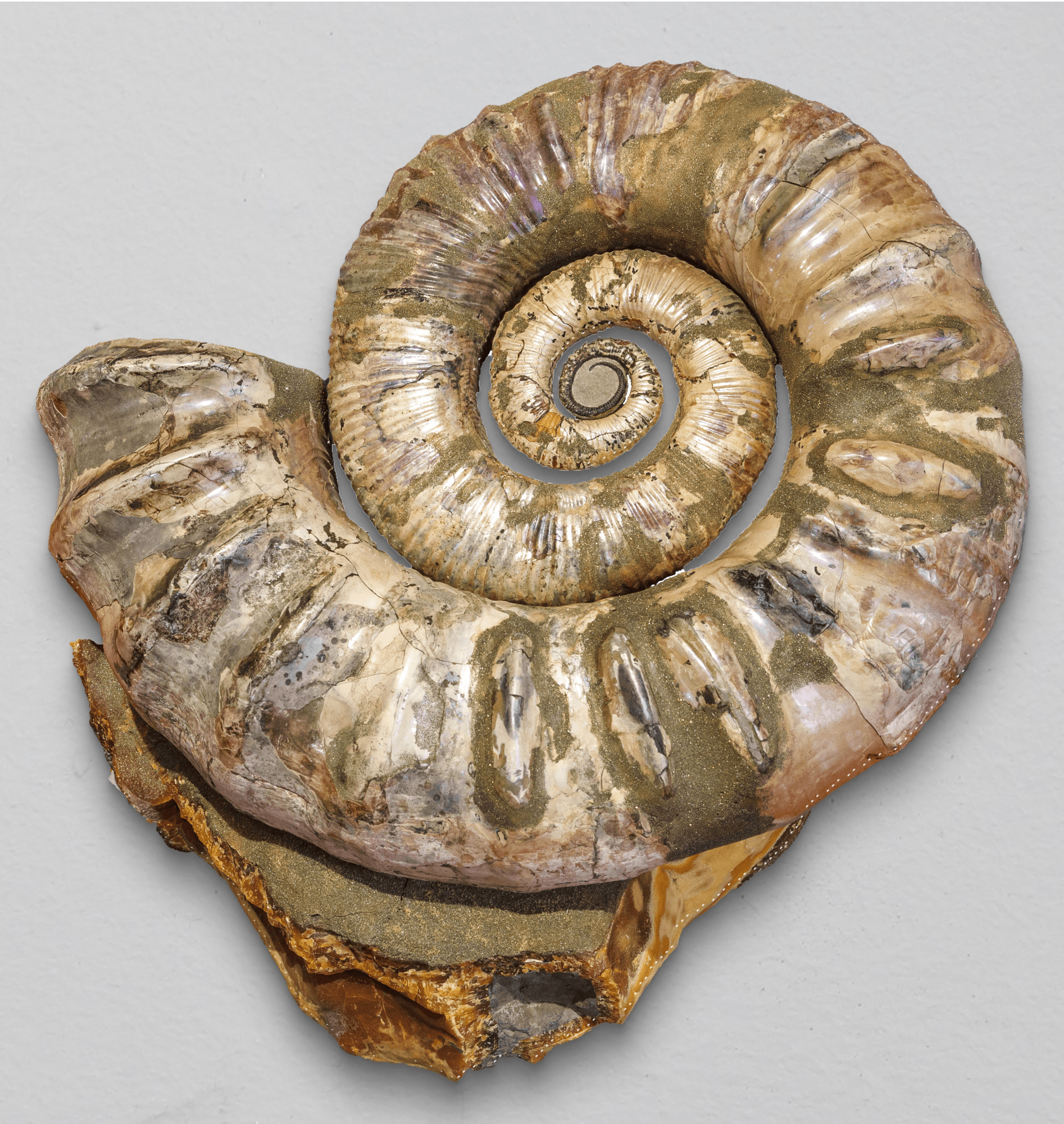
Most ammonites had a spiral shell in the form of ram’s horns. This similarity was noticed by the Roman scientist Pliny the Elder in the 1st century A.D. He was one of the first to describe the fossilized shells of ammonites, and gave them the name ammonis cornua (“the horns of Ammon”) - in honor of the Egyptian sun god Amun-Ra, whose image the Egyptians decorated with the horns of a ram.
Today, scientists count more than 10,000 species of ammonites, with shells of various sizes and shapes. Depending on the species, over their lifetimes the ammonites could stay at less than 5 mm in diameter, and weigh several fractions of a gram, or grow up to 2.5 m in diameter, and reach a mass of 1.5 tons. The shapes of the shells these cephalopods had were also very different: twisted in the form of a regular spiral, triangular, conical, or thin, straight tubes either with or without a sharp curl at the end. Ammonites lived at a depth ranging from 50–250 meters, and fed on plankton, or hunted larger prey like fish and other mollusks.
The internal structure of their shells and a soft body were things that all ammonites had in common. As the mollusks grew, they added new, more spacious chambers to their initial one. While doing that, they closed off the passageway to the chambers that they abandoned with a partition, leaving a small hole in it. This hole allowed a gas or liquid produced by the mollusks to be discharged into the empty chambers: this way the ammonites could change their buoyancy, and rise to the surface of the water or sink to the bottom of the body of water they were located in. The mollusk itself lived in the last chamber with the largest orifice, and from there it could stick out its large head with compound eyes, 8–10 tentacles, and forked jaws. In case danger arose, the ammonite closed the mouth with a strong cover that was made from its own lower jaw.
Ammonites became extinct about 65 million years ago, but their relatives still live in the seas and oceans: these include the nautilus, octopus, squid, and cuttlefish.
Most ammonites had a spiral shell in the form of ram’s horns. This similarity was noticed by the Roman scientist Pliny the Elder in the 1st century A.D. He was one of the first to describe the fossilized shells of ammonites, and gave them the name ammonis cornua (“the horns of Ammon”) - in honor of the Egyptian sun god Amun-Ra, whose image the Egyptians decorated with the horns of a ram.
Today, scientists count more than 10,000 species of ammonites, with shells of various sizes and shapes. Depending on the species, over their lifetimes the ammonites could stay at less than 5 mm in diameter, and weigh several fractions of a gram, or grow up to 2.5 m in diameter, and reach a mass of 1.5 tons. The shapes of the shells these cephalopods had were also very different: twisted in the form of a regular spiral, triangular, conical, or thin, straight tubes either with or without a sharp curl at the end. Ammonites lived at a depth ranging from 50–250 meters, and fed on plankton, or hunted larger prey like fish and other mollusks.
The internal structure of their shells and a soft body were things that all ammonites had in common. As the mollusks grew, they added new, more spacious chambers to their initial one. While doing that, they closed off the passageway to the chambers that they abandoned with a partition, leaving a small hole in it. This hole allowed a gas or liquid produced by the mollusks to be discharged into the empty chambers: this way the ammonites could change their buoyancy, and rise to the surface of the water or sink to the bottom of the body of water they were located in. The mollusk itself lived in the last chamber with the largest orifice, and from there it could stick out its large head with compound eyes, 8–10 tentacles, and forked jaws. In case danger arose, the ammonite closed the mouth with a strong cover that was made from its own lower jaw.
Ammonites became extinct about 65 million years ago, but their relatives still live in the seas and oceans: these include the nautilus, octopus, squid, and cuttlefish.