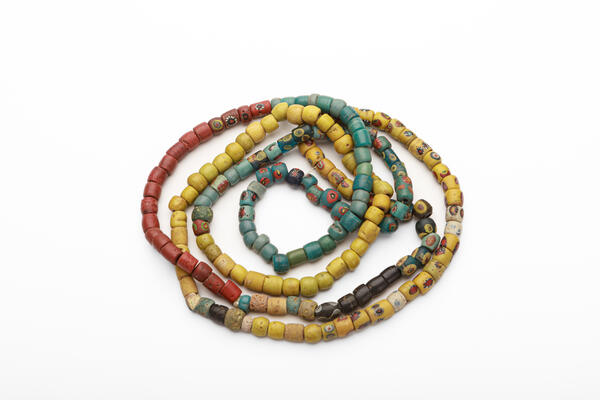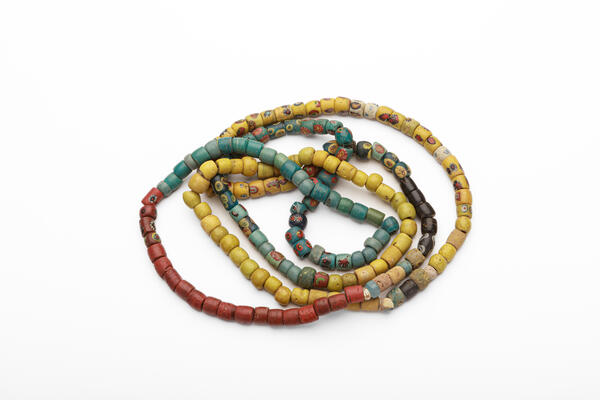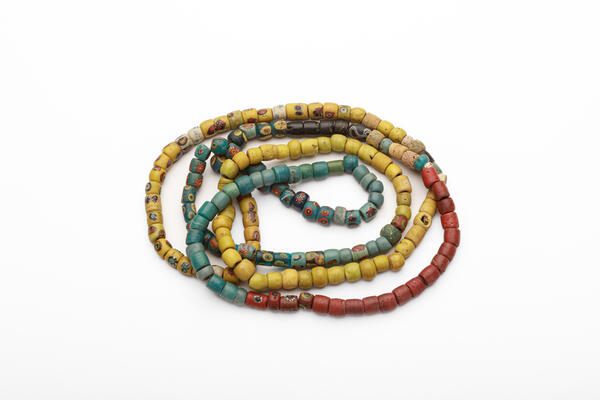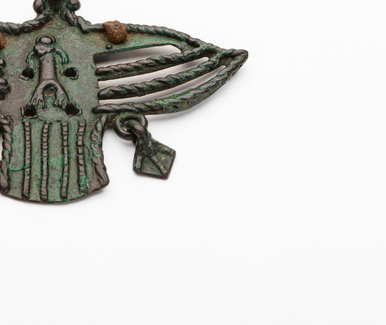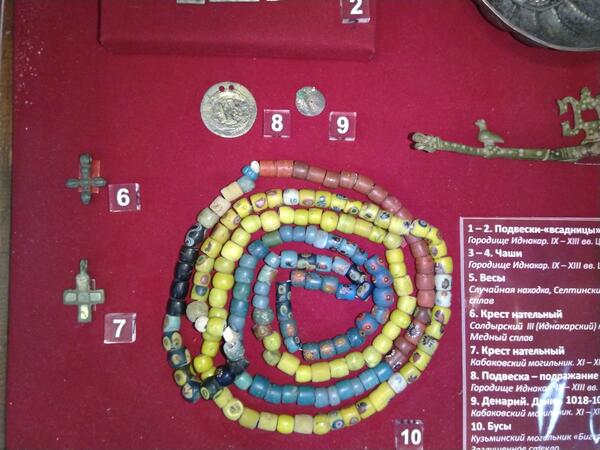
Necklaces were the most striking detail of a woman’s costume in the Middle Ages. In Idnakar, girls and women wore ornate necklaces made of several strings of multi-colored glass beads, complemented by elegant pendants.
The Russian word “boussy” for beads in its modern meaning appeared in the 17th century, and before that this type of jewelry was called “ozherelye” (a necklace), that is, something that is worn around the neck — “zherlo” in Old Slavonic.
Glass beads were imported. Together with many other goods, they came to the Chepetsk region from Volga Bulgaria — a center of trade and a large market. Scandinavian, Old Russian and Arab merchants flocked there with their goods to exchange, buy and sell them.
Strings of beads found by archaeologists in the Cheptsa River basin are of Middle Eastern and Byzantine origin. The collections of the Idnakar Museum contain many eye beads. Their appearance is associated with early people’s ideas about the world around them. People believed that one could use a look in the eye to connect oneself with a phenomenon or another being. In the animal world, direct eye contact is considered a signal of threat or attack, and humans shared the same instincts.
Belief in “the evil eye” and sorcery is found in all cultures, starting with the earliest ones. The earliest mentions of this are found in cuneiform texts of the Sumerians, Babylonians and Assyrians, written about 5,000 years ago. In a general sense, the concept of the evil eye is a metaphor for possible danger. For many peoples around the world, the eye became a mythological symbol with magical powers, which could help the hero remain invisible.
To make eye beads, multi-colored glass rods were fused into the sides of a red-hot bead. The number of eyes could indicate the value of the bead: before the spread of coins, beads were sometimes used as currency. Beads were very valuable in the Middle Ages. Arab travelers indicated that they “bought beads, each for a dirham, and made strings of them, like necklaces, for their wives.”
In the 12th–13th centuries, with the beginning of trade relations between the Prikamye region and the Slavic world, oriental jewelry gradually gave way to products made by Old Russian craftsmen.