

A steelyard, or a bezmen in Russian, is a simple portable scale with a lever and a movable pivot point. These weighing devices have been known since antiquity, and the oldest steelyard found in Russia is dated back to the 13th century. With the development of foreign and domestic trade in Russia, the steelyard quickly gained popularity. These scales worked without weights, they were easy to carry around, and the device was simple and sturdy. Throughout the country, including in the Vyatka Governorate, goods were weighed in shops, at fairs and at home. Folk ditties and riddles were created about these scales, for example, “It is thin itself, but its head is about one pound”, “Its iron soul cannot lie.”
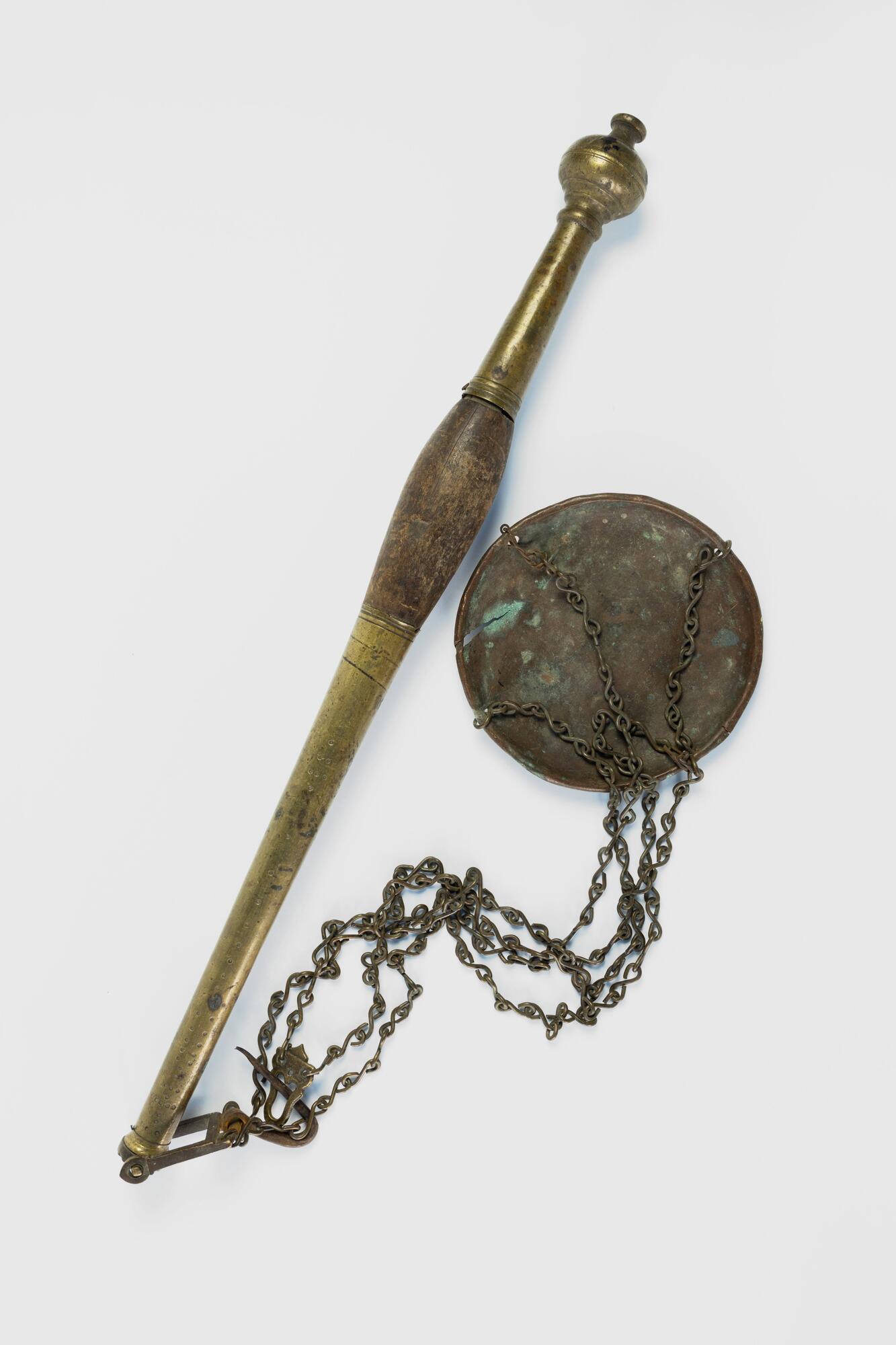
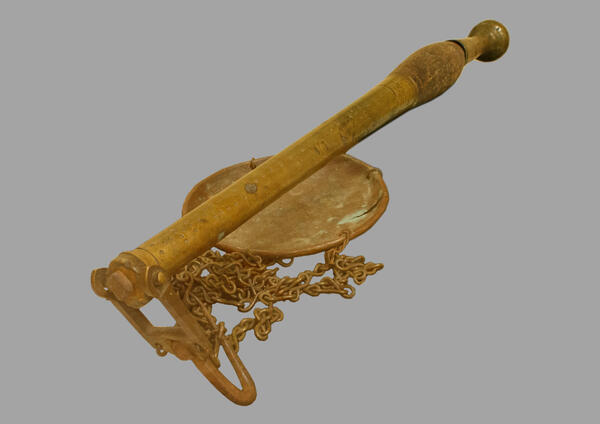
The exhibition of the Glazov Museum of Local Lore presents a device for weighing goods, which was used in the Vyatka Governorate at the turn of the 20th century. A round metal bowl is suspended on four chains from a wooden handle, and a scale with tiny notches for determining the weight of the load is marked on the arm. The steelyard exemplifies the principle of equilibrium. To measure something, one would hold the steelyard in the air suspended by a cord that could move freely along the arm. The load was placed inside the bowl, and the cord was moved along the markings towards the load until it was balanced by a counterweight — the metal end. The mark under the cord indicated the load’s weight.
The steelyard was used everywhere, but its inaccuracy was always noted. It was great for weighing small loads of 100–200 grams, but it was inaccurate when weighing something heavier than 5 kilograms. Moreover, it was easy for a merchant to deceive the customer. Even Aristotle mentioned the lack of accuracy of unequal arm balance scales, and in the Middle Ages, the steelyard was officially banned in trade in Europe. According to the Code of Laws of the Russian Empire of the 1857 edition, “the use of the ordinary Russian steelyard in petty trade is universally prohibited as it is prone to deception. Peddlers are allowed to use the bezmen, if its design is consistent with specific guidelines, but the use of this bezmen in shops is also prohibited.” However, neither the official ban nor the apparent inaccuracy of measurement stopped the active use of the bezmen in everyday life and trade until the beginning of the 20th century.
The exhibition of the Glazov Museum of Local Lore presents a device for weighing goods, which was used in the Vyatka Governorate at the turn of the 20th century. A round metal bowl is suspended on four chains from a wooden handle, and a scale with tiny notches for determining the weight of the load is marked on the arm. The steelyard exemplifies the principle of equilibrium. To measure something, one would hold the steelyard in the air suspended by a cord that could move freely along the arm. The load was placed inside the bowl, and the cord was moved along the markings towards the load until it was balanced by a counterweight — the metal end. The mark under the cord indicated the load’s weight.
The steelyard was used everywhere, but its inaccuracy was always noted. It was great for weighing small loads of 100–200 grams, but it was inaccurate when weighing something heavier than 5 kilograms. Moreover, it was easy for a merchant to deceive the customer. Even Aristotle mentioned the lack of accuracy of unequal arm balance scales, and in the Middle Ages, the steelyard was officially banned in trade in Europe. According to the Code of Laws of the Russian Empire of the 1857 edition, “the use of the ordinary Russian steelyard in petty trade is universally prohibited as it is prone to deception. Peddlers are allowed to use the bezmen, if its design is consistent with specific guidelines, but the use of this bezmen in shops is also prohibited.” However, neither the official ban nor the apparent inaccuracy of measurement stopped the active use of the bezmen in everyday life and trade until the beginning of the 20th century.