

A butter churn is a device for the manual production of butter. When cream is actively agitated, the membranes that surround the milk fat get ruptured. The fat droplets clump together and form butter. The remaining liquid is called buttermilk, it is skimmed cream. The longer and more thoroughly the cream is churned, the more tender and homogeneous the butter turns out.
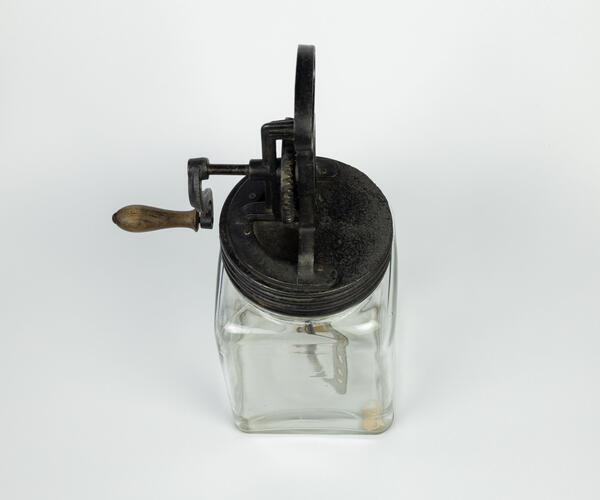
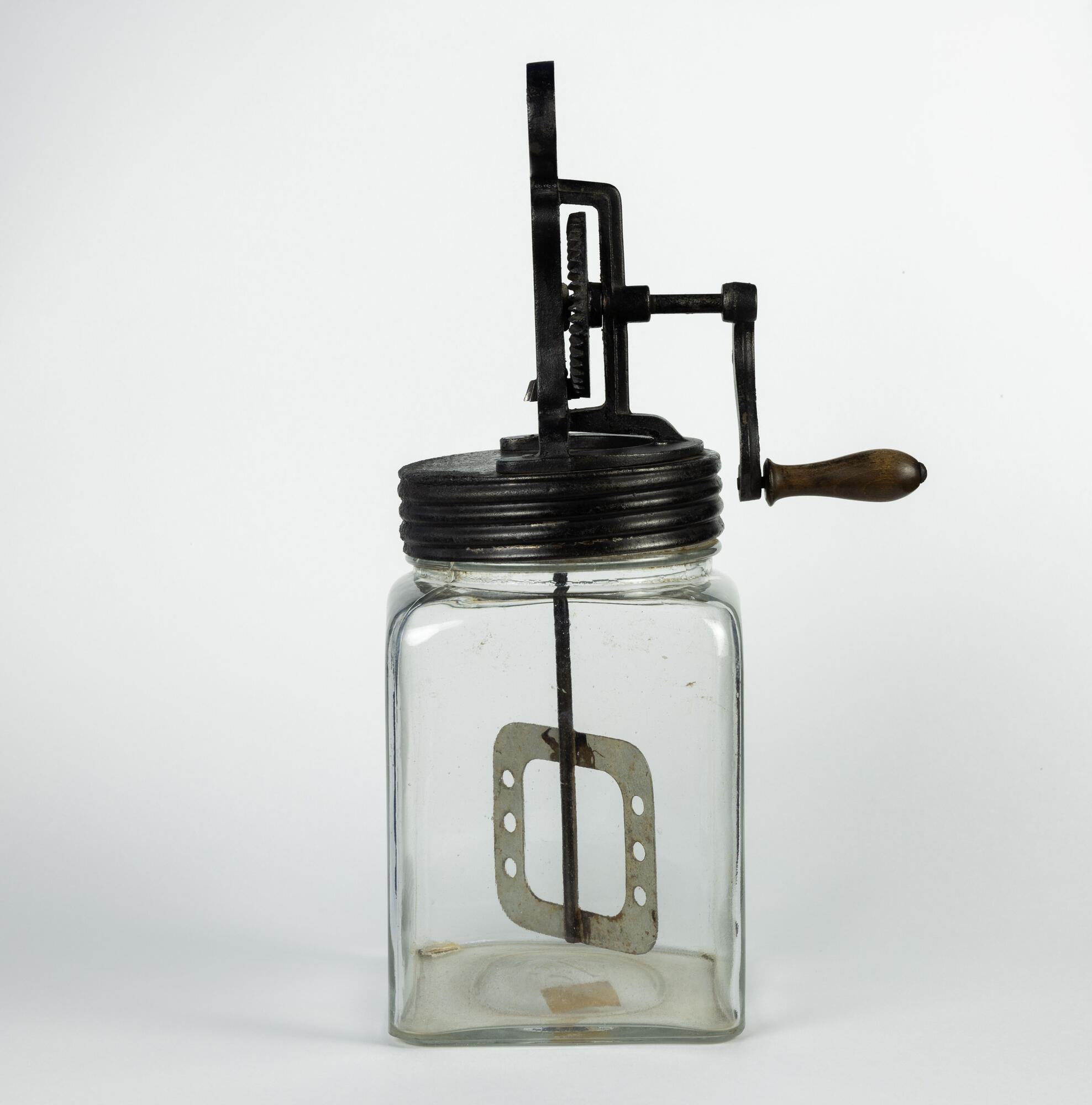
The mechanical churn from the collection of the Glazov Museum of Local Lore belonged to a Glazov resident Z.V. Barskova and was made at a German glass-blowing factory in the late 19th — early 20th century. The four-sided glass jar is closed with a ribbed lid through which a short pole with a wide blade is passed. The metal mechanism is operated by turning the curved handle.
European peasants started using wooden manual churns for household needs in the 6th century. Most often they were homemade, the size of a jug. There was a shaft that was plunged into the churn to agitate the cream. The material of the churn strongly affected the taste of butter, so in Rus it was preferred to make them from linden. In the absence of a churn, housewives churned butter by hand using wooden bowls, spoons and mashers. It was a long and time-consuming process. It took from thirty minutes to two hours to make one serving of butter.
To make homemade butter, cream or sour cream was poured into the churn, and then the handle was moved up and down, using the same working principle as a piston. Then the contents of the churn were poured into a basin with cold water. The butter that floated to the surface was collected with a spoon and tightly packed in a wooden rectangle-shaped container — a butter mold. It was covered with a lid and put in a cold place overnight, and by morning a block of fresh butter was ready.
In the 19th century, the production of butter reached an industrial scale. 700 butter mills appeared in Russia, and most of the butter was exported. In every household, where cows were kept, butter was still made at home, but with the help of a factory-made churn. From a wooden churn or a tin mortar, it turned into a glass vessel with a metal mechanism for churning.
The mechanical churn from the collection of the Glazov Museum of Local Lore belonged to a Glazov resident Z.V. Barskova and was made at a German glass-blowing factory in the late 19th — early 20th century. The four-sided glass jar is closed with a ribbed lid through which a short pole with a wide blade is passed. The metal mechanism is operated by turning the curved handle.
European peasants started using wooden manual churns for household needs in the 6th century. Most often they were homemade, the size of a jug. There was a shaft that was plunged into the churn to agitate the cream. The material of the churn strongly affected the taste of butter, so in Rus it was preferred to make them from linden. In the absence of a churn, housewives churned butter by hand using wooden bowls, spoons and mashers. It was a long and time-consuming process. It took from thirty minutes to two hours to make one serving of butter.
To make homemade butter, cream or sour cream was poured into the churn, and then the handle was moved up and down, using the same working principle as a piston. Then the contents of the churn were poured into a basin with cold water. The butter that floated to the surface was collected with a spoon and tightly packed in a wooden rectangle-shaped container — a butter mold. It was covered with a lid and put in a cold place overnight, and by morning a block of fresh butter was ready.
In the 19th century, the production of butter reached an industrial scale. 700 butter mills appeared in Russia, and most of the butter was exported. In every household, where cows were kept, butter was still made at home, but with the help of a factory-made churn. From a wooden churn or a tin mortar, it turned into a glass vessel with a metal mechanism for churning.