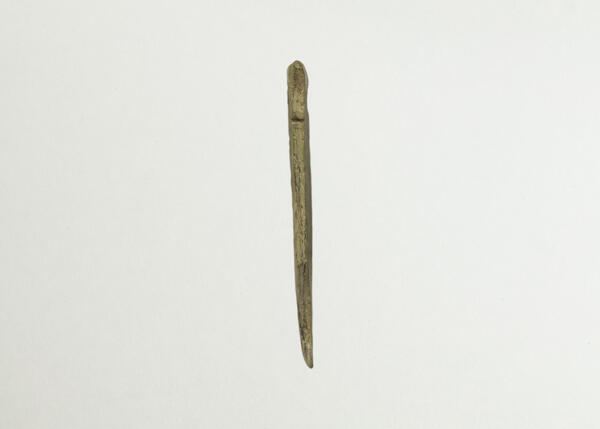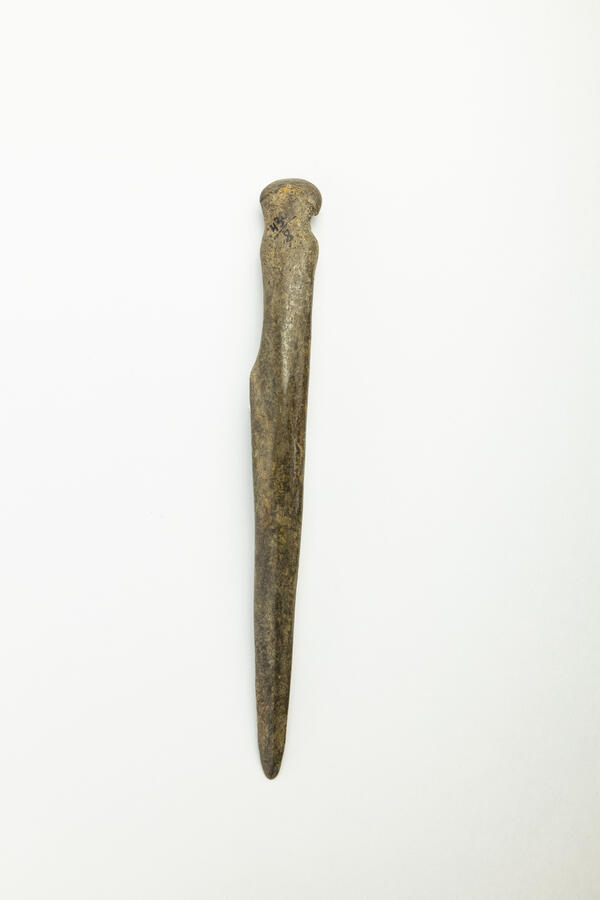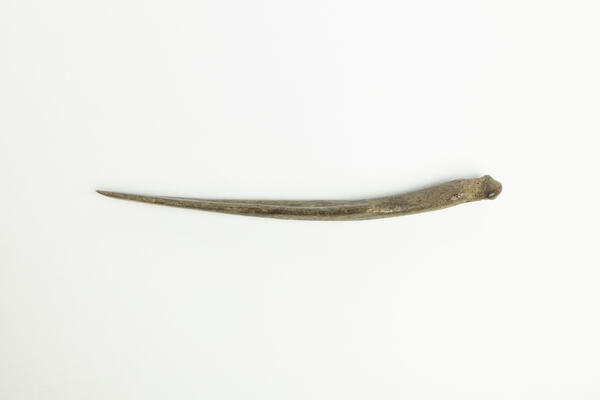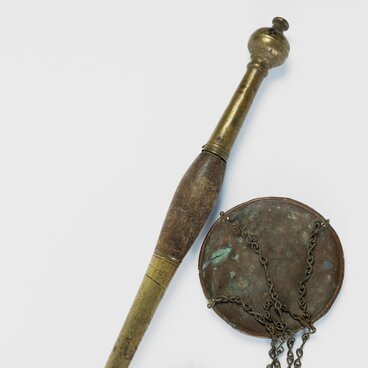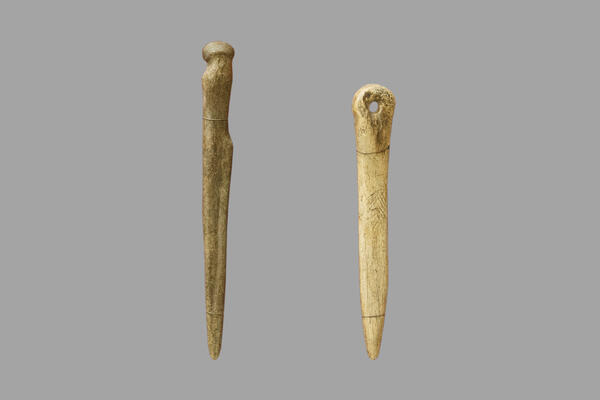
A kochedyk is a tool for weaving nets, bags, bast shoes, boxes and other items made of bast and birch bark. The kochedyk was made from ribs and split tubular bones of large animals. Its sharp end was used for weaving, and it had an eye for a cord at the other end, as it was easy to lose it. The kochedyk ranged from 14 to 23 cm in length, but there were also longer ones — over 30 cm. The kochedyks were known to the ancestors of the Udmurts since the early Middle Ages. The Udmurts used them in everyday life until the middle of the 20th century. Today, the kochedyks are made of wood and metal.
All items made of animal bones and horns were usually ornamented. The patterns included shaded triangles, rhombuses, intersecting lines and dots. They often featured a tamga or pus — a type of signature, symbols of the clan and property, which indicated that the item belonged to a specific owner. Masters carved human and animal figures on bone items using the technique of high relief carving: a horse, an elk, a bird of prey, a bear, and a marten. In medieval settlements not only bone-cutters, but also many family members knew how to carve bone.
The bone kochedyk from the collection of the Glazov Museum of Local Lore was found in 1976 during an archaeological expedition to the medieval settlement of Idnakar. It is located on Soldyr Mountain, where, according to an Udmurt legend, the ancient heroes lived — Dondy and his sons Idna, Gurya, Vesya and Zuy. The heroes settled around the area of the Cheptsa River and founded their settlements. Idna remained on the mountain to rule over the Udmurts to protect them from the White Tsar (Ivan the Terrible) and the Russian people.
The Idnakar settlement was surrounded by three protective rows, including a moat and a rampart. Its inhabitants provided themselves with everything they needed. They engaged in animal husbandry, hunting, agriculture and crafts: blacksmithing, ceramics, metalworking and bone-cutting. Idnakar was a major trade and defense center and existed until the 13th century, when it was captured and burned. Today, it is an archaeological monument of federal significance.
All items made of animal bones and horns were usually ornamented. The patterns included shaded triangles, rhombuses, intersecting lines and dots. They often featured a tamga or pus — a type of signature, symbols of the clan and property, which indicated that the item belonged to a specific owner. Masters carved human and animal figures on bone items using the technique of high relief carving: a horse, an elk, a bird of prey, a bear, and a marten. In medieval settlements not only bone-cutters, but also many family members knew how to carve bone.
The bone kochedyk from the collection of the Glazov Museum of Local Lore was found in 1976 during an archaeological expedition to the medieval settlement of Idnakar. It is located on Soldyr Mountain, where, according to an Udmurt legend, the ancient heroes lived — Dondy and his sons Idna, Gurya, Vesya and Zuy. The heroes settled around the area of the Cheptsa River and founded their settlements. Idna remained on the mountain to rule over the Udmurts to protect them from the White Tsar (Ivan the Terrible) and the Russian people.
The Idnakar settlement was surrounded by three protective rows, including a moat and a rampart. Its inhabitants provided themselves with everything they needed. They engaged in animal husbandry, hunting, agriculture and crafts: blacksmithing, ceramics, metalworking and bone-cutting. Idnakar was a major trade and defense center and existed until the 13th century, when it was captured and burned. Today, it is an archaeological monument of federal significance.