


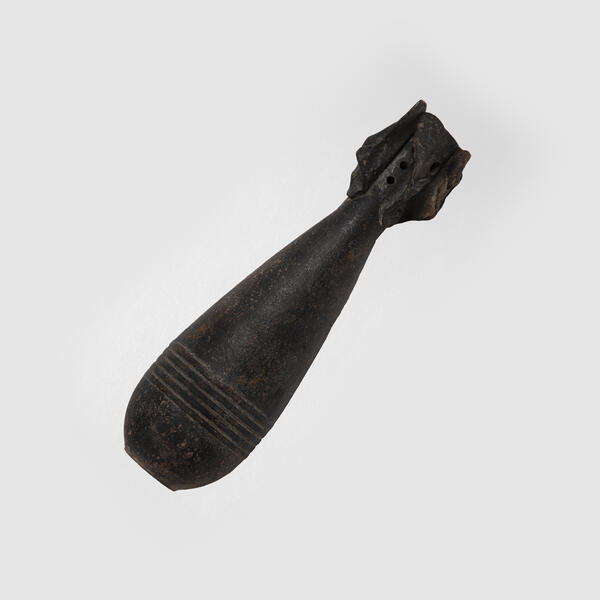
The collection of the Zimovniki Museum of Local History contains an 82-millimeter mortar bomb shell. It was used in battles during the Great Patriotic War.
The 82-millimeter mortar was designed and accepted into service in the 1930s. It became the first Soviet mortar used in rifle battalions. Soviet soldiers used the weapon to eliminate the enemy’s artillery, attack the adversary, and destroy barbed wire defenses and fortifications.
The mortar bomb from the museum’s collection has a drop-shaped casing with a fuse inside, as well as basic and additional charges that were used to adjust the muzzle velocity and the range. The mortar bomb flared to the tail section — these “fins” stabilized the shell.
The mortar bomb was 27.5 centimeters long, and together with the fuse, it weighed more than 3 kilograms. The shell exploded into 400–600 pieces that struck the enemy’s military personnel and fortifications at a distance of 600 meters. Several soldiers were needed to operate a mortar. The mortar weighed 61 kilograms in the stowed position, but it was disassembled into three parts for transportation: a barrel, a bipod and a base plate. In addition to the weapon itself, the squad carried the ammunition: a backpack that had two trays with six bombs.
There were three main types of mortar bombs depending on whether they were used for main, special or auxiliary purposes. The main-purpose mortar bombs were used to harass the adversary, destroy engineering structures and fire back. The special-purpose mortar bombs included illuminating shells that illuminated the battlefield at night and blinded the enemy, smoke shells that were used to create smoke screens for camouflage and disorientation, and carrier shells that were used to deliver propaganda leaflets. The auxiliary-purpose shells were blanks used for training — they did not have an explosive compound inside.
Before the Great Patriotic War, the Soviet army had several battalion mortar systems in service — these were 50-millimeter mm, 82-millimeter and 120-millimeter mortars. Since 1941, the weapon’s design was regularly improved. For example, the 82-millimiter mortar underwent several changes in 1941 and 1943.
The 82-millimeter mortar was designed and accepted into service in the 1930s. It became the first Soviet mortar used in rifle battalions. Soviet soldiers used the weapon to eliminate the enemy’s artillery, attack the adversary, and destroy barbed wire defenses and fortifications.
The mortar bomb from the museum’s collection has a drop-shaped casing with a fuse inside, as well as basic and additional charges that were used to adjust the muzzle velocity and the range. The mortar bomb flared to the tail section — these “fins” stabilized the shell.
The mortar bomb was 27.5 centimeters long, and together with the fuse, it weighed more than 3 kilograms. The shell exploded into 400–600 pieces that struck the enemy’s military personnel and fortifications at a distance of 600 meters. Several soldiers were needed to operate a mortar. The mortar weighed 61 kilograms in the stowed position, but it was disassembled into three parts for transportation: a barrel, a bipod and a base plate. In addition to the weapon itself, the squad carried the ammunition: a backpack that had two trays with six bombs.
There were three main types of mortar bombs depending on whether they were used for main, special or auxiliary purposes. The main-purpose mortar bombs were used to harass the adversary, destroy engineering structures and fire back. The special-purpose mortar bombs included illuminating shells that illuminated the battlefield at night and blinded the enemy, smoke shells that were used to create smoke screens for camouflage and disorientation, and carrier shells that were used to deliver propaganda leaflets. The auxiliary-purpose shells were blanks used for training — they did not have an explosive compound inside.
Before the Great Patriotic War, the Soviet army had several battalion mortar systems in service — these were 50-millimeter mm, 82-millimeter and 120-millimeter mortars. Since 1941, the weapon’s design was regularly improved. For example, the 82-millimiter mortar underwent several changes in 1941 and 1943.


