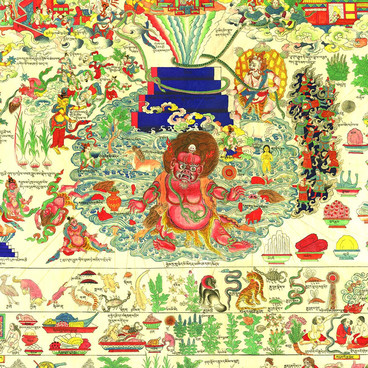
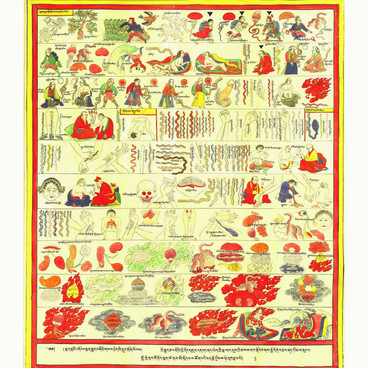
The illustration opens up the ‘Subsequent Tantra’. Its first chapter is dedicated to the pulse diagnostics. The diagnostics description is structured and divided into 13 themes. The series of images in each theme are formed into the separate sections with the headlines on the yellow background. The appearing of the teller of the ‘Subsequent Tantra’ from the lower chakra of Buddha of Medicine’s body is shown at the lower left part.
Behavior in prior of the pulse diagnostics is the first subject. The images show kinds of food and actions that break the balance between the heat and cold in the body which can result in distortion of pulse diagnostics data.
Time for executing the pulse diagnostics is the second subject. Morning is the best time for taking the pulse rate. At the illustration morning is depicted as the parallel high position of the moon and the sun in the sky. The places where the pulsating artery can be found is the third subject. The fourth subject is represented by the only image showing the pressure rate with the index, middle and fourth fingers at the point of the ulnar artery at the wrist area.
The inspection methods is the fifth subject. Taking the pulse rate at the ulnar arteries of both hands in twelve fingers positions are shown at the illustrations starting with the last picture at the third upper line. Men and women have different rates of the positions. Each position is connected with the specific organ which is depicted above. A different method of pulse diagnostics, when the pulse rate is taken from the smaller fingers’ arteries, is shown at the fifth line. The meaning of each point is shown with the pictures of the corresponding organ.
Types of the pulse is the sixth subject. The tractate points out three main types: male, female and neutral pulse. They all are shown with the schematic images of a pulse wave along with the small figures at the end of the fifth upper line. At the seventh line a series of images illustrating the fortunetelling based on the type of the pulse wave is featured.
The influence of the seasons to the pulse character is the seventh subject. The calendar of pulse diagnostics divides the year into five seasons by the number of the primary elements. The fifth season is created by means of taking 18 last days from each four seasons. Therefore, the fifth season (Earth season) is repeated four times during the year. In order to define the seasons marked with the images of their ‘holders’ (animals), a few calendars are listed. The cycle changings of the pulse during the year are connected with them. The character of pulsation of organs is compared to the voice of the birds depicted nearby.
The text in Tibetan explaining the sheet’s contents is located in the last graph.
Behavior in prior of the pulse diagnostics is the first subject. The images show kinds of food and actions that break the balance between the heat and cold in the body which can result in distortion of pulse diagnostics data.
Time for executing the pulse diagnostics is the second subject. Morning is the best time for taking the pulse rate. At the illustration morning is depicted as the parallel high position of the moon and the sun in the sky. The places where the pulsating artery can be found is the third subject. The fourth subject is represented by the only image showing the pressure rate with the index, middle and fourth fingers at the point of the ulnar artery at the wrist area.
The inspection methods is the fifth subject. Taking the pulse rate at the ulnar arteries of both hands in twelve fingers positions are shown at the illustrations starting with the last picture at the third upper line. Men and women have different rates of the positions. Each position is connected with the specific organ which is depicted above. A different method of pulse diagnostics, when the pulse rate is taken from the smaller fingers’ arteries, is shown at the fifth line. The meaning of each point is shown with the pictures of the corresponding organ.
Types of the pulse is the sixth subject. The tractate points out three main types: male, female and neutral pulse. They all are shown with the schematic images of a pulse wave along with the small figures at the end of the fifth upper line. At the seventh line a series of images illustrating the fortunetelling based on the type of the pulse wave is featured.
The influence of the seasons to the pulse character is the seventh subject. The calendar of pulse diagnostics divides the year into five seasons by the number of the primary elements. The fifth season is created by means of taking 18 last days from each four seasons. Therefore, the fifth season (Earth season) is repeated four times during the year. In order to define the seasons marked with the images of their ‘holders’ (animals), a few calendars are listed. The cycle changings of the pulse during the year are connected with them. The character of pulsation of organs is compared to the voice of the birds depicted nearby.
The text in Tibetan explaining the sheet’s contents is located in the last graph.