The composition illustrating a myth about the appearing of poisons and their antagonists’ medicaments in the human world is located in the upper part.
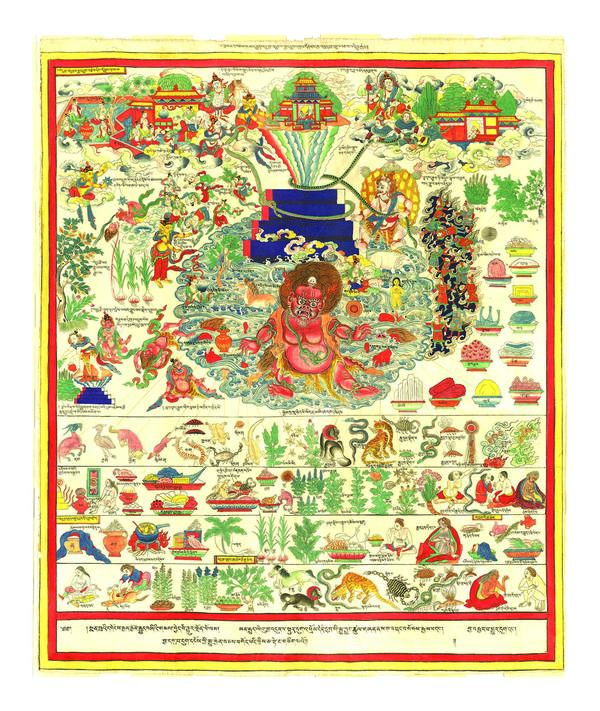
According to the legend, the deities and asuras decided to get a jar with the immortality nectar (amrita) from the depth of the ocean. The jar is depicted near demon Halahala symbolizing hell. In order to do this the deities took the Sumeru mountain (depicted as a dark blue four-step pyramid), tied it with the cosmic energy Shesha and started to whip up the ocean’s waters. Demon Halahala appeared from the waters and broke up into the poisons, both moving and motionless. Poisons of animal nature (the snake venom, the quinquestriatus toxin, the blister-beetle’s venom) and the one of hydrophobia can be attributed to the moving poisons. The motionless poisons are the ones of herbal and mineral origin. Drops of amrita nectar fell on the ground and germinated as myrobalan and garlic, the medicaments of universal quality which are shown in the left field below the deities.
The series of pictures illustrating chapter 87 and dedicated to the poisoning with artificially made poisons starts with the aconitum fischery bushes, bladderwort and blue couch grass growing right under the asuras’ palace. The bowls with mineral substances are shown below, at the right part of the table. The row of bowls with poisons of animal origin are shown at the right line before the image of the sun. A series of images illustrating a poisons’ classification based on their means of getting into the body (these are the poisons of the sun, wind, evaporation, oils and alimentary poisons getting into the body through the nose, eyes, skin and stomach) is depicted afterwards.
Chapter 88 of “Instructional Tantra” describes the turned poisons. The combinations of some alimentary products giving the poisoning effect can be attributed to them. A series of incompatible products start with the second lower line (for example, these are fresh wine and unready kefir, mushrooms and mustard oil, chicken meat and raw milk, radish and garlic and so on). At the end of the line there’s a number of images dedicated to the ‘meat poison’ intoxication. The meat becomes poisonous if one spots it with fermented milk products, blood or something ritually dirty. The raw meat thrown on the ground, hot meat covered with the top, and the meat of new born calves is also believed to be toxic.
The images of intoxicated people follow the ones of the poisons of animal nature. The one suffering from hydrophobia (and poisoned with the ‘dog poison’) has a dog’s tail. The last line has a text in Tibetan explaining the sheet’s contents.
According to the legend, the deities and asuras decided to get a jar with the immortality nectar (amrita) from the depth of the ocean. The jar is depicted near demon Halahala symbolizing hell. In order to do this the deities took the Sumeru mountain (depicted as a dark blue four-step pyramid), tied it with the cosmic energy Shesha and started to whip up the ocean’s waters. Demon Halahala appeared from the waters and broke up into the poisons, both moving and motionless. Poisons of animal nature (the snake venom, the quinquestriatus toxin, the blister-beetle’s venom) and the one of hydrophobia can be attributed to the moving poisons. The motionless poisons are the ones of herbal and mineral origin. Drops of amrita nectar fell on the ground and germinated as myrobalan and garlic, the medicaments of universal quality which are shown in the left field below the deities.
The series of pictures illustrating chapter 87 and dedicated to the poisoning with artificially made poisons starts with the aconitum fischery bushes, bladderwort and blue couch grass growing right under the asuras’ palace. The bowls with mineral substances are shown below, at the right part of the table. The row of bowls with poisons of animal origin are shown at the right line before the image of the sun. A series of images illustrating a poisons’ classification based on their means of getting into the body (these are the poisons of the sun, wind, evaporation, oils and alimentary poisons getting into the body through the nose, eyes, skin and stomach) is depicted afterwards.
Chapter 88 of “Instructional Tantra” describes the turned poisons. The combinations of some alimentary products giving the poisoning effect can be attributed to them. A series of incompatible products start with the second lower line (for example, these are fresh wine and unready kefir, mushrooms and mustard oil, chicken meat and raw milk, radish and garlic and so on). At the end of the line there’s a number of images dedicated to the ‘meat poison’ intoxication. The meat becomes poisonous if one spots it with fermented milk products, blood or something ritually dirty. The raw meat thrown on the ground, hot meat covered with the top, and the meat of new born calves is also believed to be toxic.
The images of intoxicated people follow the ones of the poisons of animal nature. The one suffering from hydrophobia (and poisoned with the ‘dog poison’) has a dog’s tail. The last line has a text in Tibetan explaining the sheet’s contents.