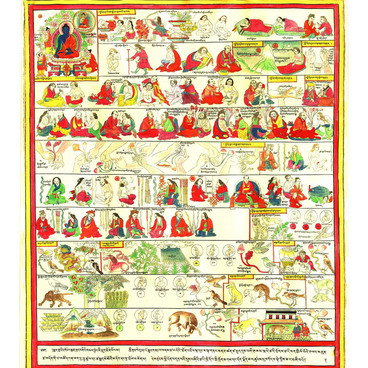
The sheet is dedicated to the physical condition evaluation and diagnostics of diseases based on pulse.
It is believed in Tibetan medicine, that in case of a healthy person the pulse intermissions are connected with the increscent and decrescent moon and the sun movement from the north to the south. In the first half of the month, during increscent moon the pulse intermissions take place at the right men’s hands and at the left women’s hands. At the second part of the month the situation changes.
During the pulse inspection a doctor should be able to see the slight difference in the beating nature and not mux up the inherent pulse type (male, female or child’s) with the different fever pulses. It is also now allowed to mix up the soft and viscous beating of bodhisattva pulse with the light and slow cold pulse. Finally, the pauses of irregular and intermissive pulse of five void free and six hollow organs can be considered death pulse’s pauses. So if the doctor never dealt with the patient before, he has to find out the type of the general patient’s pulse.
It is important to know for the proper pulse diagnostics that there are general and specific pulses. The general pulses help to define if the disease belongs to the fever or cold group. In total there are six fever pulses and six cold pulses. The general fever pulses are very strong, sharp and “overflowing”; these pulses are caused by the perturbation of three physiological energies; “high” and “rude” pulse peculiar to the diseases of blood and “pneuma”s perturbation; the “curling” pulse peculiar to blood perturbation which ends up with hard tumors. The general cold pulse is a weak pulse peculiar to the hard cold tumors; “hidden”, latent pulse which marks different types of dropsy and so on.
Diseases can be differed by specific pulses in two stages. First of all, the type of the disease is found. Then with the help of palpation the disease’s localization is spotted (which part of the body it occupied, what inner organ it is located in).
Therefore, the pulse inspection may define the character of head injuries. Based on the pulses under the fingers on left and right hands doctor can find out the diseases of heart, lungs and other organs of the upper body parts. Each of void free and hollow organs are connected with one of the sense organs. For instance, heart and small intestine are connected with the tongue and lungs, large intestine is connected with the nose, eyes are connected with liver and cholecystis.
It is believed in Tibetan medicine, that in case of a healthy person the pulse intermissions are connected with the increscent and decrescent moon and the sun movement from the north to the south. In the first half of the month, during increscent moon the pulse intermissions take place at the right men’s hands and at the left women’s hands. At the second part of the month the situation changes.
During the pulse inspection a doctor should be able to see the slight difference in the beating nature and not mux up the inherent pulse type (male, female or child’s) with the different fever pulses. It is also now allowed to mix up the soft and viscous beating of bodhisattva pulse with the light and slow cold pulse. Finally, the pauses of irregular and intermissive pulse of five void free and six hollow organs can be considered death pulse’s pauses. So if the doctor never dealt with the patient before, he has to find out the type of the general patient’s pulse.
It is important to know for the proper pulse diagnostics that there are general and specific pulses. The general pulses help to define if the disease belongs to the fever or cold group. In total there are six fever pulses and six cold pulses. The general fever pulses are very strong, sharp and “overflowing”; these pulses are caused by the perturbation of three physiological energies; “high” and “rude” pulse peculiar to the diseases of blood and “pneuma”s perturbation; the “curling” pulse peculiar to blood perturbation which ends up with hard tumors. The general cold pulse is a weak pulse peculiar to the hard cold tumors; “hidden”, latent pulse which marks different types of dropsy and so on.
Diseases can be differed by specific pulses in two stages. First of all, the type of the disease is found. Then with the help of palpation the disease’s localization is spotted (which part of the body it occupied, what inner organ it is located in).
Therefore, the pulse inspection may define the character of head injuries. Based on the pulses under the fingers on left and right hands doctor can find out the diseases of heart, lungs and other organs of the upper body parts. Each of void free and hollow organs are connected with one of the sense organs. For instance, heart and small intestine are connected with the tongue and lungs, large intestine is connected with the nose, eyes are connected with liver and cholecystis.