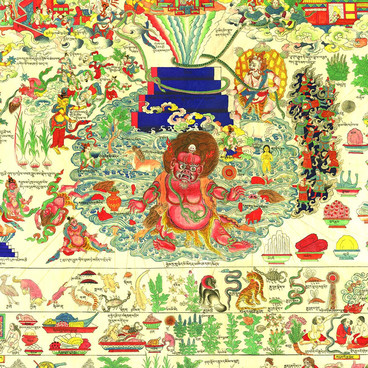
The sheet features the specific study of military field surgery and is dedicated to the treatment of wounds of different kinds. The wounds are classified, according to two criteria:
1. The weapon used to inflict a wound (cutting, piercing or dead-ended).
2. The wound’s location (head, neck, body wounds, cavity-type wounds and limb wounds).
A figure with topography of head, neck, body and limb blood vessels is depicted in the central part of the sheet.
The heads of different configurations are depicted from both sides along with the mark of the main head vessels locations. It is considered that the head type is formed depending on predominance of one or another physiological energy or the energies combination in the body. In total there’s description of seven head types: prolonged top of the head (‘pneuma’s head’), prominent occiput (“bile”s head”), head looking like a grubbing hoe (“phlegm”s head”), square head (“pneuma-pile”s head”), head grown stout (“phlegm-pneuma”s head”) and others.
The head bones’ illustration is located in the upper right part of the sheet; they all divide into three groups: ‘male bones’ (solid bones), ‘female bones’ (bones pierced with different holes by half), ‘sexless bones’ (bones mostly covered with different holes). The description of the main skull bones (such as the top of the head, anterior fontanel and neck socket) location relatively to each other is also given here.
The upper part has images of the head with brain blood vessels that are also divided into three groups:
• ‘ropes of hope’ that go along meninx and ‘branch out there like a spreading tree’; this vessels’ damage result in the deadly danger;
• parietal vessels forming the “Brahma necklace”
• the vessels that “run everywhere” and are also called the vessels “running in-and-out”.
Side images are dedicated to the body wounds treatment. The right figure demonstrates the location of inner organs of lower body part (below diaphragm). The left figure shows the position of inner organs of upper body part and the small bowel’s vessels of the lower body part. The last graph includes text in Tibetan explaining the sheet’s contents.
1. The weapon used to inflict a wound (cutting, piercing or dead-ended).
2. The wound’s location (head, neck, body wounds, cavity-type wounds and limb wounds).
A figure with topography of head, neck, body and limb blood vessels is depicted in the central part of the sheet.
The heads of different configurations are depicted from both sides along with the mark of the main head vessels locations. It is considered that the head type is formed depending on predominance of one or another physiological energy or the energies combination in the body. In total there’s description of seven head types: prolonged top of the head (‘pneuma’s head’), prominent occiput (“bile”s head”), head looking like a grubbing hoe (“phlegm”s head”), square head (“pneuma-pile”s head”), head grown stout (“phlegm-pneuma”s head”) and others.
The head bones’ illustration is located in the upper right part of the sheet; they all divide into three groups: ‘male bones’ (solid bones), ‘female bones’ (bones pierced with different holes by half), ‘sexless bones’ (bones mostly covered with different holes). The description of the main skull bones (such as the top of the head, anterior fontanel and neck socket) location relatively to each other is also given here.
The upper part has images of the head with brain blood vessels that are also divided into three groups:
• ‘ropes of hope’ that go along meninx and ‘branch out there like a spreading tree’; this vessels’ damage result in the deadly danger;
• parietal vessels forming the “Brahma necklace”
• the vessels that “run everywhere” and are also called the vessels “running in-and-out”.
Side images are dedicated to the body wounds treatment. The right figure demonstrates the location of inner organs of lower body part (below diaphragm). The left figure shows the position of inner organs of upper body part and the small bowel’s vessels of the lower body part. The last graph includes text in Tibetan explaining the sheet’s contents.