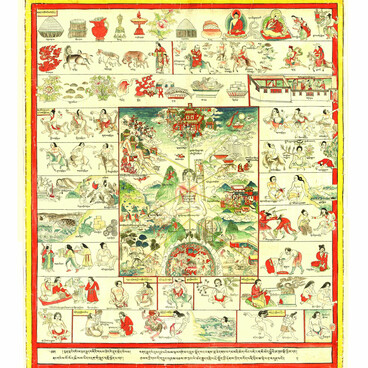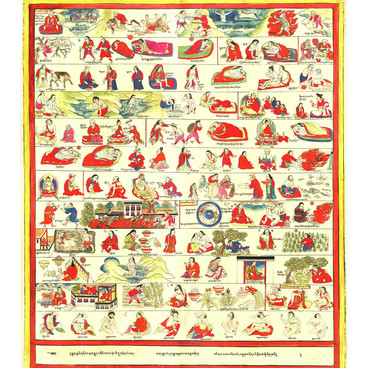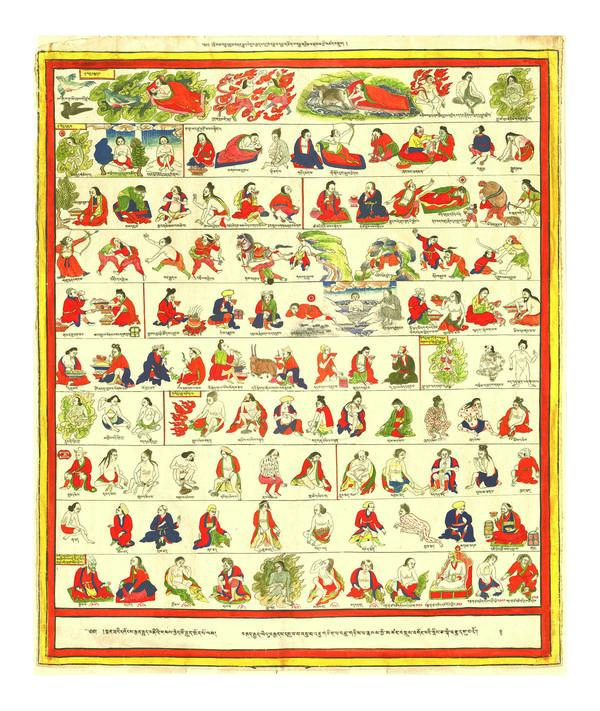
Illustrations for the 8th-12th chapters of the ‘Exegetical Tantra’ consist of the description of the basic reasons of the diseases, the disease-producing factors, the signs of pathogen disorders and the nosology.
The general reasons of the diseases are described in the 8th chapter. Three ‘soul’s poisons’ (passion, wrath, ignorance) refer to them. These poisons are symbolized by the animals: a bird (usually a rooster), a snake, and a pig. They are depicted near the people prone to these taints. Two flying birds at the beginning of the box illustrate the Buddhist aphorism: “Like a bird cannot escape its shade on the ground, a human being cannot get rid of the soul”s poisons as long as he is obsessed by the idea of himself”. Further it says that the bile has the fire nature, mucus has the water nature and the wind has the wind nature.
The seasonal factors resulting in accumulation of three physiological powers (wind, bile and mucus) are shown in the illustration to the 9th chapter, at the beginning of the second upper line, in the separate box. Further, also in the separate boxes, the specifics of the diet and the way of living provoking the stimulation of disease-producing factors are shown.
The 10th chapter is illustrated by the skeleton with the green currents on the background. It is located at the end of the fifth lower line. The belief that the bones are the place of the wind in the human’s body is expressed thereby. At the same time bile is located in blood, and all other body tissues belong to mucus.
Chapter 11 has a series of images illustrating the symptoms of oversaving the disease-provoking factors, body tissues and sewage. The series is located down from the image of a man sitting at the fire at the beginning of the fourth line. The symptoms of lacking these same very substances and the diet recommended for such states (milk and meat broth) are shown after the division.
The lower line of the illustrations for the 12th chapter has the classification of diseases based on gender and age, namely men’s, women’s, children’s and old people’s diseases as well as the classification based on their source, which means the diseases of the wind, bile, mucus. Further follows the classification based on the level of combination the disease-provoking factors, on their localization and the look. The red figures near the images show the number of diseases in each group. Each of named groups has 101 diseases with 404 in total.
The general reasons of the diseases are described in the 8th chapter. Three ‘soul’s poisons’ (passion, wrath, ignorance) refer to them. These poisons are symbolized by the animals: a bird (usually a rooster), a snake, and a pig. They are depicted near the people prone to these taints. Two flying birds at the beginning of the box illustrate the Buddhist aphorism: “Like a bird cannot escape its shade on the ground, a human being cannot get rid of the soul”s poisons as long as he is obsessed by the idea of himself”. Further it says that the bile has the fire nature, mucus has the water nature and the wind has the wind nature.
The seasonal factors resulting in accumulation of three physiological powers (wind, bile and mucus) are shown in the illustration to the 9th chapter, at the beginning of the second upper line, in the separate box. Further, also in the separate boxes, the specifics of the diet and the way of living provoking the stimulation of disease-producing factors are shown.
The 10th chapter is illustrated by the skeleton with the green currents on the background. It is located at the end of the fifth lower line. The belief that the bones are the place of the wind in the human’s body is expressed thereby. At the same time bile is located in blood, and all other body tissues belong to mucus.
Chapter 11 has a series of images illustrating the symptoms of oversaving the disease-provoking factors, body tissues and sewage. The series is located down from the image of a man sitting at the fire at the beginning of the fourth line. The symptoms of lacking these same very substances and the diet recommended for such states (milk and meat broth) are shown after the division.
The lower line of the illustrations for the 12th chapter has the classification of diseases based on gender and age, namely men’s, women’s, children’s and old people’s diseases as well as the classification based on their source, which means the diseases of the wind, bile, mucus. Further follows the classification based on the level of combination the disease-provoking factors, on their localization and the look. The red figures near the images show the number of diseases in each group. Each of named groups has 101 diseases with 404 in total.