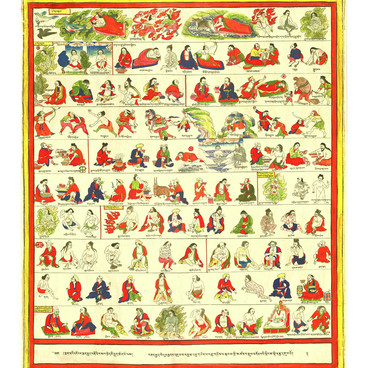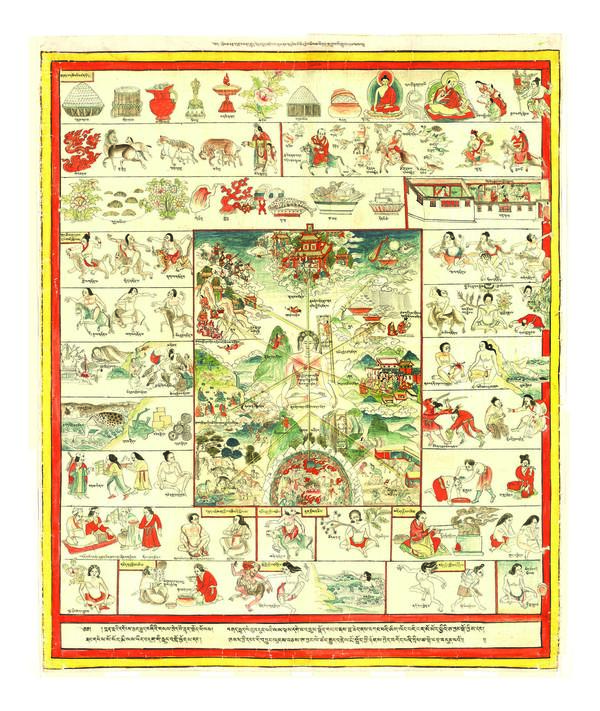
Atlas of Tibetan medicine. Sheet 17. ‘Exegetical Tantra’. The continuation of the illustration for the 7th chapter of ‘Exegetical Tantra’ is dedicated to the good and the bad signs observed by the doctor on his way to the patient.
The central image illustrates ‘the theory of dreams’. It is believed that the consciousness comes out of the heart using the vessels of its chakra and it circulates along the whole body. Getting into the location of one or another pathogen origin it provokes the dreams on the specific subjects in specific color schemes of the ‘wind’, ‘bile’ or ‘mucus’, that can give information on the human’s state.
The central illustration is surrounded by the images of the prognostic dreams. The road signs observed by the doctor on the way to the patient occupy three upper lines. For example, a vessel full of grain, shuo, qian, jewelry or a ritual bell, lampade, a flower seen by a messenger or a doctor on the way to the patient are all good signs. The burning fire, a horse with a foal and a beautiful woman with a child also predict the recovery.
Altogether the Tibetan medicine divides the dreams into six groups: the dreams on the seen things, the dreams on the heard things, the dreams on the experienced things, the dreams on the completed prayers, the dreams on the wishes’ realization the dreams appearing as a result of the physiological origins’ disorder. The first groups of dreams don’t entail any consequences. The sixth group is connected with the fact that the passages of the consciousness currents were damaged with the unhealthy increase of some physiological basis. The series of dreams having the predictive meaning are shown around, for instance, the uncertain and distant signs of death, the dreams that come to a man being under the sway of The Master of Death. In such dreams a man rides a cat, a monkey, a tiger, a fox, or a corpse.
The dreams predicting the death as a result of the diseases caused by bile, the prolonged lung disease, the benign tumours-skranas, leprosy, polyuria, madness, loss of memory and sight are shown at the separate sections.
The central image illustrates ‘the theory of dreams’. It is believed that the consciousness comes out of the heart using the vessels of its chakra and it circulates along the whole body. Getting into the location of one or another pathogen origin it provokes the dreams on the specific subjects in specific color schemes of the ‘wind’, ‘bile’ or ‘mucus’, that can give information on the human’s state.
The central illustration is surrounded by the images of the prognostic dreams. The road signs observed by the doctor on the way to the patient occupy three upper lines. For example, a vessel full of grain, shuo, qian, jewelry or a ritual bell, lampade, a flower seen by a messenger or a doctor on the way to the patient are all good signs. The burning fire, a horse with a foal and a beautiful woman with a child also predict the recovery.
Altogether the Tibetan medicine divides the dreams into six groups: the dreams on the seen things, the dreams on the heard things, the dreams on the experienced things, the dreams on the completed prayers, the dreams on the wishes’ realization the dreams appearing as a result of the physiological origins’ disorder. The first groups of dreams don’t entail any consequences. The sixth group is connected with the fact that the passages of the consciousness currents were damaged with the unhealthy increase of some physiological basis. The series of dreams having the predictive meaning are shown around, for instance, the uncertain and distant signs of death, the dreams that come to a man being under the sway of The Master of Death. In such dreams a man rides a cat, a monkey, a tiger, a fox, or a corpse.
The dreams predicting the death as a result of the diseases caused by bile, the prolonged lung disease, the benign tumours-skranas, leprosy, polyuria, madness, loss of memory and sight are shown at the separate sections.