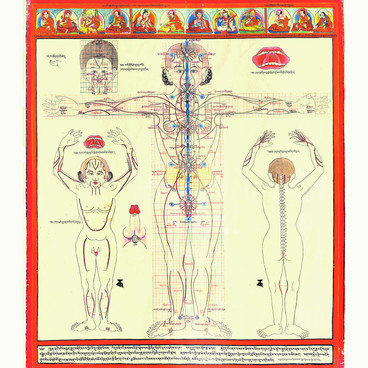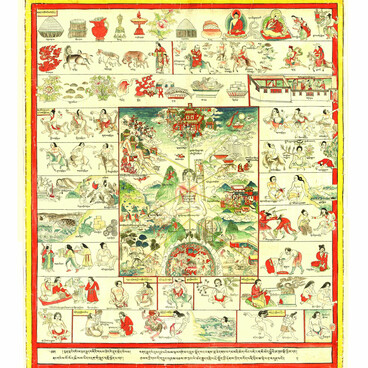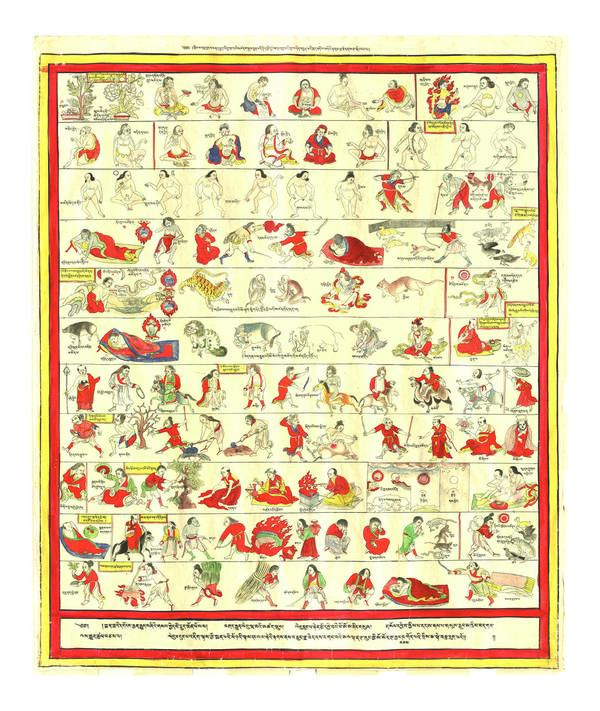
These are the illustrations for the 5Th-7th chapters of the ‘Exegetical Tantra’. They consist of the characteristics of the body elements along with the classification of the people on the basis of their sex, age, body constitution and temperament. The signs predicting the progress of treatment and the disease termination are described in these chapters.
The 5th chapter of the ‘Exegetical Tantra’ describes the body elements. The three separate boxes on the first and second upper lines have each images of five kinds of wind, bile and mucus. When applicable, the location of each element in the body is shown along with its specific activity.
The images for the 6th chapter provide insight into the people’s classification based on age, body constitution and temperament. They start with the naked figures of a man, a woman, an androgyne and a castrate. The last nude refers to the age classification and is a child. The image of a youngish man shooting a bow follows him, further on goes an old man with the crook.
It is believed that the human’s temper and fate are formed in connection with the predominance of one or another physiological energy or their combination in the body. In total there are seven types of temper. A rooster, the symbol of passion, is a sign of the people with ‘wind constitution’. Two empty semicircles are a sign of a short life, the ‘treasure’ faced edge-down is a sign of poverty. Later on the constitutional aspects of the body and the favorite activities of the people with different constitution are shown. Their manners are compared to the ones of the animals depicted in the end of the line.
The 7th chapter contains the description of the good and the bad signs predicting the treatment result and the disease termination. They all are divided into the close ones and the distant ones, the clear ones and the unclear ones based on the manifestation rate and the realization time. The illustrations start with the image of a doctor in the end of the sixth upper line. The image, origin, virtuousness and manners of the messenger matter for the prognosis along with the doctor’s state of mind, his activity during the visitor’s arrival, the time of the departing to the patient and everything he sees and hears along the way.