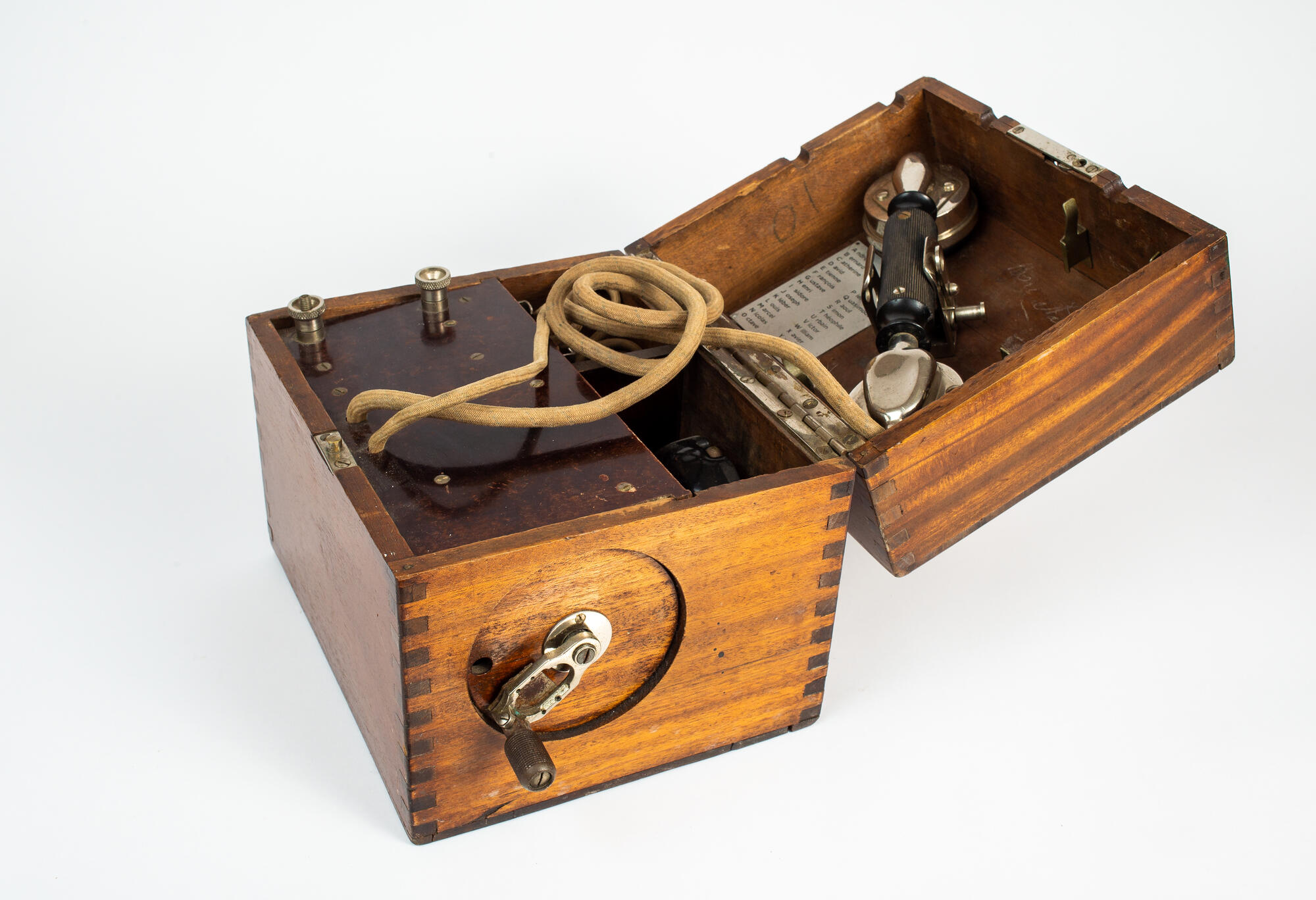


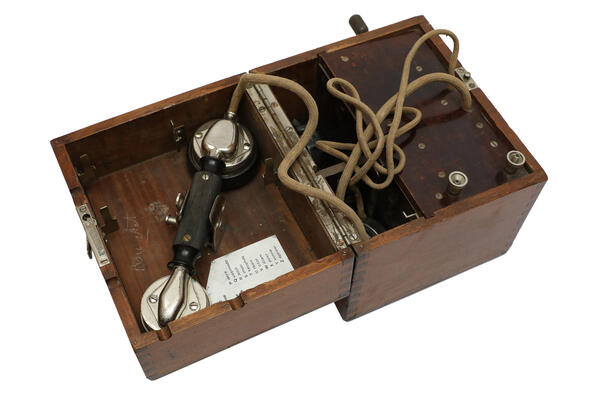
The field telephone from the collection of the Verkhnyaya Pyshma Historical Museum was made by the French company ‘Perdon Paris’ at the beginning of the 20th century. During the Great Patriotic War it was used on all fronts to communicate with divisions and the general staff.
The field telephone was encased in a wooden box with thick walls and a hinged lid — the durable case protected the device from dust, dirt and rain. Inside was a black plastic handset on a long wire and a battery.
Military communications were constantly improved, and over the course of several centuries new devices appeared: the telegraph, telephone and radio.
For the first time, the military used the telegraph during the Russo–Turkish war. In 1878, the inventor Vladimir Jacobi successfully tested a telegraph cable, first at a distance of seven kilometers, and later at 30 kilometers. The telegraph immediately came into use at the front and on the railway. Three years later, in 1881, Jacobi developed a miniature telephone set called the ‘Telekal’. It was adopted and used during the Russo-Japanese War in 1904–1905. Then all infantry regiments and artillery divisions on both sides were equipped with telephones.
By World War I, almost all armies had field telephones. Over time, field communication was modified, and communication between different troops became faster and more convenient.
In the early years of the Great Patriotic War, field telephones were the most common choice since they helped to establish communication in the field even when there was no infrastructure nearby. It was difficult for the enemy to listen to conversations led on this device since the enemy soldiers had to find the cable and connect to it directly.
Moreover, the phones were inexpensive and user friendly. After a short instruction, virtually any soldier was able to use them. Later, radio communications became more common at the front.
Nowadays, the army uses modern multichannel automated systems. They provide communication with aircraft, ships and military units that can be thousands kilometers away. Also, the military use satellite radio stations, special explosion-proof devices and ship telephones, which are produced in a waterproof durable metal case with anti-noise handsets.
The field telephone was encased in a wooden box with thick walls and a hinged lid — the durable case protected the device from dust, dirt and rain. Inside was a black plastic handset on a long wire and a battery.
Military communications were constantly improved, and over the course of several centuries new devices appeared: the telegraph, telephone and radio.
For the first time, the military used the telegraph during the Russo–Turkish war. In 1878, the inventor Vladimir Jacobi successfully tested a telegraph cable, first at a distance of seven kilometers, and later at 30 kilometers. The telegraph immediately came into use at the front and on the railway. Three years later, in 1881, Jacobi developed a miniature telephone set called the ‘Telekal’. It was adopted and used during the Russo-Japanese War in 1904–1905. Then all infantry regiments and artillery divisions on both sides were equipped with telephones.
By World War I, almost all armies had field telephones. Over time, field communication was modified, and communication between different troops became faster and more convenient.
In the early years of the Great Patriotic War, field telephones were the most common choice since they helped to establish communication in the field even when there was no infrastructure nearby. It was difficult for the enemy to listen to conversations led on this device since the enemy soldiers had to find the cable and connect to it directly.
Moreover, the phones were inexpensive and user friendly. After a short instruction, virtually any soldier was able to use them. Later, radio communications became more common at the front.
Nowadays, the army uses modern multichannel automated systems. They provide communication with aircraft, ships and military units that can be thousands kilometers away. Also, the military use satellite radio stations, special explosion-proof devices and ship telephones, which are produced in a waterproof durable metal case with anti-noise handsets.