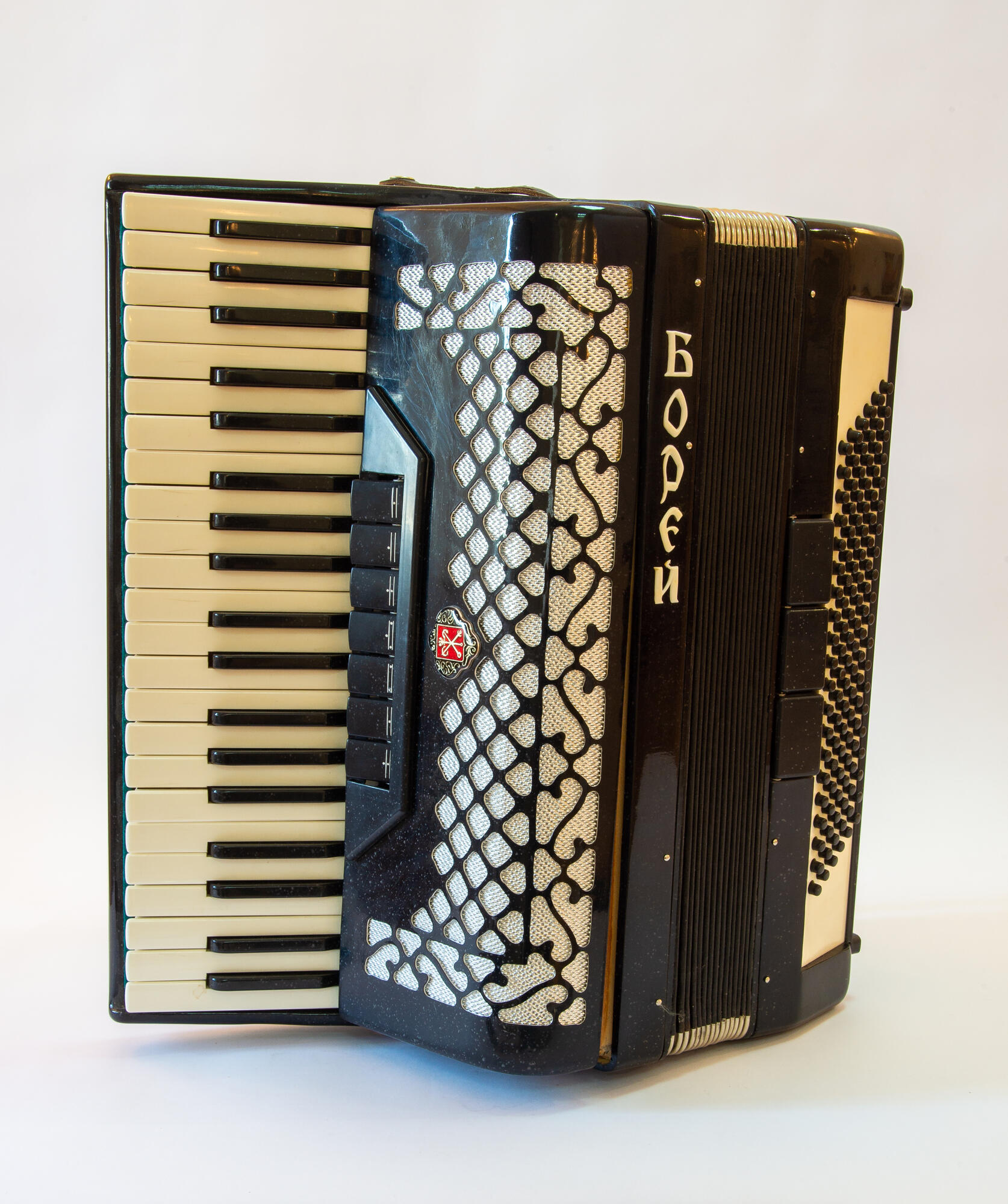


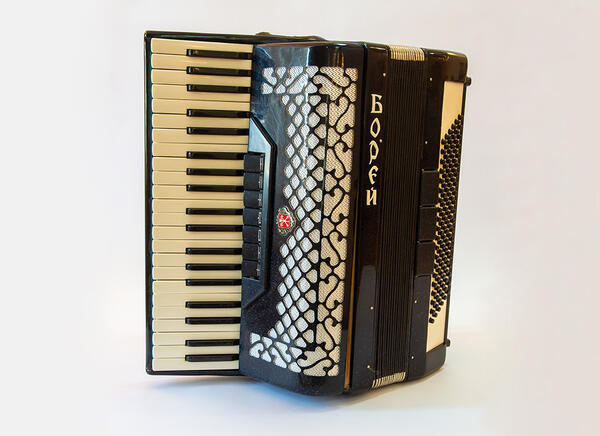
The Verkhnyaya Pyshma Historical Museum houses a Soviet accordion ‘Borey’ made in the 1980s. On the right side of the instrument is a piano keyboard with four incomplete octaves, and on the left side there are six rows of buttons.
Two leather straps worn over the shoulders are attached at the back of the accordion. On the side of the buttons, there is another additional strap for the left hand.
It is not known for certain who created the first accordion. Historians claim that it was the German watchmaker Christian Buschmann or the Czech master František Kirchner. They did not know each other, lived in different countries and worked completely independently of each other.
In the 1770s, Kirchner worked at the Imperial Court in St. Petersburg — he tuned the organ. He designed a new instrument that became the forerunner of the harmonica. The master blew into it and pressed the reeds, the inside metal plate vibrated and produced sound. Then the instrument was tuned to the organ.
Christian Buschmann also tuned organs in German churches. He created a similar instrument — a tuning fork in the form of a small box. When Bushman blew into it, the metal tongues inside made a sound of a certain pitch. Later, the instrument maker added an air reservoir — the bellows. And he added valves to the reeds so that they did not vibrate at the same time. To obtain the desired tone, it was necessary to open the valve above a certain plate.
In 1829, the Viennese organ master Kirill Demian improved the accordion: he divided the body of the instrument into two equal parts, equipped them with keyboards for the left and right hands, and connected the halves with bellows — a stack of durable folded leather discs. Each key had a corresponding chord, hence the name ‘accordion’.
The right side was for the main melody and the left one was for the accompaniment. They forced air into the instrument and directed it further, to the valves and regulators to produce sound.
Soon, Demian received a patent for his invention and started factory production of tools.
Over time, the second accordion type appeared — with buttonboards. The button accordion is an example of this type. However, keyboards, as the exhibit from the museum collection, were more common.
Two leather straps worn over the shoulders are attached at the back of the accordion. On the side of the buttons, there is another additional strap for the left hand.
It is not known for certain who created the first accordion. Historians claim that it was the German watchmaker Christian Buschmann or the Czech master František Kirchner. They did not know each other, lived in different countries and worked completely independently of each other.
In the 1770s, Kirchner worked at the Imperial Court in St. Petersburg — he tuned the organ. He designed a new instrument that became the forerunner of the harmonica. The master blew into it and pressed the reeds, the inside metal plate vibrated and produced sound. Then the instrument was tuned to the organ.
Christian Buschmann also tuned organs in German churches. He created a similar instrument — a tuning fork in the form of a small box. When Bushman blew into it, the metal tongues inside made a sound of a certain pitch. Later, the instrument maker added an air reservoir — the bellows. And he added valves to the reeds so that they did not vibrate at the same time. To obtain the desired tone, it was necessary to open the valve above a certain plate.
In 1829, the Viennese organ master Kirill Demian improved the accordion: he divided the body of the instrument into two equal parts, equipped them with keyboards for the left and right hands, and connected the halves with bellows — a stack of durable folded leather discs. Each key had a corresponding chord, hence the name ‘accordion’.
The right side was for the main melody and the left one was for the accompaniment. They forced air into the instrument and directed it further, to the valves and regulators to produce sound.
Soon, Demian received a patent for his invention and started factory production of tools.
Over time, the second accordion type appeared — with buttonboards. The button accordion is an example of this type. However, keyboards, as the exhibit from the museum collection, were more common.