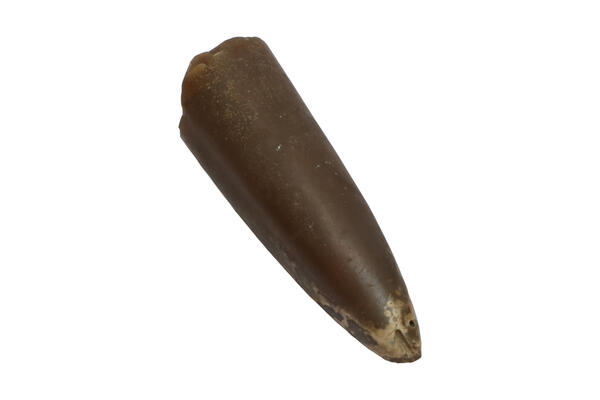
The collection of the Verkhnyaya Pyshma Historical Museum houses a fragment of a belemnite, an extinct cephalopod. From the outside, it looked like a squid, but had an inner shell that protected its internal organs.
Archaeologists regularly find ancient belemnite imprints in rocks and soil. The finds help restore what the cephalopod looked like millions of years ago. The belemnite had an elongated body that was 15 — 20 centimeters long, big eyes, ten front tentacles and fins.
The belemnite had a hard inner shell. It consisted of three parts. The pro-ostracum is a thin plate that covered the belemnite’s back. The conical, chambered phragmocone helped the cephalopod swim. And the third part was the dense guard — a kind of a spear-shaped tail.
The guard was the most durable part so it has survived to this day the best. Because of its elongated conical shape, archaeologists began to call belemnite the “devil”s finger”, “thunder arrow” or “Perun”s arrows”.
Researchers believe that the guard helped cephalopods balance so that the belemnite could swim smoothly and did not wiggle from side to side. Cartilage was attached to the guard, which lent support to the fins.
Although the guard was inside, it was covered with thin transparent skin and had color on one side. Some belemnites had vessels imprinted on the guard.
Belemnites lived in the seas, were predators and swam well and quickly. They had hooks on their tentacles, which helped to capture other cephalopods. Their lifestyle was similar to that of modern squid ¬– the belemnites the same size and age swam in huge flocks. There might have been rare cases of belemnites living individually.
Belemnites ceased to exist during the last great extinction, along with dinosaurs. The reasons for the mass extinction of these animals are still unknown. Now the remains of such mollusks are often found in the Urals and in the central part of Russia, including Moscow, during the construction of new metro stations.
Archaeologists regularly find ancient belemnite imprints in rocks and soil. The finds help restore what the cephalopod looked like millions of years ago. The belemnite had an elongated body that was 15 — 20 centimeters long, big eyes, ten front tentacles and fins.
The belemnite had a hard inner shell. It consisted of three parts. The pro-ostracum is a thin plate that covered the belemnite’s back. The conical, chambered phragmocone helped the cephalopod swim. And the third part was the dense guard — a kind of a spear-shaped tail.
The guard was the most durable part so it has survived to this day the best. Because of its elongated conical shape, archaeologists began to call belemnite the “devil”s finger”, “thunder arrow” or “Perun”s arrows”.
Researchers believe that the guard helped cephalopods balance so that the belemnite could swim smoothly and did not wiggle from side to side. Cartilage was attached to the guard, which lent support to the fins.
Although the guard was inside, it was covered with thin transparent skin and had color on one side. Some belemnites had vessels imprinted on the guard.
Belemnites lived in the seas, were predators and swam well and quickly. They had hooks on their tentacles, which helped to capture other cephalopods. Their lifestyle was similar to that of modern squid ¬– the belemnites the same size and age swam in huge flocks. There might have been rare cases of belemnites living individually.
Belemnites ceased to exist during the last great extinction, along with dinosaurs. The reasons for the mass extinction of these animals are still unknown. Now the remains of such mollusks are often found in the Urals and in the central part of Russia, including Moscow, during the construction of new metro stations.