Between 1925 amd 1952, many Soviet plants produced the legendary Rekord loudspeaker. By now, it is nearly impossible to pinpoint and count all of its modifications and upgrades, as the clear timeline of producing such loudspeakers is forever lost in archive depths.
Loudspeakers of this type could be either desktop or wall-mounted, suspended or placed onto a special base. The device’s structure was fairly simple: it included a diffuser and supports with a built-in electro-magnetic mechanism and volume controls.
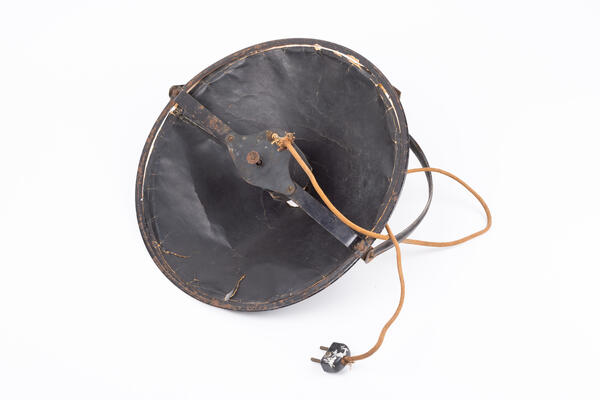
The diffuser was the main visible element of the dish-like loudspeaker. The most common diffusers looked like cones; in rare cases, they could be oval-shaped. They were usually made from paper or fine fiber, and reached approximately 40 centimeters in diameter. The very first diffusers were not particularly sturdy, often causing the device to crack.
To power up their subscription radio station, users needed a plug and a cable. The original cable that came with the first Rekord models would wear down quickly; furthermore, it was too short and very rigid. The radio plug and mains outlet diameter did not match, so users had to plug the device into a power socket. It was not until a few years later than the Rekord plugs got equipped with flat contacts.
With time, the loudspeaker gained quite a few colloquial nicknames: brekhunets (“babbler”), dish, or simply radio. Those black dishes were the only source of information for many Soviet citizens, especially for those who were not particularly literate. The upbeat, enthusiastic labor news were particularly popular during the 1930s and 1940s.
And it was those devices that announced the beginning of the Great Patriotic War in 1941. As warfare unfolded, the government ordered private citizens to give their household radio receivers away for military communication needs. After victory in the war, however, the devices were returned to their owners.
The interior design of an average Soviet living space had little variety, and a new Rekord added a dash of interest. For many people, such loudspeakers were literal family heirlooms: buying one was an achievement to boast of, and sometimes, proud Rekord owners even took pictures with their prized possession.
Loudspeakers of this type could be either desktop or wall-mounted, suspended or placed onto a special base. The device’s structure was fairly simple: it included a diffuser and supports with a built-in electro-magnetic mechanism and volume controls.
The diffuser was the main visible element of the dish-like loudspeaker. The most common diffusers looked like cones; in rare cases, they could be oval-shaped. They were usually made from paper or fine fiber, and reached approximately 40 centimeters in diameter. The very first diffusers were not particularly sturdy, often causing the device to crack.
To power up their subscription radio station, users needed a plug and a cable. The original cable that came with the first Rekord models would wear down quickly; furthermore, it was too short and very rigid. The radio plug and mains outlet diameter did not match, so users had to plug the device into a power socket. It was not until a few years later than the Rekord plugs got equipped with flat contacts.
With time, the loudspeaker gained quite a few colloquial nicknames: brekhunets (“babbler”), dish, or simply radio. Those black dishes were the only source of information for many Soviet citizens, especially for those who were not particularly literate. The upbeat, enthusiastic labor news were particularly popular during the 1930s and 1940s.
And it was those devices that announced the beginning of the Great Patriotic War in 1941. As warfare unfolded, the government ordered private citizens to give their household radio receivers away for military communication needs. After victory in the war, however, the devices were returned to their owners.
The interior design of an average Soviet living space had little variety, and a new Rekord added a dash of interest. For many people, such loudspeakers were literal family heirlooms: buying one was an achievement to boast of, and sometimes, proud Rekord owners even took pictures with their prized possession.