The territory of the Black Sea coast was developed at different times by the Greeks, Romans, and Genoese. In the early 6th century, the Byzantines inherited the Roman territories and began to extend its influence to the eastern shores of the Black Sea, including the area where modern Sochi is now located.
The Byzantine state was formed in the 4th century during the collapse of the Roman Empire and occupied its eastern part (the Balkan Peninsula, Asia Minor, the South-Eastern Mediterranean). After reaching its heyday in the 6th century, the state tried to expand its borders to the eastern shores of the Black Sea. This explains why the era of the Early Middle Ages in the vicinity of Sochi is represented by a significant number of fortresses and churches. The remains of several dozen fortresses and places of worship have been discovered in a relatively small area. Archaeologists have explored Christian churches in Khosta, Adler, Vesyoloye, Lipniki, Lesnoy, Golitsyn, Monastyr, and other places.
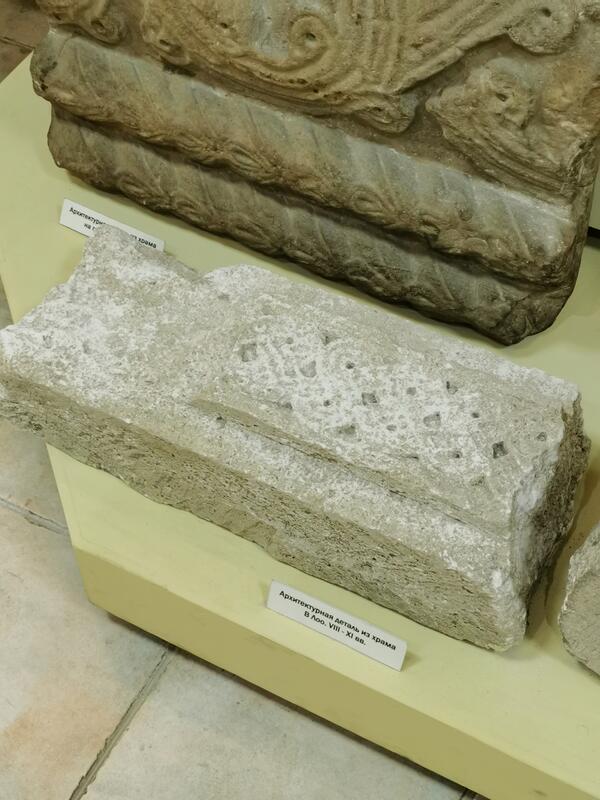
The limestone architectural detail from the church in Loo, displayed in the museum, is a fragment of the cladding of a Christian cathedral in the Byzantine style dating from the 8th to the 11th centuries. The ruins of the building are located in the village of Loo in the Lazarevsky district of Sochi. The medieval Byzantine church in Loo is special for its extreme northern location in relation to other similar churches of this period. The cross-domed church was erected 2 kilometers from the seashore, at an altitude of about 200 meters above sea level. It was built from sandstone and slates, while processed limestone blocks served as cladding. There are no traces of carved decor on the walls of the church, but several fragments with carved patterns were found during excavations, including the architectural detail on display.
The church in Loo is taken under state protection as an archaeological monument of federal significance. The carved architectural detail and other objects found on the territory of the church are kept in the Museum of the History of the Resort City of Sochi.