Ancient cephalopods, the ammonites, appeared about 400 million years ago, and died out along with the dinosaurs, around 65 million years ago. Over the millions of years that they existed, they have almost all saltwater bodies of water in both hemispheres on the planet, and became one of the most widespread sea creatures. One of the features of the surviving relatives of ammonites - the octopus, squid, and cuttlefish - is their high level of intelligence. They can be trained, people can have them as pets.
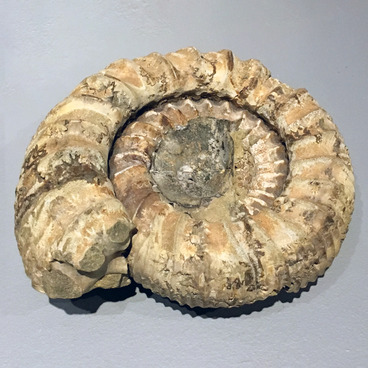
At present, scientists count more than 10,000 types of ammonites, with sizes ranging from 5 millimeters to 2.5 meters in diameter. Ammonites Speetoniceras versicolor, were classified as large species: their shells reached up to 50 centimeters in diameter. They flourished in the warm Mesozoic seas about 130-120 million years ago.
Like other ammonites, the Speetoniceras versicolor was hatched from an egg, and had a tiny shell right from the start. As they grew, they built up the walls of their shells in both length and width, moved into new living chambers, and walled up the abandoned ones. They left small holes in the partitions between the chambers, and through those the mollusk injected liquid or gas into the old ones; this was the way it changed the buoyance of its dwelling.
The living chamber could take up half of the shell’s whorl, or its entirety. While searching for food, the mollusk poked its large head with 8–10 tentacles through the wide orifice of the living chamber, and in moments when danger arose it pulled completely inward, and closed the mouth with a lid from its own forked lower jaw.
The Speetoniceras versicolor was a predator, but studies show that they were sedentary, swam along the bottom, and ate mainly plankton, invertebrates, and carrion.
Despite the strong shell up to 1 centimeter thick that large species had, ammonites fell prey to various predators: lobsters, fish, reptiles, and other cephalopods. Predators tried to damage the orifice, or break through the base of the living chamber. If the ammonite managed to survive, it patched up the damaged areas to repair them; those are easy to detect with the naked eye - in the places where the patches are there are none of the ridges or septums that are typical for the correct pattern of the shell. For this kind of damage incurred during their lifetimes, scientists are putting together descriptions of the Mesozoic predators that were more powerful than the ammonites themselves.
At present, scientists count more than 10,000 types of ammonites, with sizes ranging from 5 millimeters to 2.5 meters in diameter. Ammonites Speetoniceras versicolor, were classified as large species: their shells reached up to 50 centimeters in diameter. They flourished in the warm Mesozoic seas about 130-120 million years ago.
Like other ammonites, the Speetoniceras versicolor was hatched from an egg, and had a tiny shell right from the start. As they grew, they built up the walls of their shells in both length and width, moved into new living chambers, and walled up the abandoned ones. They left small holes in the partitions between the chambers, and through those the mollusk injected liquid or gas into the old ones; this was the way it changed the buoyance of its dwelling.
The living chamber could take up half of the shell’s whorl, or its entirety. While searching for food, the mollusk poked its large head with 8–10 tentacles through the wide orifice of the living chamber, and in moments when danger arose it pulled completely inward, and closed the mouth with a lid from its own forked lower jaw.
The Speetoniceras versicolor was a predator, but studies show that they were sedentary, swam along the bottom, and ate mainly plankton, invertebrates, and carrion.
Despite the strong shell up to 1 centimeter thick that large species had, ammonites fell prey to various predators: lobsters, fish, reptiles, and other cephalopods. Predators tried to damage the orifice, or break through the base of the living chamber. If the ammonite managed to survive, it patched up the damaged areas to repair them; those are easy to detect with the naked eye - in the places where the patches are there are none of the ridges or septums that are typical for the correct pattern of the shell. For this kind of damage incurred during their lifetimes, scientists are putting together descriptions of the Mesozoic predators that were more powerful than the ammonites themselves.