‘Archeopark’ is a cultural and tourist complex and a striking landmark in Khanty-Mansiysk. It covers an area of 3.5 hectares and includes a geological monument, an archeological monument and a sculpture park. The place for its creation was not chosen by chance: the park is located at the foot of the Samarovo glacial outlier - a hill with an outcropping of ancient rocks.
The Samarovo outlier is a well-known geological section that captures the events of the maximum glaciation in Western Siberia. The uniqueness of this natural monument lies in the fact that it shows a picture of deposits that have been layered over many millions of years - as if we are seeing pages on which a significant part of the history of the region is recorded.
For two centuries scientific disputes have been going on regarding the geological monument, with each of the two existing theories having supporters. For example, adherents of the theory of continental glaciation believe that this territory was covered with an ice shell. The advancing glacier captured a huge block of rocks several hundred kilometers from its present location and moved it to the confluence of the Ob and Irtysh. Therefore, the remnant rocks have nothing to do with the underlying surface.
According to another version, Western Siberia has never been glaciated, and the Samarovo outlier is not of glacial origin. In this case, the formation of the Khanty-Mansi hills is explained by the processes of clay diapirism - when plastic clay rocks were squeezed out from the depth to the surface and spread out, forming a dome.
At the top of the hill there is an archeological monument ‘Samarov Gorodok’. Legends say that the settlement was once the residence of the Ostyak prince Samara, whose name was given to this place. However, numerous archaeological finds made at the Lugovskoye site show that the first people appeared here long before the prince, and mammoths once grazed around their sites.
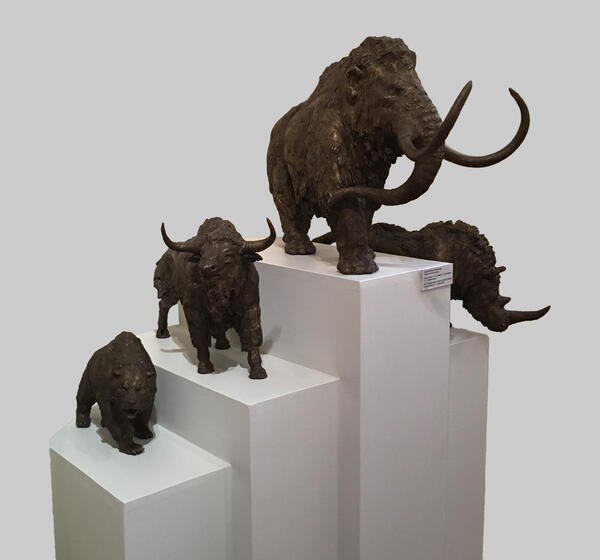
The centre-piece of the park is the bronze sculptures of ancient animals. For example, the mammoths are installed as if they had just emerged from the forest and are now wandering along the foot of the Samarovo hill. In addition to them, here you can see a primitive bison, a pack of wolves, a cave bear, two woolly rhinos and primitive people themselves.
The sculptural composition ‘Archeopark’ was made especially for the ‘Museum of Nature and Man’ during the development of the sculpture park. The authors of the work were Ilya Gureev, Andrey Mitenev and Lyudmila Semikopenko.
The Samarovo outlier is a well-known geological section that captures the events of the maximum glaciation in Western Siberia. The uniqueness of this natural monument lies in the fact that it shows a picture of deposits that have been layered over many millions of years - as if we are seeing pages on which a significant part of the history of the region is recorded.
For two centuries scientific disputes have been going on regarding the geological monument, with each of the two existing theories having supporters. For example, adherents of the theory of continental glaciation believe that this territory was covered with an ice shell. The advancing glacier captured a huge block of rocks several hundred kilometers from its present location and moved it to the confluence of the Ob and Irtysh. Therefore, the remnant rocks have nothing to do with the underlying surface.
According to another version, Western Siberia has never been glaciated, and the Samarovo outlier is not of glacial origin. In this case, the formation of the Khanty-Mansi hills is explained by the processes of clay diapirism - when plastic clay rocks were squeezed out from the depth to the surface and spread out, forming a dome.
At the top of the hill there is an archeological monument ‘Samarov Gorodok’. Legends say that the settlement was once the residence of the Ostyak prince Samara, whose name was given to this place. However, numerous archaeological finds made at the Lugovskoye site show that the first people appeared here long before the prince, and mammoths once grazed around their sites.
The centre-piece of the park is the bronze sculptures of ancient animals. For example, the mammoths are installed as if they had just emerged from the forest and are now wandering along the foot of the Samarovo hill. In addition to them, here you can see a primitive bison, a pack of wolves, a cave bear, two woolly rhinos and primitive people themselves.
The sculptural composition ‘Archeopark’ was made especially for the ‘Museum of Nature and Man’ during the development of the sculpture park. The authors of the work were Ilya Gureev, Andrey Mitenev and Lyudmila Semikopenko.