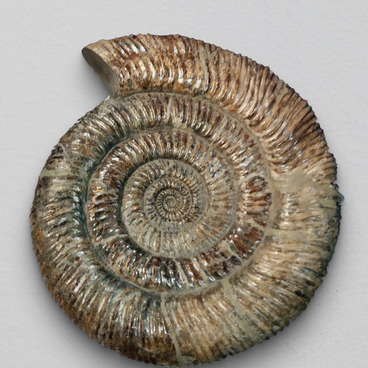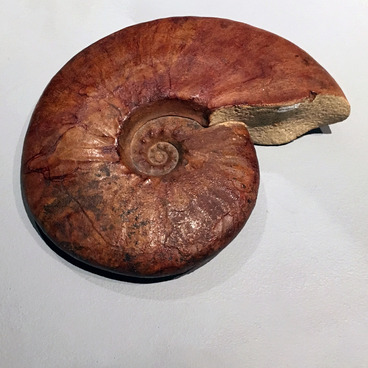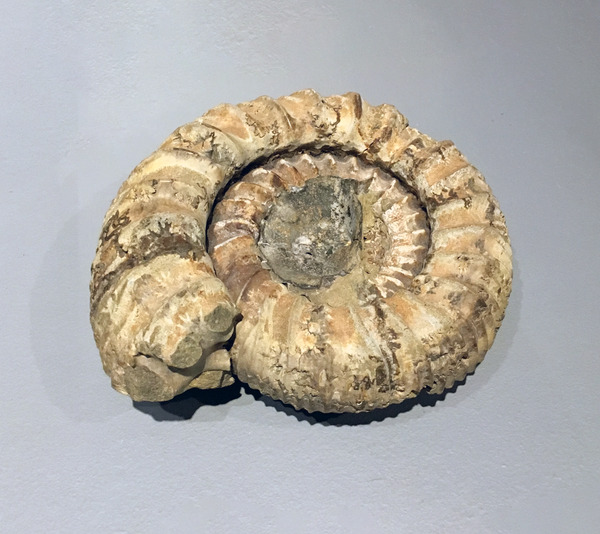
Ammonites are ancient cephalopods. They appeared in salty seas and oceans about 400 million years ago, and died out along with dinosaurs about 65 million years ago. At present, scientists count more than 10,000 species and dozens of genera of ammonites. Depending on the species, ammonites could stay tiny throughout their lifetimes - no more than 5 millimeters in diameter - or grow up to 2.5 meters in diameter. Ammonites in the genus Pavlovia existed about 150 million years ago. The genus got its name in honor of the famous Russian geologist that lived at the beginning of the 20th century, member of the Academy of Sciences Alexei Pavlov, who was an expert in Jurassic ammonites.
Pavlovian ammonites were not giants among the ammonites: the diameter of the shells for the largest reached 200 millimeters. They fed on plankton, small fish, and mollusks. Ammonites were also not averse to eating carrion. When hunting, the ammonites were assisted by a delicate sense of touch, large compound eyes, and 8–10 tentacles with sticky surfaces. One of the advantages ammonites had over other inhabitants of the seas was their level of intelligence. Their modern cousins - the octopus, cuttlefish, and squid - are trainable, and can live with humans as pets.
Pavlovian shells were distinguished by a wide navel, which was the initial chamber and first curl. The shell whorls are thick, rounded, or like rounded rectangles, and the ridges are sharp, marked by constrictions. As they grew, the mollusks built up new, wider chambers, and the old ones were cordoned off with partitions that had narrow openings. Through this hole, the mollusk could inject gas or liquid into the empty chambers and rise to the surface of the water, or sink down to the depths, like a submarine.
Pavlovian ammonites lived in the seas in the northern part of modern Eurasia for a fairly short time in geological terms - from the end of the Jurassic to the beginning of the Cretaceous periods. Scientists have found their fossilized shells on the Russian plateau, in the subpolar area of the Ural Mountains, and in Western Europe. This made ammonites one of the most accurate instruments for determining the age of ancient rock formations. For example, having found a shell of a Pavlovian mollusk in a rock formation on the Severnaya Sosva River in the Berezovskiy region of Yugra, and a shell from a similar species in Greenland, we can say with a high degree of confidence that the rock mass that has these ammonites was formed at the same time.
Pavlovian ammonites were not giants among the ammonites: the diameter of the shells for the largest reached 200 millimeters. They fed on plankton, small fish, and mollusks. Ammonites were also not averse to eating carrion. When hunting, the ammonites were assisted by a delicate sense of touch, large compound eyes, and 8–10 tentacles with sticky surfaces. One of the advantages ammonites had over other inhabitants of the seas was their level of intelligence. Their modern cousins - the octopus, cuttlefish, and squid - are trainable, and can live with humans as pets.
Pavlovian shells were distinguished by a wide navel, which was the initial chamber and first curl. The shell whorls are thick, rounded, or like rounded rectangles, and the ridges are sharp, marked by constrictions. As they grew, the mollusks built up new, wider chambers, and the old ones were cordoned off with partitions that had narrow openings. Through this hole, the mollusk could inject gas or liquid into the empty chambers and rise to the surface of the water, or sink down to the depths, like a submarine.
Pavlovian ammonites lived in the seas in the northern part of modern Eurasia for a fairly short time in geological terms - from the end of the Jurassic to the beginning of the Cretaceous periods. Scientists have found their fossilized shells on the Russian plateau, in the subpolar area of the Ural Mountains, and in Western Europe. This made ammonites one of the most accurate instruments for determining the age of ancient rock formations. For example, having found a shell of a Pavlovian mollusk in a rock formation on the Severnaya Sosva River in the Berezovskiy region of Yugra, and a shell from a similar species in Greenland, we can say with a high degree of confidence that the rock mass that has these ammonites was formed at the same time.