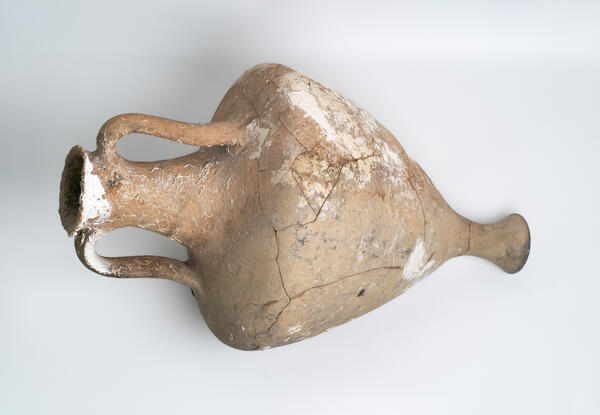
This Mendean amphora of the Porticello type was recovered from the seabed near Kalos Limen. It has a distinctive sharp-edged rim cut from beneath. It belongs to the common type of Mendean pottery. By examining amphorae like this one, researchers can learn a lot about the trade contacts of the people who lived in Kalos Limen.
An amphora is a large clay vessel with two handles, a pointed bottom, and a long neck. In ancient times, amphorae were used as the most popular containers for transporting liquid and dry products. The shape was well-suited for transportation by ship and for carrying. By looking at an amphora, one could easily determine the city of origin. This made it possible to estimate both the quality and quantity of its contents. Each city tried to give its amphorae a look that reflected the aesthetic taste of the time and region. However, all amphorae shared some common features that made them the most practical choice for transporting goods.
In the cities where amphorae were manufactured in large quantities, the products often featured special brands. The brand indicated the name of the owner of the pottery workshop that produced the amphora, sometimes the name of the city, or its coat of arms. On the one hand, such brands were “trademarks” that advertised the product and certified its quality. On the other hand, they also served as a guarantee that the container was compliant with the established standards and that its contents had the specified weight. Amphorae were branded only in cities where this practice was mandatory and widely used. Additionally, only a certain percentage of amphorae was branded — for example, every fifth or tenth amphora. Despite this, thanks to archaeological excavations, approximately 200,000 amphora brands have already been discovered.
The museum collection features a Mendean amphora of the Porticello type which came from the Chalkidiki peninsula in the northwest of the Aegean Sea. In ancient times, Chalkidiki was an important wine region, and the white wine from the city of Mende on the Pallene peninsula in Chalkidiki was considered one of the best in Greece. It was exported in large amounts and greatly appreciated.
The significance of the wine industry for the economic prosperity of this city, as well as the popularity of Mende wine, are reflected in the symbols of Mende. Its emblem depicts the god of wine, Dionysus, reclining on a donkey. It can be seen on amphora brands and coins from Mende.