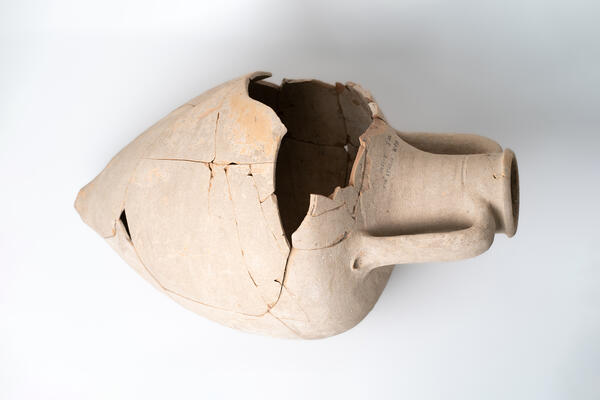
Containers of this type, such as the displayed amphora, were not covered with engobe or branded. In all cases, the edge has a beak-shaped spout at the edge and a sharp-ribbed stem. Based on similar artifacts from the Chersonese burial ground, necropolises of the Panskoye settlement, and Kalos Limen (where this vessel was found), the researchers can say for certain that this vessel dates back to the third quarter of the 4th century BCE.
This amphora was intended for the funeral of a child. In the funerary rites, amphorae held a significant place, and they were used not only to keep the items that accompanied the deceased. Such amphorae were also used as ossuaries for the remains of children. According to the archaeologist Vadim Kutaisov, nine similar burials have been documented within the burial mounds. In each case, the amphora had a sufficient volume as a container for the remains. In five cases, Chersonese amphorae were used. The mouths of the amphorae faced different directions.
This type of burial was an essential part of the Greek funeral rituals. All of them were “entrance burials” near existing burial mounds. It meant that they accompanied other burials in the necropolis. An analysis of all child burials in the vessels from the Northern Black Sea region led modern researchers to conclude that the tradition of burying infants in amphorae was not typical of Miletus and its Pontic colonies but was widespread in Dorian cities such as Callatis and Chersonesus. Consequently, the emergence of this type of burial in the remote agricultural lands of the Northwestern Crimea in the second half of the 4th century BCE was linked to the influence of Chersonesus and the migration of part of the Doric population from that city to this region.
Chersonese amphorae have been found in other Greek colonies in the Northern Black Sea region and even in Athens. By the 4th century BCE, Chersonesus had achieved significant economic development and engaged in active trade with several other Greek cities. The Tauric Chersonese was the only ancient city in the Northern Black Sea area which remained populated until the end of the 14th century.