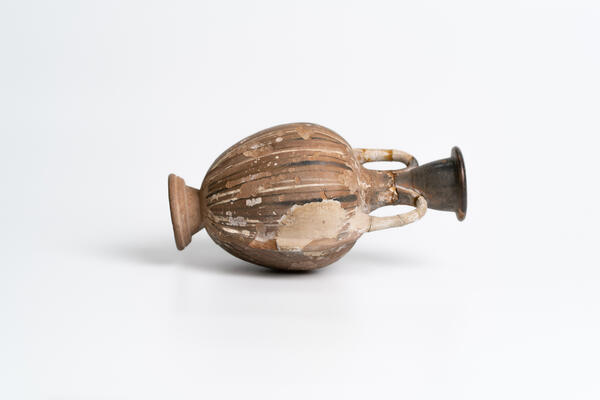
The exhibit was discovered during excavations at the Panskoye settlement in the northwestern Crimea. In 1969, the Tarkhankut expedition led by Alexander Shcheglov began conducting research at the Panskoye settlement. The expedition was organized by the Leningrad Branch of the Institute of Archaeology at the Academy of Sciences. An amphoriskos is a small amphora used as a container for aromatic and cosmetic oils.
Unlike ceramic amphorae, an amphoriskos was usually decorated, though there are also plain terracotta vessels of this type. Among the Ionian pottery of the Northern Pontic cities, there were many vessels with ornamental designs in the form of bands, wavy lines, and various combinations of geometric patterns.
In the production of aromatic and cosmetic products, the ancient Greeks drew on the experience of the Egyptians. Body oils and incense remained the most common cosmetic products. The Greeks expanded the range of aromatic substances. In addition to resins, balms, and spices, they began using essential oils extracted from flowers and plants. They were particularly fond of such aromas as rose, lily, iris, sage, thyme, marjoram, saffron, mint, and anise.
A large portion of the incense and aromatic components came from the East. Due to the long-distance transportation of ingredients, perfumes became more expensive, so only wealthy citizens could afford such “foreign fragrances”. Instead of using a single aroma ingredient, people started developing complex perfume compositions. During excavations in ancient Greek cities, clay tablets containing perfume recipes were discovered.
In everyday life, it was considered good taste to
cover one’s body with scented oils and ointments. This practice was followed by
both women and men. Not only did this have aesthetic significance, but it also
had practical benefits. Such ointments also served as disinfectants. Incense
was used in worship, rituals, and for embalming the bodies of the dead.
Archaeologists have found that among the personal belongings in burials, there
were sometimes bottles of incense. Fragrances were associated with gods. Each
god had its own unique fragrance. This was an integral part of ancient Greek
beauty culture.