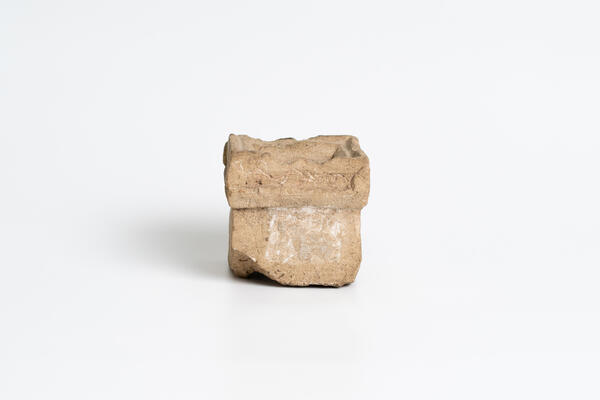
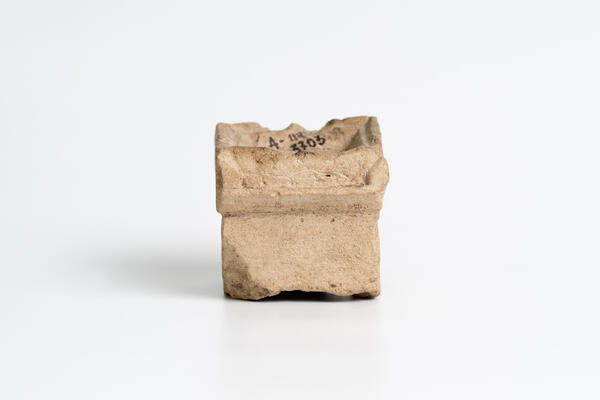
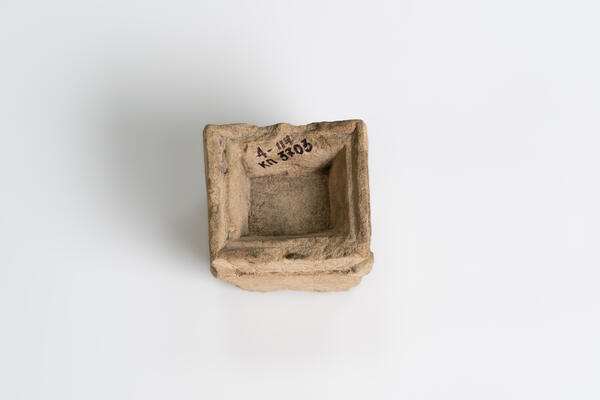
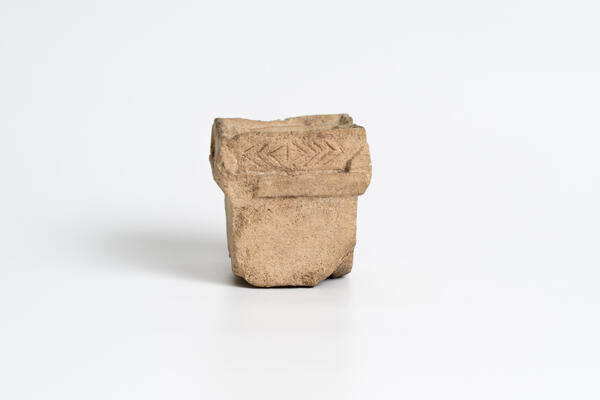
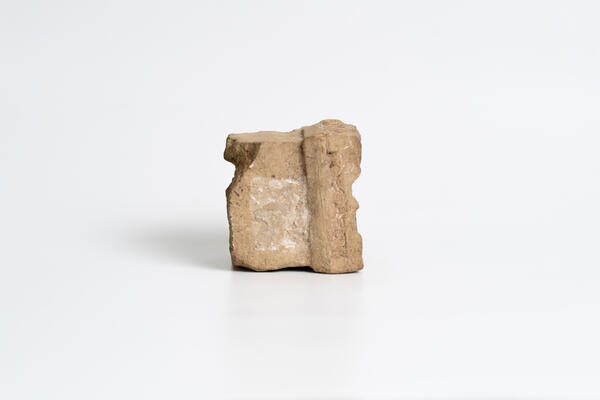
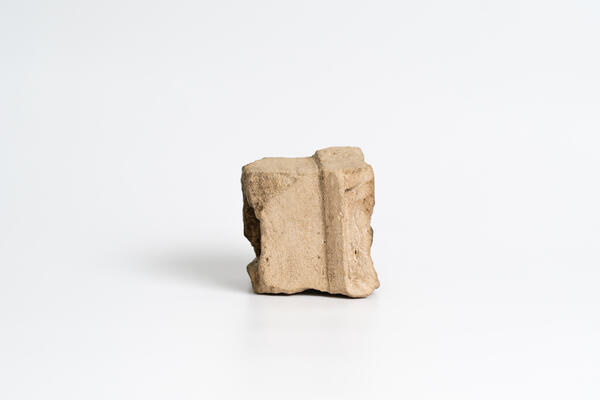
The displayed altar was found during excavations at the Bolshoi Kastel Estate in the Northwestern Crimea. It was discovered by members of the Tarkhankut expedition from the Leningrad Branch of the Institute of Archaeology. This miniature stone altar indicates that the residents of the Chersonesus chora followed the same religious beliefs as Greek colonists. The word “chora” was used to refer to the agricultural lands used by residents of ancient cities.
One of the main deities who was venerated on the territory of the estate was Demeter, the goddess of agriculture and fertility. In one of the Orphic hymns, she is addressed as a goddess who “gives prosperity and wealth, ” “nourishes the ears of corn, ” “protects seeds, green fruit, and abundant grain, ” and “gives sustenance to all.” Among the followers of Orphism, she is identified with Rhea, the mother of Zeus, who gave birth to his daughter Persephone. The followers offered incense offerings to Demeter, burning incense and tree resin. In addition to the worship of Demeter, the worship of Hercules, a demigod known for his extraordinary strength and courage, was also widespread in the area. The local residents regarded him as a protector.
Small altars were made according to the design of larger altars. The locations of their discovery indicate that they were placed in niches in the walls of private houses. The upper part of such an altar was decorated as a pediment. At the top, there was a recess where various substances could be placed for burning. Both locals and visitors made offerings at these altars. The inscription made in the 4th century BCE on a small stone altar from Hermonassa indicates that a citizen of Heraclea brought it as a gift to Aphrodite.
Altars often featured relief decorations. Such images can be seen on the imported marble altar and locally made terracotta one from Olbia. Similar finds have been discovered in Chersonesus and the Bosporus region. Aromatic substances were burned on some of the altars to produce incense smoke for the gods. Similar rituals were adopted in the Northern Black Sea region. Evidence can be seen in the traces of burning found on two terracotta altars at the Kulchuk settlement near the Gromovo village in the Northwestern Crimea.