#12
Abyl, tomar
#15
#13
#3
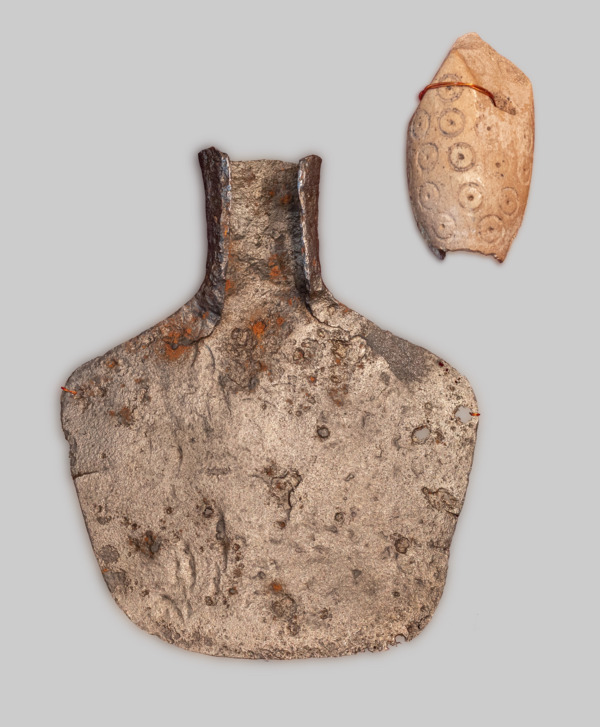
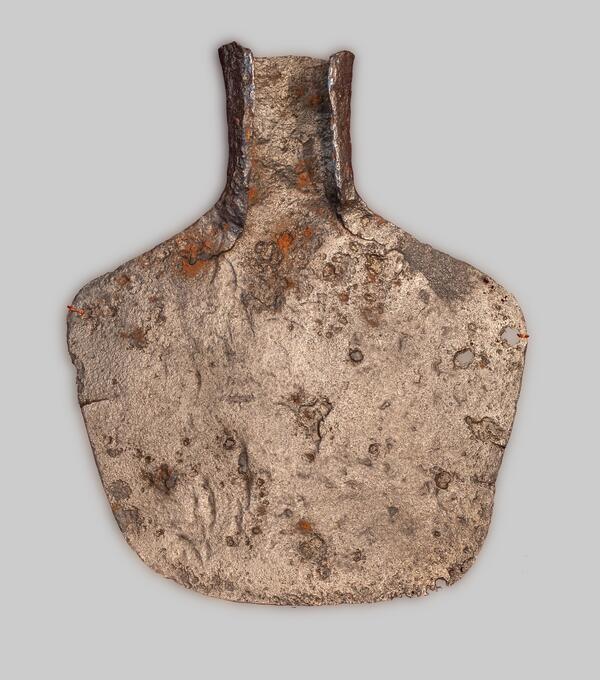
The museum collection contains an abyl – a small round-point spade-shaped iron hoe, set on an angle handle. Abyl was used for manual tilling. It was operated the same way as a pickaxe.
A hoe is a hand farming tool. Other names for it are dibber, mattock, digger, ‘sapa’ (from French ‘sape’, in the South of Russia), аnd also, ketmen (grab hoe), in Central Asia. It consists of a wooden handle and a metal useful area set transversely to it. The useful area can be wide or narrow, flat or cambered, or spade-shaped. The blade can also be flat or convex.
A light hoe is used for tillage or weeding. A heavier grab hoe is also used for digging, instead of a spade. And potent hoes called pickaxe or grub axe are used for digging heavy ground and for rock mining. Specific feature of an abyl is a bent handle, and a wide spade-shaped useful area.
Kuznetsk tartars who lived in Kuznetsk region were not only engaged in hunting and crafts. They raised cattle, and vegetable farming was also popular. They grew switch grass and barley, though in modest quantities. It was possible to till a small plot of land using an abyl.
The abyl used for tillage was inherited via female lineage and was an indispensable item of girls’ dowry. The museum artefact discovered in Kuznetsk ostrog was another confirmation of marriages between the Russian and indigenous population.
As all iron and steel items of Kuznetsk tartars, abyl was made of refined iron – a semi-fabricated product of bloomer process. The bloom was heated in the furnace many times over, and forged on a stone anvil to finally shape it. Iron ores of Mountain Shoriya contain natural impurities (manganese, titanium, vanadium) in the amounts sufficient for obtaining high quality alloy metal.
#9
Full name: Iron hoe abyl
Date of Foundation: XVII cent.
Technique: Forging
Dimensions: Overall length-17.6 cm, collar length-5 cm, blade length-12.6 cm, max width-14.4 cm, min width-8.5 cm, thickness-0.15 cm
Collection: XVII – XVIII cent., Kuznetsky Ostrog — the town of Kuznetsk. Excavations of various years
Image copyright holder: Kuznetsk fortress
The Restorers A. P. Scheglakov
State catalog number: 6539467
Date of Foundation: XVII cent.
Technique: Forging
Dimensions: Overall length-17.6 cm, collar length-5 cm, blade length-12.6 cm, max width-14.4 cm, min width-8.5 cm, thickness-0.15 cm
Collection: XVII – XVIII cent., Kuznetsky Ostrog — the town of Kuznetsk. Excavations of various years
Image copyright holder: Kuznetsk fortress
The Restorers A. P. Scheglakov
State catalog number: 6539467
#16
Tomar
#14
#5
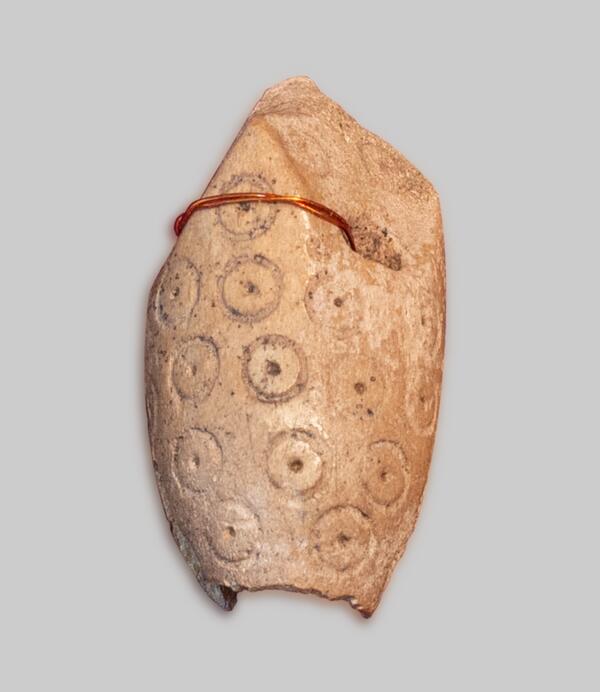
TomAr is a bone arrowhead for fur game hunting. It is oval in shape with a slightly pointy tip and hollow inside. The entire external surface of the arrowhead is covered with circular decoration – 0.5 cm circles with a point inside. The arrowhead was found during excavations of Kuznetsk ostrog.
Other names for that arrowhead are ‘tomar strelny’ or ‘tomara’. They were mainly made from bone, but iron items could also be encountered. Besides the fur game hunting, those arrows could be used for fowling. Tomar with a faceted tip was also used in battles.
An arrow with a thickened tip and no arrowhead could also be called tomar. The size and shape of bone arrowheads (tomar) could be different: hollow cylinder, or oval. According to a game manager Barschevsky, large tomsrs, especially cylindrically shaped ones, could be used to hunt large fur game, first of all, beavers.
Beavers could be hunted all year round. It is very unlikely that such arrowheads were used to hunt squirrels or martens – they were too large for that game. Small tomsrs were used to hunt small-size pelting animals.
Indigenous population of Siberia paid a tribute –“yasak ‘– in furs of pelting animals. Apart from costly sable fur, the hunters valued beaver, fox, glutton, weasel, and otter fur skins. A special blunt arrow, tomar, killed the animal but did not damage the valuable fur.
The Russian nationals also got engaged in fur trade right upon their arrival to Siberia. Furs were the only Siberian commodity in those times. It could be exchanged for any other goods. The need for those was especially urgent in the first years when the Russian population found themselves in poor Siberian regions where neither agriculture farming nor industry were developed.
#8
Full name: bone arrowhead-tomar
Date of creation: XVII century
Technique: bone, carving
Dimensions: length-4.3 cm, size at the base-1.3 cm, middle part size-2.3 cm
Collection: XVII-XVIII cent. Kuznetsk ostrOg – the town of Kuznetsk. Excavations of various years
Image copyright holder: Kuznetsk fortress
State catalog number: 6539611
Date of creation: XVII century
Technique: bone, carving
Dimensions: length-4.3 cm, size at the base-1.3 cm, middle part size-2.3 cm
Collection: XVII-XVIII cent. Kuznetsk ostrOg – the town of Kuznetsk. Excavations of various years
Image copyright holder: Kuznetsk fortress
State catalog number: 6539611
read morehide
00:00
00:00
1x
2
 Point your smartphone camera to open in the app
Open in app
Share