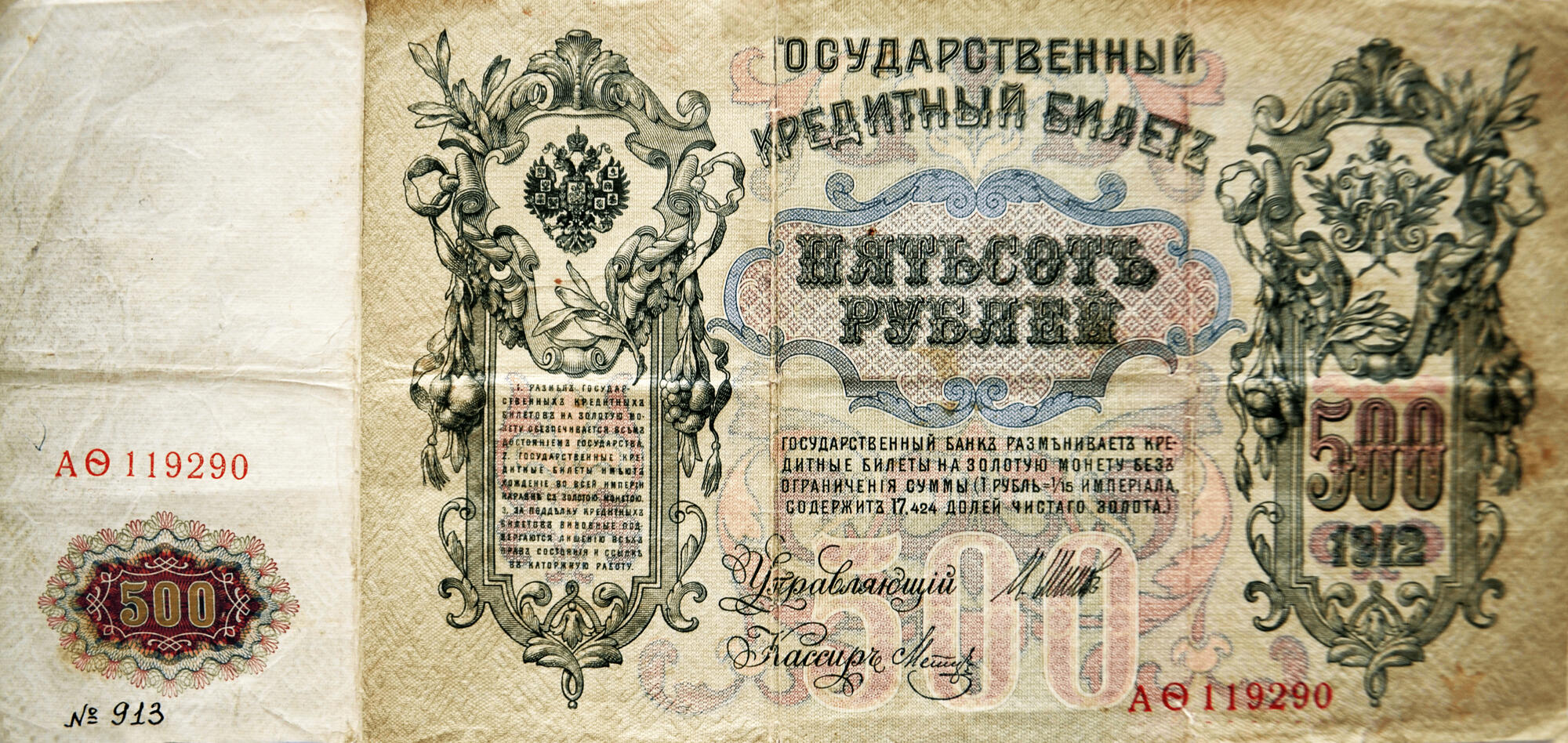


The numismatic collection of the Karasuksky Regional Museum includes a paper banknote, with a face value of 500 rubles, issued in 1912. The serial code ‘АѲ’ means that this banknote was issued under the Provisional Government, between March and October 1917. These credit notes stand out for their unusual design, developed by Rihards Zariņš. Zariņš would later go on to create the first revolutionary stamps of Soviet Russia, commonly known as ‘the hand with the sword, cutting the chain’.
On the obverse side of the 500-ruble notes, decorated in steel-blue, Zariņš positioned a portrait of Peter the Great in a decorated oval frame with a crown at the top. He used an engraving from Carl Moore’s famous portrait, completed in 1717. These banknotes were called ‘Petenki’ by the population. Either side of the portrait, there are two identical columns - an oval with the number 500 at the bottom, and on top of them the figure of an angel, supporting a rectangle with the banknote’s face value. On the right side, Zariņš has positioned an allegorical drawing of Russia in the form of a young woman, holding an orb and scepter, with a laurel wreath on her head. There is a sun above her right hand, with the number 500 shining out from the center.
The reverse side is decorated with bas-reliefs of plants and laurel branches. The 1883 small State coat of arms is positioned within one of the wreaths, whilst the royal cipher of the then emperor, Tsar Nicholas II, supported by two crossed laurel branches, is positioned inside the other. The artists placed a rosette with the number ‘500’ on this side, as well as basic technical information: text about the collateral gold, excerpts from the law, the face value, signatures from the Manger of the State Bank and clerk. There is also a two letter serial code and six-digit serial number. There are reliable watermarks on the note as well. The number ‘500’ is repeated, tilted to one side at an angle of 45 degrees. There is also a local watermark, duplicating the portrait of Peter the Great.
The 500-ruble note was printed by metallographic printing, without a pattern behind the text. The image is clear and slightly raised above the surface of the paper. On the reverse, typographic printing was used, with the Orlovsky method giving the pattern five different colors. The Orlovsky printing method is where the colors are applied to the composite roller in turn, and then transferred to the stamp, and then finally to the sheet of paper.
State credit notes made between 1905 and 1912, including this 500-ruble note, were in circulation until 1 October 1922.
On the obverse side of the 500-ruble notes, decorated in steel-blue, Zariņš positioned a portrait of Peter the Great in a decorated oval frame with a crown at the top. He used an engraving from Carl Moore’s famous portrait, completed in 1717. These banknotes were called ‘Petenki’ by the population. Either side of the portrait, there are two identical columns - an oval with the number 500 at the bottom, and on top of them the figure of an angel, supporting a rectangle with the banknote’s face value. On the right side, Zariņš has positioned an allegorical drawing of Russia in the form of a young woman, holding an orb and scepter, with a laurel wreath on her head. There is a sun above her right hand, with the number 500 shining out from the center.
The reverse side is decorated with bas-reliefs of plants and laurel branches. The 1883 small State coat of arms is positioned within one of the wreaths, whilst the royal cipher of the then emperor, Tsar Nicholas II, supported by two crossed laurel branches, is positioned inside the other. The artists placed a rosette with the number ‘500’ on this side, as well as basic technical information: text about the collateral gold, excerpts from the law, the face value, signatures from the Manger of the State Bank and clerk. There is also a two letter serial code and six-digit serial number. There are reliable watermarks on the note as well. The number ‘500’ is repeated, tilted to one side at an angle of 45 degrees. There is also a local watermark, duplicating the portrait of Peter the Great.
The 500-ruble note was printed by metallographic printing, without a pattern behind the text. The image is clear and slightly raised above the surface of the paper. On the reverse, typographic printing was used, with the Orlovsky method giving the pattern five different colors. The Orlovsky printing method is where the colors are applied to the composite roller in turn, and then transferred to the stamp, and then finally to the sheet of paper.
State credit notes made between 1905 and 1912, including this 500-ruble note, were in circulation until 1 October 1922.