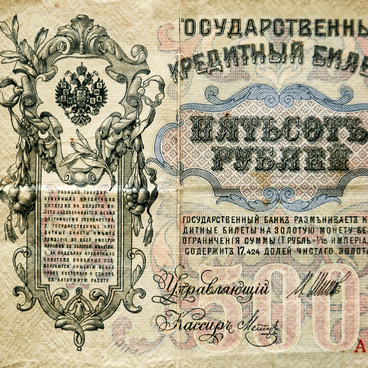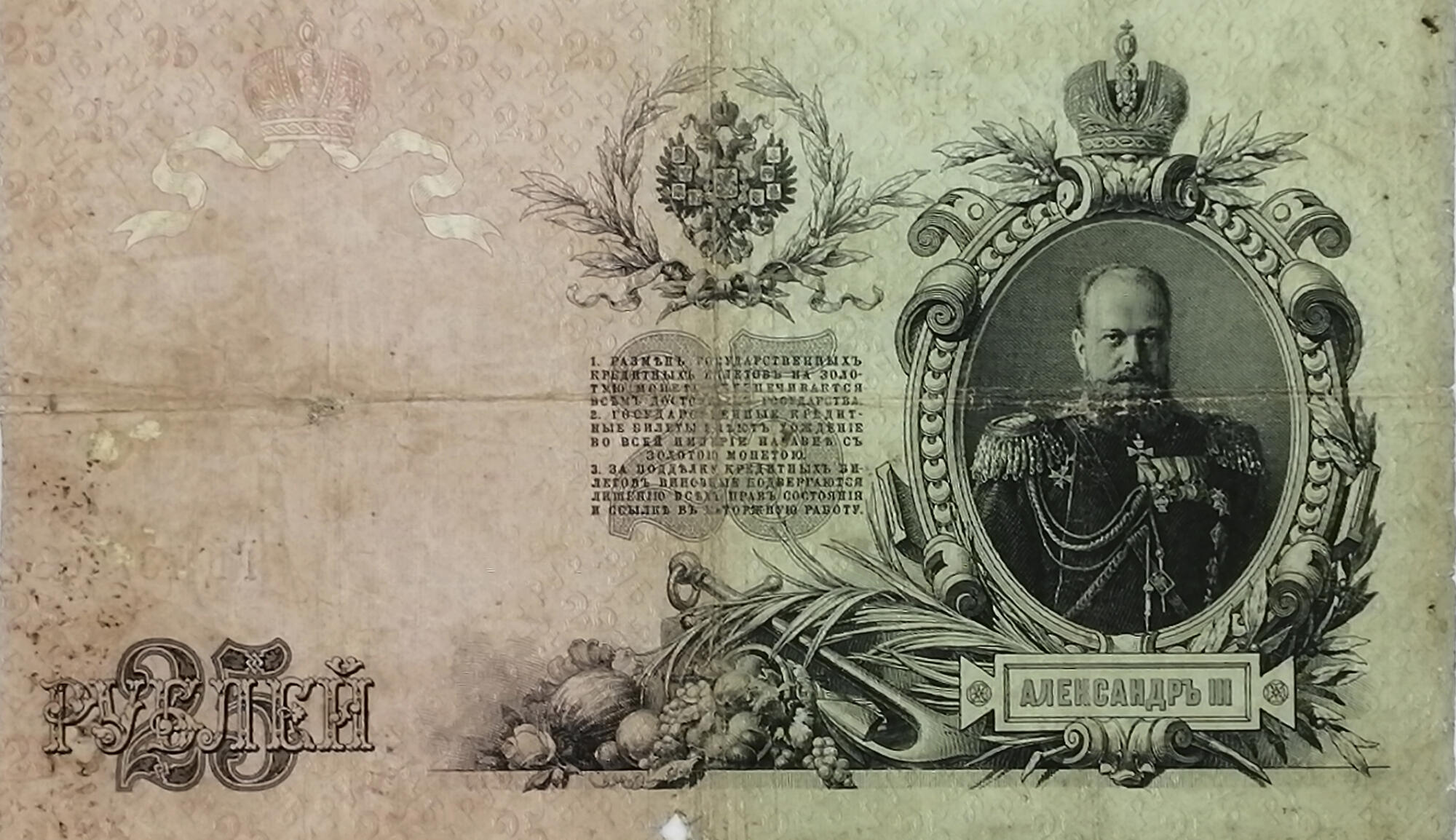


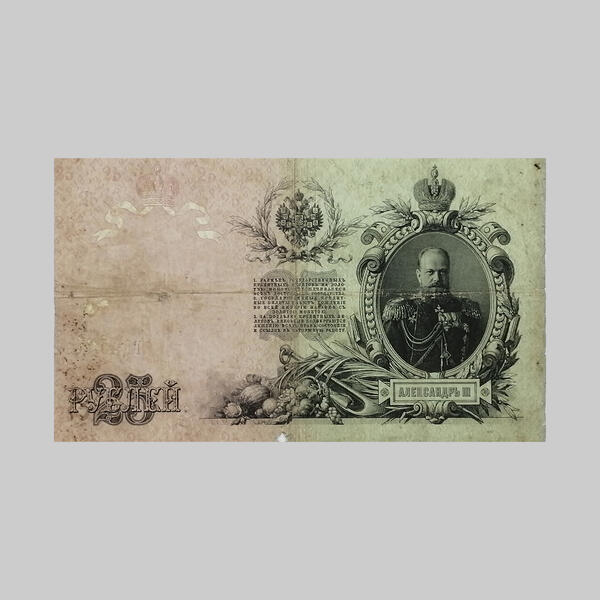
The numismatic collection of the Karasuksky Regional Museum includes a paper banknote, with a face value of 25 rubles, issued in 1909. This credit note was issued some time after April 1914, since at this time, Ivan Shipov, whose signature is on the banknote, was the manager of the Russian Empire’s State Bank. This design of banknote was issued right up until 1918, with a total circulation of 53 million notes. In 1912, in Tomsk, this note would buy you five poods (or around 80 kilograms) of high-quality beef, or three pairs of excellent boots.
This was the second issuance of 25-ruble banknotes under Tsar Nicholas II. The first took place in 1898, four years after Nicholas took the throne, whilst the second took place in 1909. The reason for the introduction of these new paper banknotes was to improve the printing techniques of the banknotes. The credit notes produced between 1905 and 1912 were printed on white paper (apart from the 100 ruble notes, which were printed on a yellowy paper), and had watermarks. Printing with usual and metallographic printing techniques made the text and the colorful design slightly raised off the surface of the note. Printers could utilize five different colors on one side of the banknote. Money printed with this technique was very hard to forge. These banknotes remained in circulation until October 1922.
The 25-ruble note’s obverse is made up of two different halves. The left half is printed in lilac, whilst the right one is bluey-green in color, with black text. The main design on the right-hand side is a portrait of Alexander III, surrounded by a decorated oval frame, with a crown at the top. The 1883 State coat of arms is depicted in the center of the note. Beneath it, an extract of the 14 November 1897 law is inscribed, warning about the punishment of hard labor for anyone found forging money.
The reverse’s background is dark purple, with a multicolored design and black text. The 1883 small State coat of arms is printed on this side of the note, as well as the face value and a five-line inscription about the gold collateral held for this credit note. The banknote was signed by the manger of the State Bank, Ivan Shipov, and its clerk, Gusev. There are more complex water marks on this banknote than on the five ruble note. The number 25 is repeated with the shortened word ‘RUB’ perpendicular to each other, tilted diagonally. There is also a local watermark, duplicating the portrait of Alexander III.
This was the second issuance of 25-ruble banknotes under Tsar Nicholas II. The first took place in 1898, four years after Nicholas took the throne, whilst the second took place in 1909. The reason for the introduction of these new paper banknotes was to improve the printing techniques of the banknotes. The credit notes produced between 1905 and 1912 were printed on white paper (apart from the 100 ruble notes, which were printed on a yellowy paper), and had watermarks. Printing with usual and metallographic printing techniques made the text and the colorful design slightly raised off the surface of the note. Printers could utilize five different colors on one side of the banknote. Money printed with this technique was very hard to forge. These banknotes remained in circulation until October 1922.
The 25-ruble note’s obverse is made up of two different halves. The left half is printed in lilac, whilst the right one is bluey-green in color, with black text. The main design on the right-hand side is a portrait of Alexander III, surrounded by a decorated oval frame, with a crown at the top. The 1883 State coat of arms is depicted in the center of the note. Beneath it, an extract of the 14 November 1897 law is inscribed, warning about the punishment of hard labor for anyone found forging money.
The reverse’s background is dark purple, with a multicolored design and black text. The 1883 small State coat of arms is printed on this side of the note, as well as the face value and a five-line inscription about the gold collateral held for this credit note. The banknote was signed by the manger of the State Bank, Ivan Shipov, and its clerk, Gusev. There are more complex water marks on this banknote than on the five ruble note. The number 25 is repeated with the shortened word ‘RUB’ perpendicular to each other, tilted diagonally. There is also a local watermark, duplicating the portrait of Alexander III.