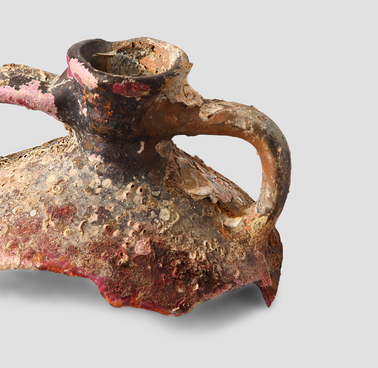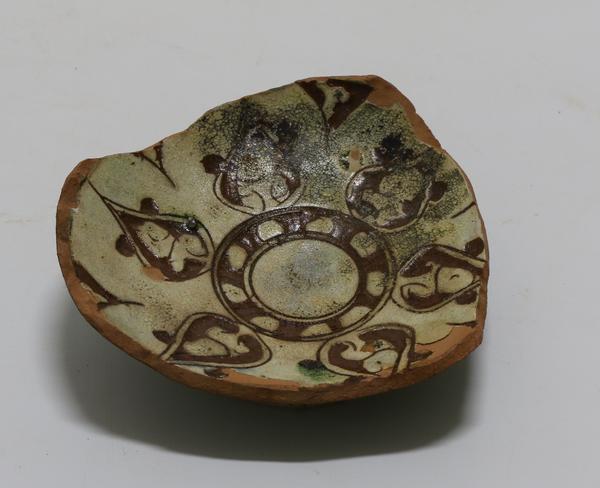
The mass production of Byzantine ceramics led to the flourishing of pottery, which is represented by this glazed plate, decorated with a contour drawing in the sgraffito technique and floral elements.
The factors that determined the development of pottery production in the 13th–14th centuries help scientists to identify not only the cultural but also the political and economic context of the history of the Byzantine Empire.
As the capital of the Byzantine Empire (until 1204), Constantinople was the main supplier of reference models. Thanks to developed trade relations, the achievements of Byzantine artisans were quickly adopted by craftsmen from other regions. The demand prompted the establishment of mass production of ceramics and the introduction of new equipment, such as separating tripods for firing several products at a time and, most likely, stamps. (The latter is confirmed by wares featuring almost identical images of birds and “sunny faces of bird women” found in different parts of the Mediterranean Basin).
While being the capital of the Latin Empire in 1204–1261, Constantinople practically lost the status of a cultural trendsetter, which led to a more active development of local pottery centers.
During the Crusades, Western, Eastern and Byzantine cultures overlapped. Pottery, mainly with late sgraffito with the prevalence of Eastern motifs, was exported from emporiums, which served as Crusader fortresses.
After 1261, restored by the Palaiologoi, Byzantium never regained its former position. The times of luxury had passed, and the production of dishware from precious metals had to be drastically reduced. The Byzantine writer, philosopher and historian Nicephorus Gregoras (1295–1360) noted that even at the feast in honor of the coronation of John VI Cantacuzene (1347–1354), treats were served in earthenware and tinware.
The Latin West had a strong influence on the lifestyle of the Byzantines, including their food habits. This affected the traditional cutlery and cooking ware and led to the appearance of their modifications, as well as some new items. The characteristic Middle Byzantine ware for heating food was replaced by small thin-walled goblets and large flat dishes. Wide, deep bowls on feet were intended for inexpensive liquid food with less sauce or juice than before; dishes like trays were used for serving roast meat or poultry at feasts.