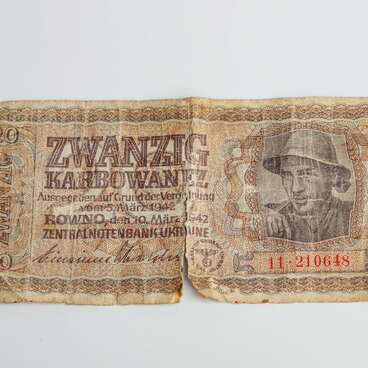
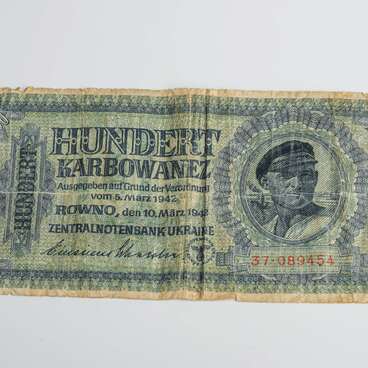
The Museum of Intelligence Officer Nikolai Kuznetsov displays a 50-karbovanets banknote issued in 1942 by the Central Bank of Ukraine (Zentralnotenbank Ukraine) under the authority of the Reichskommissariat Ukraine.
From 1942 to 1944, German occupation authorities introduced a special currency — the karbovanets — in the occupied territories of western Ukraine, including Rovno, the administrative capital of the Reichskommissariat. Like other occupation banknotes, it served not only an economic function but also acted as a tool of propaganda, intended to foster the illusion of a “new order” and legitimize German rule.
The banknotes featured inscriptions in both German and Ukrainian — a deliberate effort to present the occupation regime as responsive to local identity. Nevertheless, during the Great Patriotic War, Soviet rubles and pre-war currencies remained dominant in everyday circulation. The exchange rate of the karbovanets was rigidly controlled by the occupiers, but public confidence in the currency was extremely low; it was widely perceived as a symbol of foreign domination.
As stated on the 50-karbovanets note itself, it entered circulation on March 10, 1942. This is confirmed by the official German inscription: Ausgegeben auf Grund der Verordnung vom 5. März 1942 / ROWNO, den 10. März 1942. ZENTRALNOTENBANK UKRAINE (“Issued pursuant to the ordinance of March 5, 1942 / Rovno, March 10, 1942. Central Bank of Ukraine”).
At the bottom of the note is the signature of the bank’s manager. To its right appears an official stamp bearing the emblem of the Third Reich: an eagle with outstretched wings clutching a wreath of oak leaves encircling a swastika. Adjacent to this, within an ornamental rectangular frame, is a portrait of a miner wearing a helmet, set against the backdrop of a mine — symbolizing the region’s exploited labor and industrial resources. Beneath the image is the note’s series designation, followed by a six-digit serial number; both are printed in red.
On the reverse side, inscriptions appear in both German and Ukrainian. To the left of the central numeral “50” is a warning in German: GELDFÄLSCHUNG WIRD MIT ZUCHTHAUS BESTRAFT (“Counterfeiting currency is punishable by imprisonment”).