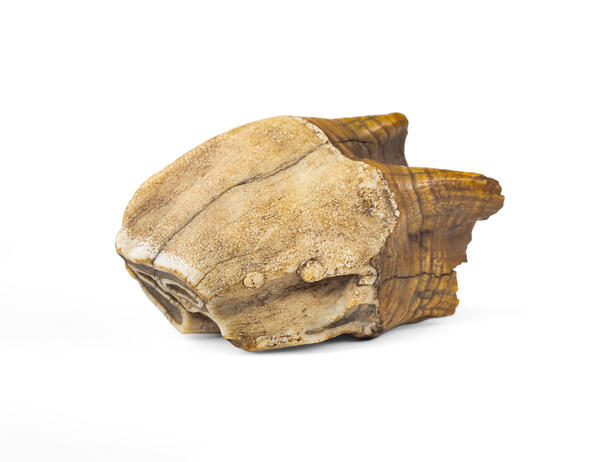
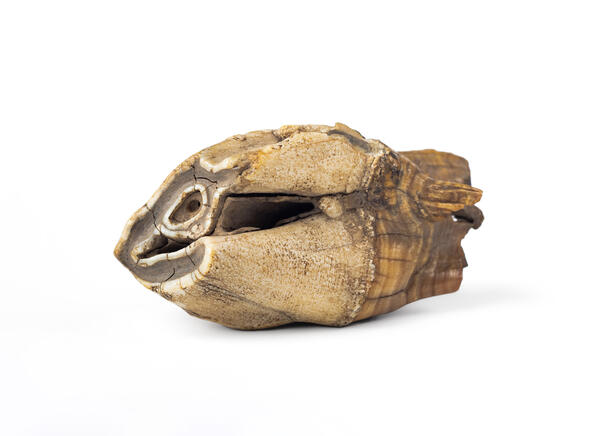
The tooth of the wooly rhinoceros belonged to an extinct mammal, a representative of the odd-toed order of ungulates that lived on the territory of the Khakass-Minusinsk basin, a depression between the mountain systems of Southern Siberia.
These animals completely disappeared between 8 and 14 thousand years ago. The territory of the basin was often visited by Russian paleontological expeditions. Scientists noted that dozens of species of large mammals lived in the southern part. The tooth found by archaeologists is hollow inside. On one side, its enamel is worn off, the edge is grinded down, and some cracks are present.
The first fossil bones, horns, skulls and fragments of a wooly rhinoceros carcass were discovered in the early 1770s in Siberia. In those years, the discovery was made by a native of Prussia, Peter Simon Pallas, who served in the Russian Academy of Sciences until his death. This scientist became the first to describe the previously unknown fossil species. From the time of Simon Pallas until the 1840s, further research on this animal was not conducted in the Russian Empire.
The history of the study and description of the wooly rhinoceros shows that the priority in its primary description (on specific specimens that are stored in the collection of type specimens of the Zoological Institute of the Russian Academy of Sciences) belongs to the Russian researcher and academician Peter Pallas, and not to the German researcher Johann Friedrich Blumenbach, whose species name Coelodonta antiquitatis was eventually assigned to the wooly rhinoceros.
These animals inhabited the vast territory of Northern Eurasia at the end of the last glaciation. At that time, they spread from the Iberian Peninsula to Chukotka, and in the north their range went far beyond the Arctic circle. The weight of a wooly rhinoceros could reach up to 3 tons with a body length of 3.5 meters. The females were noticeably smaller than the males.
It is believed that
wooly rhinoceroses led a solitary lifestyle, like their African counterparts,
uniting with a female for a short time every three to four years to mate. After
a year and a half of pregnancy, as a rule, one calf was born, which continued
to graze next to its mother for about two years. Like many other animals of the
Ice Age, the rhinoceros was covered with thick long hair. It had two horns on
the front of his head.