Font
Color
Graphics
Изображение точки

To see AR mode in action:

1. Install ARTEFACT app for iOS or Android;

2. Find the exhibition «Gelendzhik: Past and Present»

3. Push the «Augmented reality» button and point your phone's camera at the exhibit;

Скрыть точки интересаПоказать точки интереса
Показать в высоком качестве

Telescope, Bullet mold, Pistol, Powder flask

0
Open in app
#1
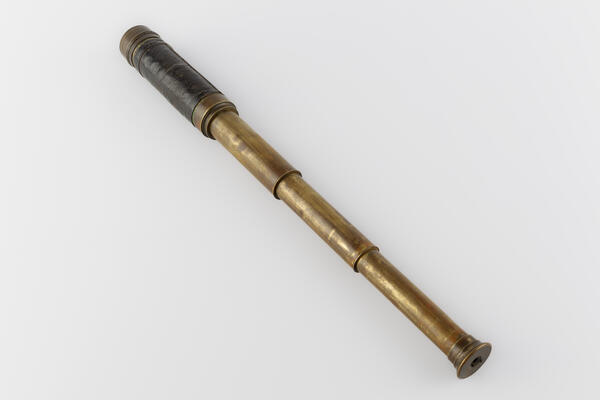
Telescope
#2
One of the important attributes of travelers, commanders and sailors from the 12th to the 19th centuries was a telescope — an optical device for observing distant objects. It was used for stargazing, hunting, reconnaissance and landscape studies.

Since ancient times, inventors have tried to create a device that would help the human eye to see further. The properties of a container with water that bent rays and magnified objects were noticed in antiquity. In 1268, Roger Bacon, an English Franciscan friar, described a prototype of a telescope. The famous scientist Leonardo da Vinci managed to design a detailed scheme of a telescope with two lenses.

The famous Italian scientist Galileo Galilei designed a telescope and in 1624 launched its mass production. Almost simultaneously with Galileo, the German astronomer Johannes Kepler, in his 1611 book “Dioptrics”, proposed his own improved design of a telescope, which was called “Keplerian”. Unlike the Galilean telescope, Kepler’s optical instrument produced a much greater magnification due to two biconvex glasses, the first of which formed the image, and the second enlarged it. However, the disadvantage of the Keplerian telescope was that it produced an inverted image. Only in 1850, Ignazio Porro, an Italian optical engineer, came up with a system of prisms that re-oriented the inverted image and made the telescope shorter. In this system, a beam of light passed through the prisms and reflected from them four times. Telescopes are still being used and improved in our days.

The Keplerian telescope from the museum collection has a six-fold magnification. It is easy to store and transport the device, because it consists of four hollow tubes of different diameters, inserted one into the other, which helps to reduce the total length. To keep the optical device safe and to enhance convenience, the outer tube is sheathed in leather: this protects the case from dents and from slipping. The eyepiece of the tube is equipped with a latch to prevent damage to the lens. Inside the eyepiece tube, there is a relay lens system.
#3
Наименование: Telescope
Дата создания: the second half of the 19th century
Техника: copper, optical glass, leather; factory assembled
Размеры: length — 40 cm, diameter — 34 mm
#4
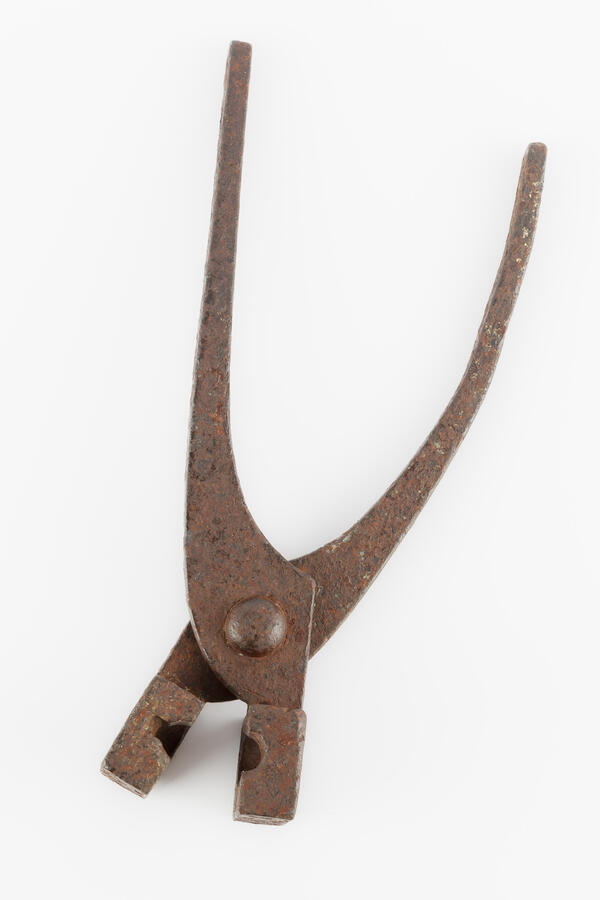
Bullet mold
#5
A bullet mold is a tool for forming lead bullets. Since ancient times, lead has been used to make ammunition due to being cheap, widespread, readily available, resistant to moisture, and easily melted. Over a considerable time, the shape of the bullet has changed, and a device for replenishing ammunition has evolved. There were several types of bullet molds in terms of caliber, bullet shape and appearance. They could be designed for the casting of one or several bullets at once.

The bullet mold found in the Gelendzhik region looks like pincers, only with a cavity for pouring lead. This tool was used by the soldiers of the garrison in the Gelendzhik fortification. Specifically, this version of the bullet gun was used to make Minié balls for rifles. During the Caucasian War, Russian soldiers had to make their own bullets from the lead they were given.

At first glance, the process of casting a bullet seems simple: its essence boils down to the fact that molten lead was poured into a bullet-shaped cavity and cooled down, the bullet mold was opened, and the bullet was removed. However, in fact, everything was more complicated. Before starting work and pouring lead, the bullet mold had to be rubbed with chalk to prevent oxidation. The heating temperature of lead was determined approximately, which required some experience. Insufficiently heated lead did not completely fill the mold cavity and became layered. However, overheated lead led to surface oxidation and continued to boil inside the mold, so that cavities and voids appeared inside the bullet. The metal casting itself had to be homogeneous. If the timing was too short, the air did not have time to leave the cavity, while in the case of delay the lead solidified in layers, and the bullet turned out to be uneven. The bullet mold itself also had to be heated. For this, several test castings were made. The resulting bullets were carefully examined, their shape and color were checked. The casting process began only after a satisfactory result was achieved. Indeed, if the bullets had defects, accuracy and firing range deteriorated significantly.

A bullet mold was to be handled with care. It was allowed to clog its cavities with lead and small debris. It was strictly prohibited to clean bullet molds with emery or crushed brick. When the work was finished, the bullet mold was thoroughly wiped with a clean rag, and the metal parts were lubricated with a thin layer of low quality olive oil.
#6
Наименование: Bullet mold
Дата создания: the middle of the 19th century
Техника: iron, casting
Размеры: 26,5×5×5,5 cm
#7
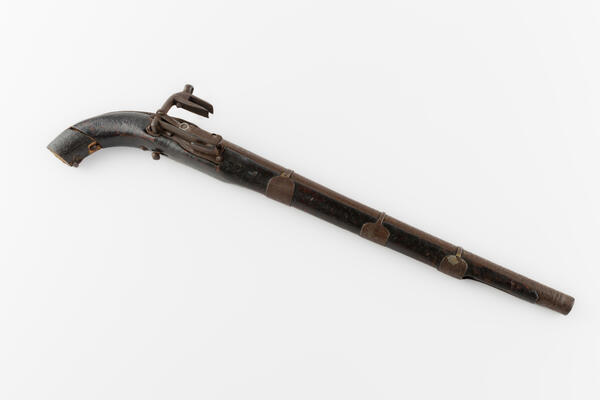
Caucasian flintlock pistol
#8
A pistol was one of the auxiliary weapons of a Circassian warrior.

The first pistols that appeared in the 15th century were bulky and inconvenient. They consisted of a short barrel mounted on a wooden block, and the gunpowder was ignited with a wick. In general, the pistol of that period differed from the gun mostly in size and weight. A pistol was created in order to equip equestrians with firearms: an infantryman could handle a gun, but it was very difficult for a rider, especially since the process of loading a gun was so complicated.

Later on, pistols would change in parallel with other types of firearms. One of the improvements in the design of the pistol was made by Leonardo da Vinci — it was a wheel-lock that was wound up with a key. It is noteworthy that it was the only invention of the great scientist and inventor that received lifetime recognition.

The range and accuracy of a pistol were inferior to those of a rifle and depended on the model of the pistol. Many versions of this weapon were developed; they were suitable for various purposes: from short-barreled pistols for point-blank fire to long-barreled ones with the range of 30–40 meters. Reloading the pistols was complicated, the fire range was relatively short, so the pistol was more of a secondary weapon for the Circassian warriors. Nevertheless, since the weapon was small, a warrior could carry several loaded pistols and use them at medium and short distances.

The museum exhibits a Caucasian handmade smoothbore pistol, with a flintlock and a caliber of 11 mm. It was transferred to the museum from the Adyghe Regional Museum of Local Lore in 1971. Such a pistol was popular among the Circassians, especially among representatives of the feudal aristocracy. It has a thin wooden stock, which, like the forearm of guns, was made mainly of walnut. The flintlock is similar to that of a rifle but smaller. The barrel is quite long, and has no rifling or sights. It is attached to the stock and the handle with three hoops — ferrules and a shank.
#9
Наименование: Caucasian flintlock pistol
Дата создания: the 19th century
Техника: steel, wood, forging, handmade
Размеры: 35×10×5 cm
#10
Powder flask
#11
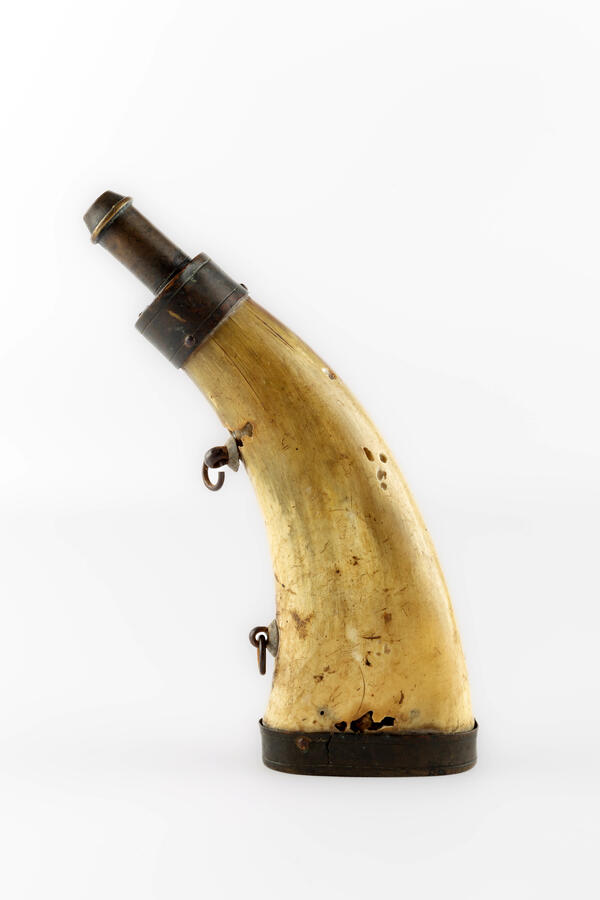
A powder flask is an essential part of shooting equipment. It is a small container for gunpowder, which was worn by warriors and hunters. A powder flask was included in the shooting equipment along with other pieces — bullet bags and a supply of wads. A powder flask was used to load muzzle-loading weapons. This happened as follows: gunpowder was placed in the barrel (in the early versions of firearms it was a measured amount with a wad seal), after which a bullet rolled into the barrel, followed by another wad, which prevented the bullet from rolling back. Only from the 17th century a ready-made cartridge came into use. However, in both charging options, it was necessary to place the loose priming powder on the lock pan and set it on fire.

Since the 15th century, there have been various types of powder flasks. They came out of use and became unnecessary, when unitary cartridges were introduced in the late 19th century. It is noteworthy that today a powder flask image has been preserved in heraldry. For example, there is such an image on the coat of arms of the Federal Agency for State Reserves of the Russian Federation. It also became a catchphrase — “there is still gunpowder in the powder flasks” from the novel “Taras Bulba” by Nikolay Gogol.

Small powder flasks (“natruskas”) contained high-quality “priming” powder, which was put onto the pan of a rifle or pistol flint lock to ignite the main charge.

In general, any convenient bag, box or vessel could be a powder flask, but two types of containers were usually preferred — round and horn-shaped. This sample is made of cow horn. This design made it possible to keep the gunpowder dry, and the shape was convenient: it made it possible to measure the amount of gunpowder needed for priming thanks to the measure set in the neck. This, in turn, helped to load the weapon faster.

Such items of equipment were made by local artisans and were always in demand. Usually powder flasks had rings, which were used to attach them to the waist or weapon belt, so that they would always be at hand and would not get lost.
#12
Наименование: Powder flask
Дата создания: the first half of the 20th century
Техника: horn, metal, handicraft
Размеры: 17×6×3,5 cm
#13
read morehide
00:00
00:00
1x

Telescope, Bullet mold, Pistol, Powder flask

0
Point your smartphone camera to open in the app
Share
VkontakteOdnoklassnikiTelegram
Share on my website
Copy linkCopied
Copy
Open in app
To see AR mode in action:
  1. Install ARTEFACT app for 
  2. iOS or Android;
  3. Find and download the «Paintings in Details» exhibition
  4. Push the «Augmented reality» button and point your phone's camera at the painting;
  5. Watch what happens on your phone screen whilst you flip through the pictures.
 
We use Cookies
Cookies on the Artefact Website. We use cookies to ensure that we give you the best experience on our website. If you continue without changing your settings, we'll assume that you are happy to receive all cookies on the Artefact website. However, if you would like to, you can change your cookie settings at any time.
Learn more about useHide
Content is available only in Russian

X

Нашли опечатку?...

%title%%type%