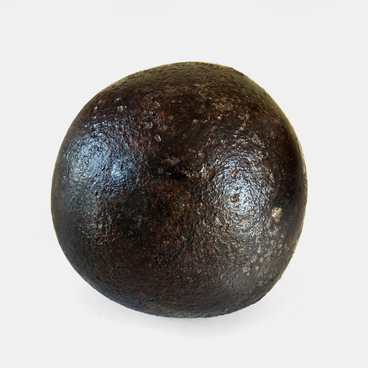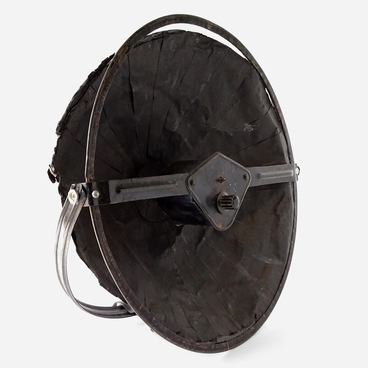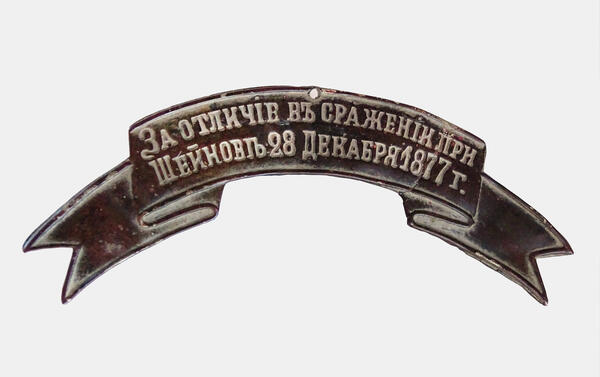
On 17 April 1878, the 1st Don Cossack Regiment was awarded the insignia on the headdress “For Distinction in the Battle of Sheynovo on 28 December 1877”.
The Battle of Sheynovo is one of the final battles of the Russian-Turkish War of 1877-1878. During the war of 1877, Sheynovo was part of a vast fortified camp set up by the Turks in the valley against the Shipka Pass.
When Pleven fell at the end of November 1877, the commander-in-chief of the Russian army, taking advantage of the fact that he had a significant number of troops freed, decided to urgently, despite the cold weather, to cross the Balkans and move to Adrianople and beyond. He was urged to do so by the extremely difficult situation of the detachments of Generals Gurko and Radetzky, who were already in the mountains. At the disposal of General Radetsky, who occupied the Shipka Pass, was, with the arrival of reinforcements from under Plevna, up to 45 thousand; however, even with such forces frontal attack of Turkish positions against the pass was risky and by the conditions of the terrain and tactical situation. Therefore, it was decided to send to the Turkish fortified camp two bypass columns: the eastern (about 19 thousand), under the command of Prince Svyatopolk-Mirsky, through the Trevnensky pass, and the western (16 thousand), under the command of General Skobelev 2nd, through the Imitliysky pass. At Radetsky himself remained on Shipka positions up to 11 thousand. Preparations for the winter campaign through the Balkans took a lot of time and were completed only by 24 December.
At this time, the Turkish troops against Radetzky were commanded by Wessel Pasha; the largest part of his forces occupied a fortified camp, while another part was located on the mountains.
On the morning of the 24th of December Sviatopolk-Mirsky’s column set out from the vicinity of Trevna and Drenov. Despite the fact that about 2 thousand Bulgarians were sent forward to clear the snow-covered road, the movement through the pass was so difficult that the field artillery had to return to Trevna, and the column was left with one mountain battery. On the 26th of December, about 5 o’clock in the afternoon, this column descended to the south side of the mountains. Its main forces: 19 battalions, 5 Cossack hundreds and 8 mountain guns gathered at the position near the village of Gyusovo.
Skobelev’s 2nd troops left the village of Toplish in the evening of 24 December, and when moving through the pass they met even greater difficulties than the western column, as they had to break through the snow debris, which in some places reached up to 2.16 m in height. Even here it was impossible to transport field artillery. In the morning of the 26th of December the advanced troops of the column came to the southern descent from the Balkans, but since it was necessary to knock out the Turkish detachments occupying the heights dominating over the descent, the vanguard (6 battalions) only by the evening had time to descend to the village of Imitlia; the main forces at this time were still stretched across the whole pass.
The fortified camp occupied by the Turks was about 7.5 kilometers in circumference and consisted of 14 redoubts, with infantry trenches in front and between them. The strategic importance belonged to the southern front of the camp, with the loss of which the Turks were deprived of their retreat route. The approaches to the camp from the east and west were equally disadvantageous for the attackers, as they had to advance 2-3 versts on a completely flat and open terrain.
In the morning of 27 December Svyatopolk-Mirsky led an attack on the eastern front and by 1 o’clock mastered the first line of fortifications, but he failed to take the second line. His flank detachment unhindered occupied Kazanlik and became on the way of retreat of Turks to Adrianople.
Skobelev’s vanguard on the 27th of December again had to dislodge the Turks from the heights, from where they were obstructing the movement of the rest of the western column with their fire. Although these detachments were thrown back, however Skobelev, due to the insignificance of his forces, which had time to descend from the mountains to the valley, did not dare to conduct a real attack on that day and limited himself to demonstrations. In the early morning of the 28th of December the Turks went on the offensive against the troops of the eastern column. All their onslaughts were not only repelled, but the Russians managed to seize the village of Shipka and several trenches. Further development of this success was impossible, because at this time (about 10 am) on the part of Skobelev attack has not yet begun.
Svyatopolk-Mirsky, having suffered considerable losses and used up a large amount of ammunition, considered his situation very difficult and sent a report to Radetsky. The latter, not seeing behind the dense fog covering the valley, the beginning of Skobelev’s offensive, decided to draw away part of the Turkish forces by frontal attack of their position. For this purpose, he assigned them seven battalions. At 12 o’clock in the afternoon they descended from Mount St. Nicholas; but further advance along the narrow and icy road, under the cross-artillery and rifle fire of the enemy, was accompanied by such heavy losses that they, having reached the first row of trenches, were forced to retreat.
Meanwhile, Skobelev at the beginning of the 11th hour of the morning began the offensive, directing the main attack on the south-western corner of the Sheynovskaya grove. After various vicissitudes his troops gained possession of this grove and broke into the middle of the fortified camp. At the same time Svyatopolk-Mirsky’s column renewed its attack on the eastern flank. About 3 o’clock in the afternoon Wessel Pasha, convinced of the impossibility of further resistance, decided to surrender. His troops, who were in the mountains, were also sent an order to lay down their arms. A large part of the Turkish cavalry, however, managed to escape.
Altogether 43 Tabor surrendered, with 93 guns. On the Russian side about 5,700 men were put out of action. The victory at Sheynovo had the most decisive consequences. With the capture of Wessel Pasha’s army there was no one to cover the shortest route to Adrianople and Constantinople, which, in connection with the defeat of the last forces of Suleiman Pasha’s army, pursued by the troops of General Gurko, made it impossible for Turkey to continue the war.