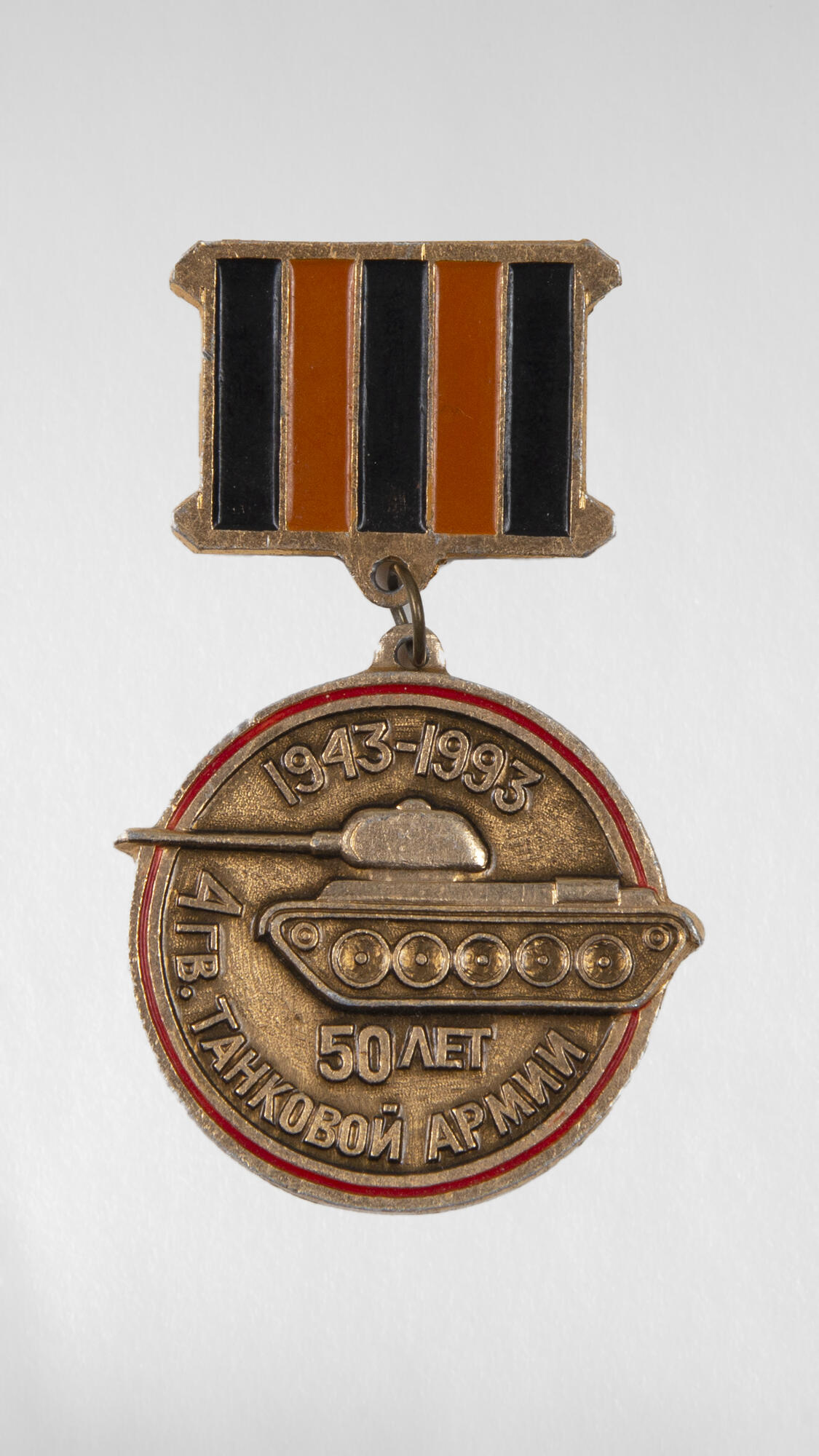


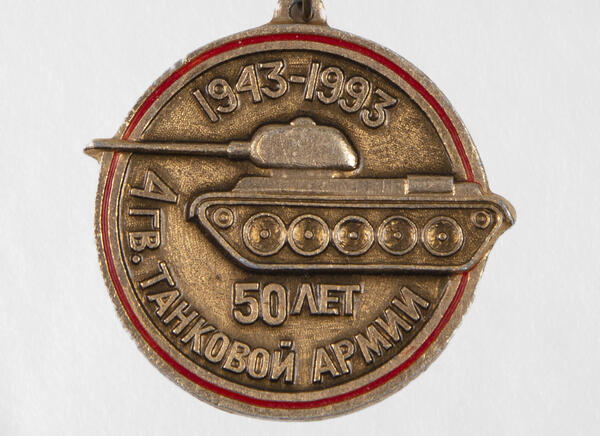
The collection of the Zimovniki Museum of Local History houses a badge, issued for the anniversary of the 4th Guards Tank Army in 1993. On the front side of the medal, there is a relief side image of the tank, which protrudes beyond the boundaries of the round medallion. At the top, there are the dates: 1943–1993. In addition, at the bottom there is the inscription “50 years of the 4th Guards Tank Army”. The medallion was attached to a rectangular block in black and orange with a suspender and a suspension ring.
The history of the 4th Tank Army began in July 1943 when the Supreme High Command issued an order to form a unit on the basis of the 19th cavalry corps in the Moscow Military District. It included the 11th and 30th Tank Corps, 6th Guards Mechanized Corps, as well as separate military units.
In March 1945 by the order of the People’s Commissariat of Defense of the Soviet Union the rank of “Guards” was added to the 4th Tank Army and the battle banner was awarded for the courage shown in fights for the Motherland and the skillful fulfillment of combat tasks.
The army participated in the liquidation of German Oppeln grouping and two days after that event, on March 24, 1945, attacked the Germans on the dangerous Leobschütz-Troppau direction. The Soviet soldiers fought fiercely, but managed to recapture only three to four kilometers from the enemy. Then the army commander introduced additional corps to reinforce the group. During the next three days the front line advanced as much as 10 kilometers, the Soviet troops surrounded the Germans and destroyed them.
However, the main battle, in which the 4th Guards Tank Army demonstrated its military training, was the battle for Berlin. During the operation, soldiers of the unit destroyed more than 43 thousand soldiers and officers of the enemy, captured more than 30 thousand Germans and seized more than a thousand guns and mortars. Thousands of soldiers of the 4th Guards Tank Army received orders and medals.
When the war ended, the army was initially in the Soviet occupation zone. In 1946, there was an order to transform the unit into a division, and in 1960 — into an all-armored tank army.
The history of the 4th Tank Army began in July 1943 when the Supreme High Command issued an order to form a unit on the basis of the 19th cavalry corps in the Moscow Military District. It included the 11th and 30th Tank Corps, 6th Guards Mechanized Corps, as well as separate military units.
In March 1945 by the order of the People’s Commissariat of Defense of the Soviet Union the rank of “Guards” was added to the 4th Tank Army and the battle banner was awarded for the courage shown in fights for the Motherland and the skillful fulfillment of combat tasks.
The army participated in the liquidation of German Oppeln grouping and two days after that event, on March 24, 1945, attacked the Germans on the dangerous Leobschütz-Troppau direction. The Soviet soldiers fought fiercely, but managed to recapture only three to four kilometers from the enemy. Then the army commander introduced additional corps to reinforce the group. During the next three days the front line advanced as much as 10 kilometers, the Soviet troops surrounded the Germans and destroyed them.
However, the main battle, in which the 4th Guards Tank Army demonstrated its military training, was the battle for Berlin. During the operation, soldiers of the unit destroyed more than 43 thousand soldiers and officers of the enemy, captured more than 30 thousand Germans and seized more than a thousand guns and mortars. Thousands of soldiers of the 4th Guards Tank Army received orders and medals.
When the war ended, the army was initially in the Soviet occupation zone. In 1946, there was an order to transform the unit into a division, and in 1960 — into an all-armored tank army.


