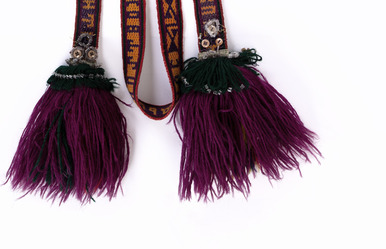
The costume consists of a shirt, poneva (waist clothes), coverall apron with sleeves, a complex headdress “soroka” and beaded ornaments. The fabric for almost all clothing items was produced domestically on simple peasant looms, and wool, hemp and linen yarns served as the raw material provided by their own households. The white homespun cloth was embellished with red or white threads of store-bought cotton, added in the process of weaving. That increased the value of the cloth in the eyes of peasants. The red or white threads often became the basis for textured weave and tabby patterns consisting of geometric or stylized vegetal figures. Multicolored checks on a black or dark blue background distinguished the woolen waist clothes of the women of the southern Russian governorates. This clothing called poneva was an exclusively women’s garment. The basis of a complex headdress “kichka” is a soft canvas cap with a quilted forehead part, which sets the shape of the whole outfit. The front and back parts of the headdress are abundantly decorated with embroidery of metal thread, beads, sequins, silk cords and ribbons. The costume is supplemented with multicolored beaded ornaments with geometric patterns — a necklace and a chain, on which a copper cross is suspended. Back ornaments could be attached to the chain — similar bands woven from wool and beads, to the ends of which tassels of bright store-bought wool were tied.
Festive costumes of a young recently married woman consisted of the most colorful and ornamented items of clothing. They were made of high-quality homespun cloth and supplemented with manufactured fabrics, webbing and ribbons purchased at fairs, which was quite expensive, so not every peasant family could afford it. In some cases, family property was pawned in order to buy the best for the young woman.
To emphasize a woman’s beauty and youth, the decorative patterns of fabrics and clothing were enriched with contrasting colors, with red being the most prominent among them, of course. In addition to the color scheme, the pattern on a young woman’s costume was also distinguished by a highly dense and rich pattern, which, as a rule, could not be found in the clothes of women of other ages and statuses. The most festive version of the costume was worn by women on the second day of their wedding and on the most important holidays of their village and family. As soon as women had children, they stopped wearing their best clothes, passing them on to younger female relatives entering their prime.