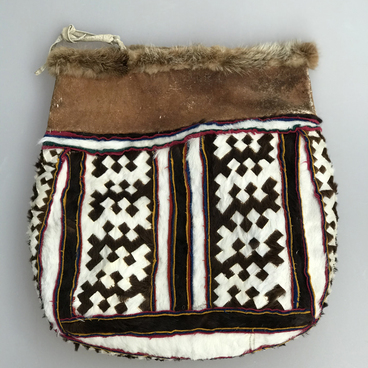


The bag, which is called “tutchan” in the Khanty language, was traditionally worn and made only by women. Such bags for storing handicraft items were essential for any housewife in the culture of the indigenous northern peoples. Each woman had more than ten bags in which she kept various items.
“Tutchan” was opulently decorated. Such bag decoration demonstrated the skill of its owner. That is why the girls learned to sew tutchans from childhood. Young craftswomen stored pieces of fabric, fur, needles and threads there, with which they made dolls and doll dresses.
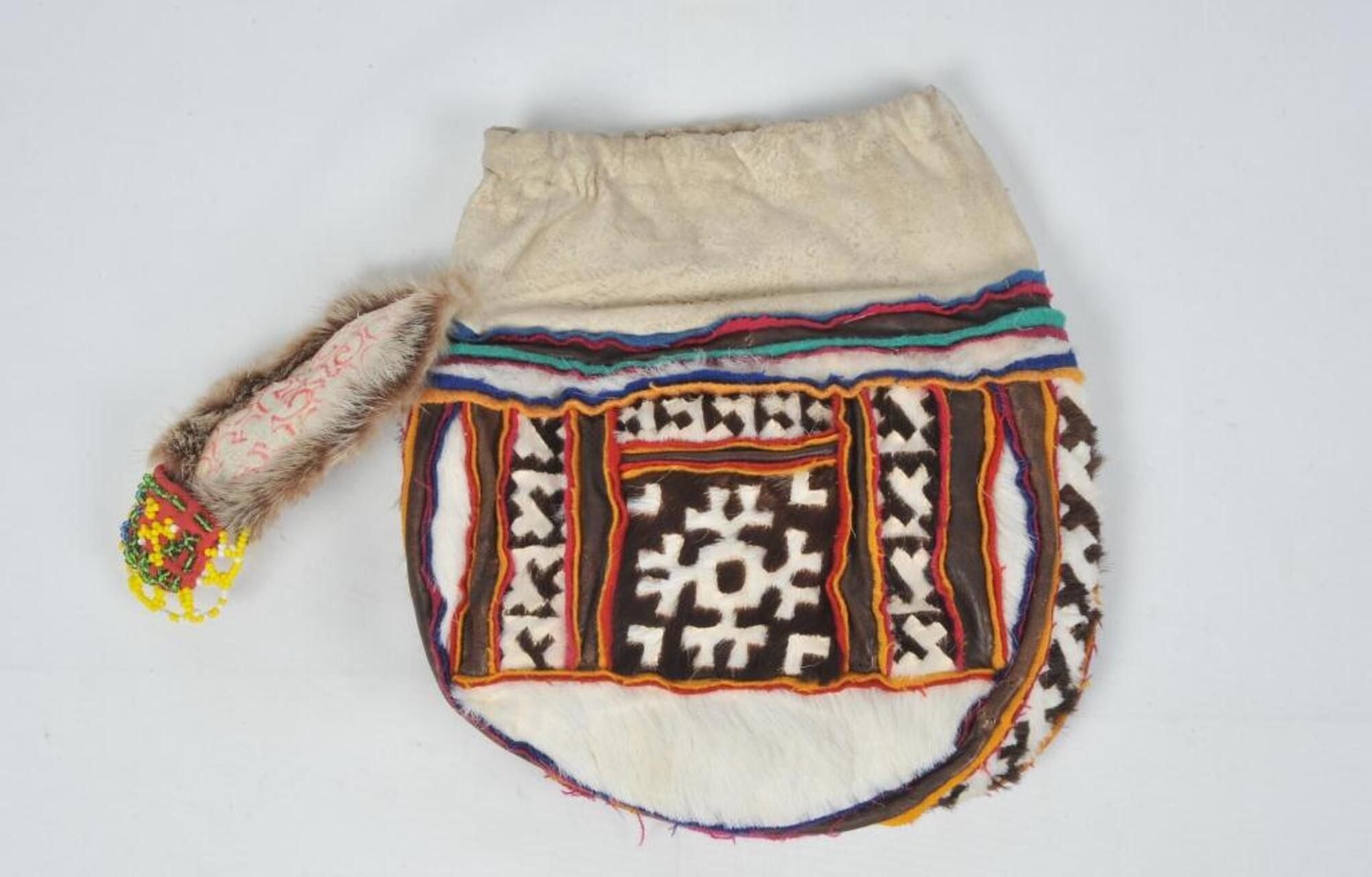
As a rule, the front and back sides of the bag were assembled from a large number of separate pieces, simple and ornamented ones. The central part was decorated in a special way. The women used either linear-geometric ornament or a stylized image of an animal, for example, a deer, or some household item. Wide pieces of dark and light short-haired fur were needed, since the central part of the bag was quite large. The skin from the forehead of a deer or calf was often used for this purpose.
The contour of the central image was framed with leather and patterned ribbons made of fur. The ribbon, in its turn, was trimmed with colored cloth. In some bags, the central ornament took almost the entire surface of the bag and was separated from the lateral side by one or two contrasting ribbons of fur.
The bags were additionally decorated with a fringe made of deerskin, which was called a “rovduga”. Beads were strung on it, chains and metal plates were attached, after which the fringe was sewn to the top of the item.
The bag from the collection is called “tutchan hir”, which translates as “forest bag”. It was created for long-term storage or transportation of things during migrations. It was used to store small things for handicrafts, sewing, clothes, and even shoes.
The tutchan is a small bag made of deerskin. Several parts are made of cloth and deer fur. Squirrel fur is sewn to the upper edge. The tutchan is opulently decorated with fur mosaics. All its details are sewn with threads that had been made of deer tendons according to ancient technology.
“Tutchan” was opulently decorated. Such bag decoration demonstrated the skill of its owner. That is why the girls learned to sew tutchans from childhood. Young craftswomen stored pieces of fabric, fur, needles and threads there, with which they made dolls and doll dresses.
As a rule, the front and back sides of the bag were assembled from a large number of separate pieces, simple and ornamented ones. The central part was decorated in a special way. The women used either linear-geometric ornament or a stylized image of an animal, for example, a deer, or some household item. Wide pieces of dark and light short-haired fur were needed, since the central part of the bag was quite large. The skin from the forehead of a deer or calf was often used for this purpose.
The contour of the central image was framed with leather and patterned ribbons made of fur. The ribbon, in its turn, was trimmed with colored cloth. In some bags, the central ornament took almost the entire surface of the bag and was separated from the lateral side by one or two contrasting ribbons of fur.
The bags were additionally decorated with a fringe made of deerskin, which was called a “rovduga”. Beads were strung on it, chains and metal plates were attached, after which the fringe was sewn to the top of the item.
The bag from the collection is called “tutchan hir”, which translates as “forest bag”. It was created for long-term storage or transportation of things during migrations. It was used to store small things for handicrafts, sewing, clothes, and even shoes.
The tutchan is a small bag made of deerskin. Several parts are made of cloth and deer fur. Squirrel fur is sewn to the upper edge. The tutchan is opulently decorated with fur mosaics. All its details are sewn with threads that had been made of deer tendons according to ancient technology.