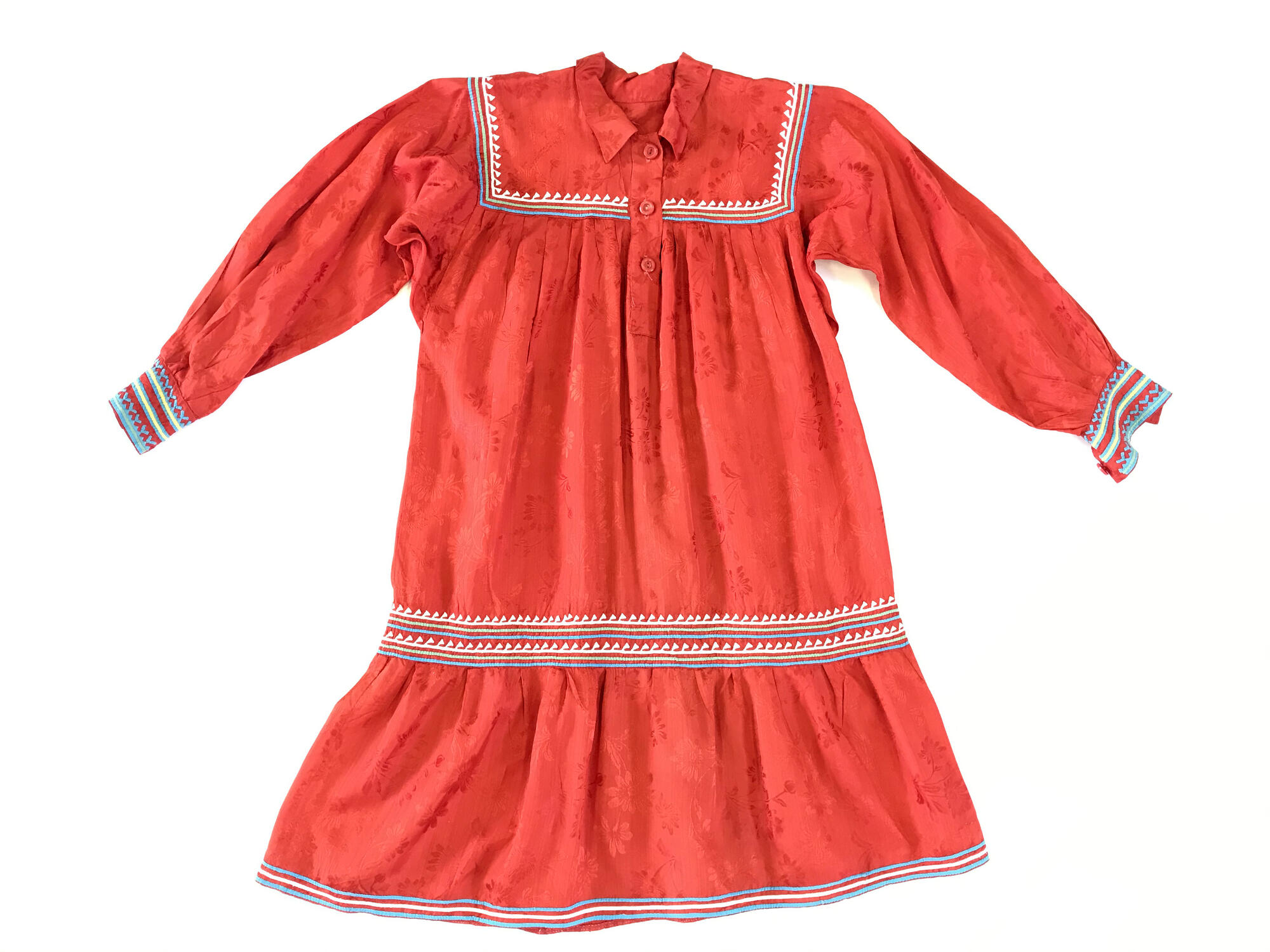


The traditional women’s costume of the Khanty people is not only practical, but also beautiful. The national dress, which is called “yernas” in the local dialect, is sewn from a plain fabric, for example, from chintz, satin, or flannel.
In the old days, northern craftswomen wove cloths from nettles. The plant was picked and dried in autumn, when leaves fell from trees. After that, the nettle was divided into fibers and crushed with a mallet to make them elastic. Threads were woven, from which the fabric was then made.
National dresses are decorated with monochromatic strips of fabric made of different materials. They are sewn on the dress closely to each other — so the cuffs, flaps, and hemline have colored borders. According to legend, this trimming marks the border between a person and the outside world and protects from the spirits of diseases. Between the strips is a patterned ribbon with a small ornament made in the application technique. All parts of the dress are decorated with some pattern and strips of fabric and only then sewn together.
To create a traditional dress, craftswomen mostly use white, red, green, yellow, and blue. Each of them has a symbolic meaning. White symbolizes snow, red symbolizes fire, yellow is a symbol of life, green means taiga, and blue symbolizes water and sky.
The production time of one yernas depends on the talent and experience of the craftswoman. One of the beliefs of the Khanty people says that when a woman is busy with handicraft, her thoughts are “sewn” into the seams and ornaments of the future thing. Therefore, the craftswomen try to think only about the good things while working.
The dress is traditionally worn with a necklace. It is made from beads, decorated with Khanty geometric ornaments. Such a necklace is an amulet for its owner and additional protection from evil spirits.
In the museum, you can see a traditional national dress (yernas). It is a so-called shirt dress with a wide ruffle at the hemline and a turn-down collar, sewn without shoulder seams. There is a cut on the chest that is fastened with three buttons. The collar, hem, and cuffs are decorated with white, light turquoise and blue stripes in the technique of applique fabric.
In the old days, northern craftswomen wove cloths from nettles. The plant was picked and dried in autumn, when leaves fell from trees. After that, the nettle was divided into fibers and crushed with a mallet to make them elastic. Threads were woven, from which the fabric was then made.
National dresses are decorated with monochromatic strips of fabric made of different materials. They are sewn on the dress closely to each other — so the cuffs, flaps, and hemline have colored borders. According to legend, this trimming marks the border between a person and the outside world and protects from the spirits of diseases. Between the strips is a patterned ribbon with a small ornament made in the application technique. All parts of the dress are decorated with some pattern and strips of fabric and only then sewn together.
To create a traditional dress, craftswomen mostly use white, red, green, yellow, and blue. Each of them has a symbolic meaning. White symbolizes snow, red symbolizes fire, yellow is a symbol of life, green means taiga, and blue symbolizes water and sky.
The production time of one yernas depends on the talent and experience of the craftswoman. One of the beliefs of the Khanty people says that when a woman is busy with handicraft, her thoughts are “sewn” into the seams and ornaments of the future thing. Therefore, the craftswomen try to think only about the good things while working.
The dress is traditionally worn with a necklace. It is made from beads, decorated with Khanty geometric ornaments. Such a necklace is an amulet for its owner and additional protection from evil spirits.
In the museum, you can see a traditional national dress (yernas). It is a so-called shirt dress with a wide ruffle at the hemline and a turn-down collar, sewn without shoulder seams. There is a cut on the chest that is fastened with three buttons. The collar, hem, and cuffs are decorated with white, light turquoise and blue stripes in the technique of applique fabric.


