In the Nazi-occupied city of Rovno, Nikolai Ivanovich Kuznetsov operated under the meticulously crafted identity of Oberleutnant Paul Siebert, a German officer. This convincing cover allowed him to infiltrate the highest levels of the German occupation administration, gather critical intelligence, and carry out acts of sabotage against the enemy. The legend was so credible that Kuznetsov moved freely among German officers, frequented entertainment venues, and even joined hunting parties.
According to his legend, Oberleutnant Paul Siebert had served in occupied Poland until March 1940. His unit was then transferred westward, where he took part in multiple battles during the German campaign in France. On June 23, 1940, he suffered a concussion and shrapnel wounds from a grenade explosion. After several weeks in a military hospital, he was reassigned to a convalescent unit in Berlin. By that time, Siebert had already been commissioned as an officer — he received his lieutenant’s certification on April 20, 1940.
Following Germany’s invasion of the Soviet Union in June 1941, Siebert was recalled to active duty. Still not fully recovered, he was instead offered a non-combat role as an emergency commissioner attached to the Economic Command in frontline territories — thus explaining his presence in Rovno.
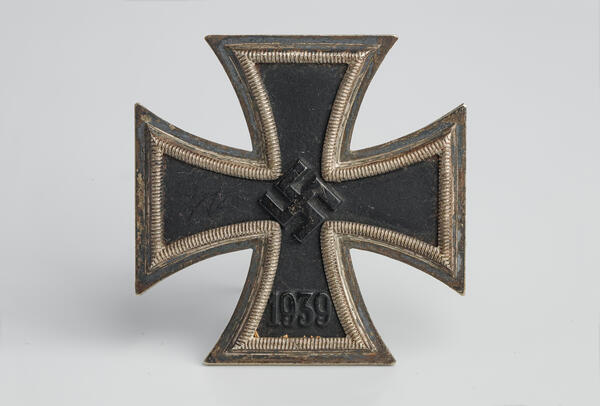
The Siebert persona was further bolstered by a prestigious decoration: the Iron Cross, 1st Class, awarded on August 4, 1940. In 1975, a replica of this medal was donated to the Nikolai Kuznetsov Museum by Leonid Dmitrievich Lukoyanov, Kuznetsov’s classmate from the Talitsa Forestry College.
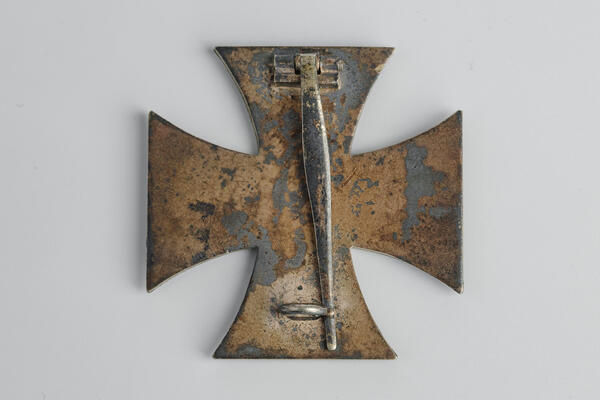
The Iron Cross featured a black enameled cross with a raised, convex swastika at its center and the date “1939” beneath it. A thin silver border outlined the black field, and the reverse bore a simple flat metal clasp with a hook for attachment.
Originally instituted in 1813 during the Napoleonic Wars, the Iron Cross became Germany’s most distinguished military decoration throughout the 19th and 20th centuries — until the end of World War II. Awarded for battlefield bravery, exceptional leadership, or successful planning of combat operations, it was notable not only for its martial prestige but also for its democratic nature: unlike many other honors, it could be bestowed upon both high-ranking officers and ordinary soldiers who demonstrated extraordinary courage.
Adolf Hitler reinstated the award in 1939, adding the swastika to its design. The Iron Cross 1st Class could only be conferred upon individuals who had already received the Iron Cross 2nd Class (or its equivalent badge).
Criteria for the award varied by service branch. Ground troops typically needed to complete three to five especially difficult missions while displaying conspicuous bravery. Fighter pilots qualified after scoring five aerial victories (each counted as one “point”). In bomber aviation, the decoration was granted for completing 25 combat sorties. Naval personnel earned it either by sinking enemy vessels totaling at least 50,000 tons displacement or by fulfilling three to five high-risk missions with exceptional valor.