

The watercolorist Valentin Zhdanov, who created many murals and decorative works, was born in the Perm Oblast. He is a member of the Artists’ Union of Russia. He graduated from the Graphic Arts Faculty of the Nizhny Tagil Pedagogical Institute. Zhdanov was awarded a diploma of the Russian Academy of Arts for achievements in the field of contemporary fine art.
The world that Valentin Zhdanov creates in his paintings is quite authentic, but at the same time enhanced, and filled with various reflections and comparisons of recent and long-gone times. The pictorial manner of Valentin Vasilyevich is unhurried. He paints broadly and smoothly, generalizes details, achieves color cohesion and constructs the space. The reality reveals itself gradually and steadily, as it does in nature. The artist’s perception of the world is diverse in emotional expression. In his strive to make mundane things poetic, we can see the desire to find something stable and natural that would reflect the meaning of sanity or disharmony of being. Prior to turning to various themes, subjects, and artistic means, Zhdanov works a lot on life studies and sketches. The artist draws inspiration from nature, from his comprehension of its harmony, and in it he also sees a unique feature of our time.
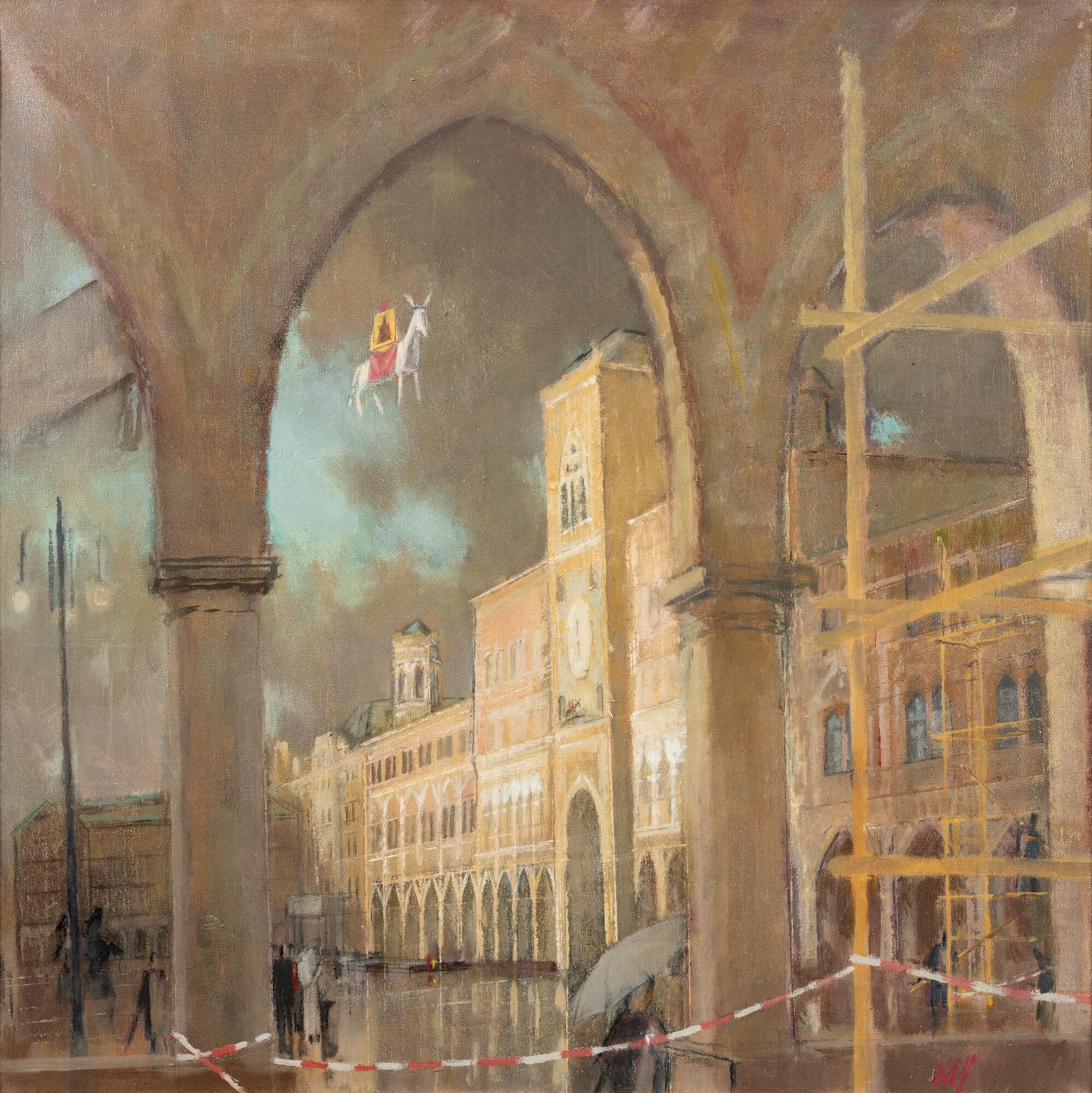
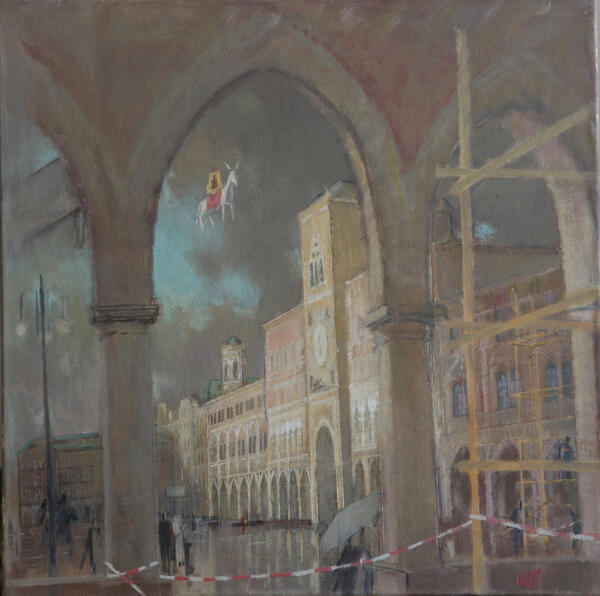
The canvas “The Donkey Above Yoshkar-Ola” was created during the All-Russian plein-air “Mari El in the mirror of art: a contemporary’s view”. At the end of the plein-air session, his work won the Grand Prix of the competition. The picture is metaphorical: city dwellers and tourists do not see the famous donkey in its usual place — in the clock of the sculptural composition “The Appearance of the Icon of The Three Handed Mother of God”. Instead, it walks through the clouds in the sky to bring the icon to the city church. Zhdanov adds a complex spiritual subtext to the pictorial structure of the painting and the chosen artistic means. The artist builds the perspective in such a way that we see the square with an urban architectural ensemble through the vertical pillars with semicircular arches. On the left, closer to the viewer, there are scaffoldings; a tape tied at the bottom of this temporary structure and pillars restricts the area. The square itself has just seen rain; the arched passages of the gallery are reflected in the puddles. The figures of the people in the foreground are only slightly outlined, as they are minor characters. The color scheme includes grayish-blue and soft sand colors in the center.
The world that Valentin Zhdanov creates in his paintings is quite authentic, but at the same time enhanced, and filled with various reflections and comparisons of recent and long-gone times. The pictorial manner of Valentin Vasilyevich is unhurried. He paints broadly and smoothly, generalizes details, achieves color cohesion and constructs the space. The reality reveals itself gradually and steadily, as it does in nature. The artist’s perception of the world is diverse in emotional expression. In his strive to make mundane things poetic, we can see the desire to find something stable and natural that would reflect the meaning of sanity or disharmony of being. Prior to turning to various themes, subjects, and artistic means, Zhdanov works a lot on life studies and sketches. The artist draws inspiration from nature, from his comprehension of its harmony, and in it he also sees a unique feature of our time.
The canvas “The Donkey Above Yoshkar-Ola” was created during the All-Russian plein-air “Mari El in the mirror of art: a contemporary’s view”. At the end of the plein-air session, his work won the Grand Prix of the competition. The picture is metaphorical: city dwellers and tourists do not see the famous donkey in its usual place — in the clock of the sculptural composition “The Appearance of the Icon of The Three Handed Mother of God”. Instead, it walks through the clouds in the sky to bring the icon to the city church. Zhdanov adds a complex spiritual subtext to the pictorial structure of the painting and the chosen artistic means. The artist builds the perspective in such a way that we see the square with an urban architectural ensemble through the vertical pillars with semicircular arches. On the left, closer to the viewer, there are scaffoldings; a tape tied at the bottom of this temporary structure and pillars restricts the area. The square itself has just seen rain; the arched passages of the gallery are reflected in the puddles. The figures of the people in the foreground are only slightly outlined, as they are minor characters. The color scheme includes grayish-blue and soft sand colors in the center.