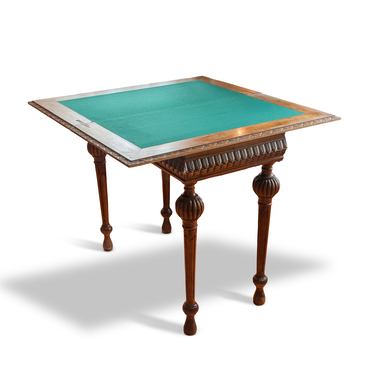
The pier glass is housed in the Apartment-Museum of the Ulyanov family. It is enclosed in a wooden frame in the shape of an arch, which is decorated with a wide shallow groove. A folding card table, which is designed for playing cards, serves as a pedestal. The table top consists of three tightly connected boards put into a frame. The end side of the table is profiled with carvings in the form of vertical grooves. The table stands on four chiseled legs.
The history of the trumeau mirror goes back to the Baroque period, in the 17th–18th centuries. Back then there was a fashion for mirrors, which sometimes reached more than two meters in height. A table with a mirror performed not only a practical function, but also demonstrated the level of prosperity of its owner, and was considered a symbol of luxury and wealth. In those days, furniture was made of precious woods or overlays were created from expensive materials on top of cheap ones.
The first dressing tables were richly decorated with bronze and gold patterns, and Asian motifs were popular. They looked like works of art. Small mirrors stood on special stands or were mounted in a hinged lid.
In Russia, such items appeared by the 18th century. The reason for the late adaptation of this furniture was a biased attitude towards the mirror in Russia. For a long time, mystical properties were attributed to them and therefore mirrors were hidden in a box or covered with a cloth.
Mirrors were widely used in the home interior during the reign of Peter the Great. Since then, dressing tables have become commonplace.
At the beginning of the 20th century, tables called psyché were especially fashionable. The mirror in this model had a special design: it could be tilted at different angles and people had the opportunity to look at themselves from different sides. Psyché was often associated with femininity. For example, in the family of Mikhail Afanasyevich Bulgakov, this object was called “Psyche” — after the Greek goddess.
“I had to break into your Psyche (sorry! But what to do?). I broke into it and was stunned to see hundreds of paper pieces in candy boxes. First of all, I tried to guess the system by which they are stacked, but I wasn’t able to. A pack of ‘Nile’, a pack of rent, an old Torgsin book, a pack of electrical bills, an invitation ticket to the Bolshoi Theater. The House of creativity in Yalta, the housekeeper’s account book, a receipt for a registered letter… My gods! What is waiting for me?! Sympathize with me, Luy!”, M.A. Bulgakov wrote to his wife when he was forced to look for documents in her belongings.