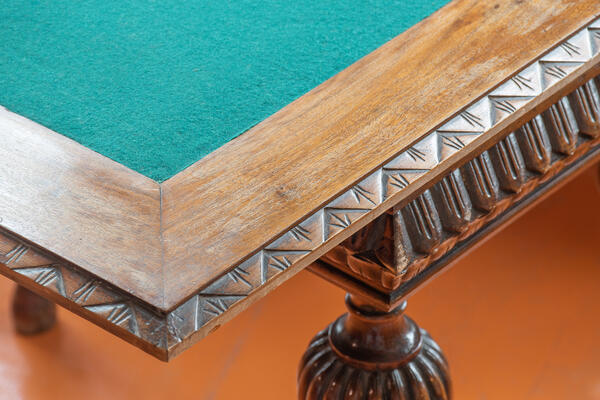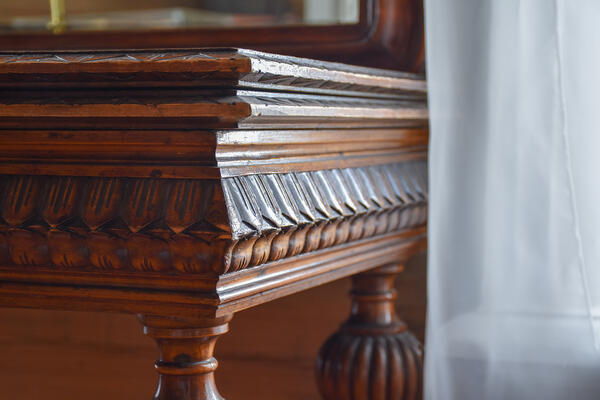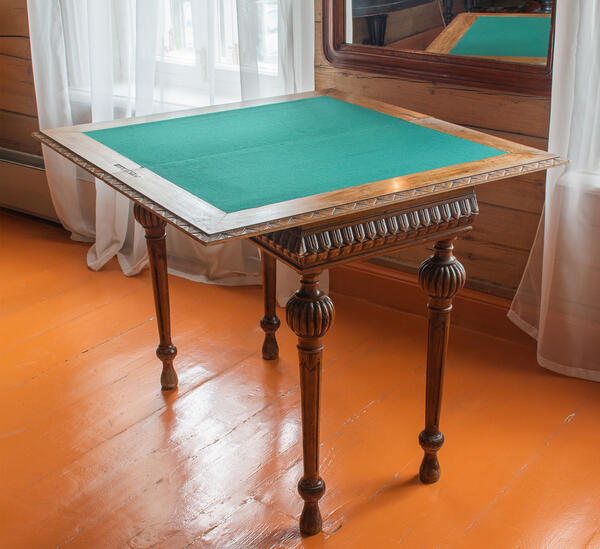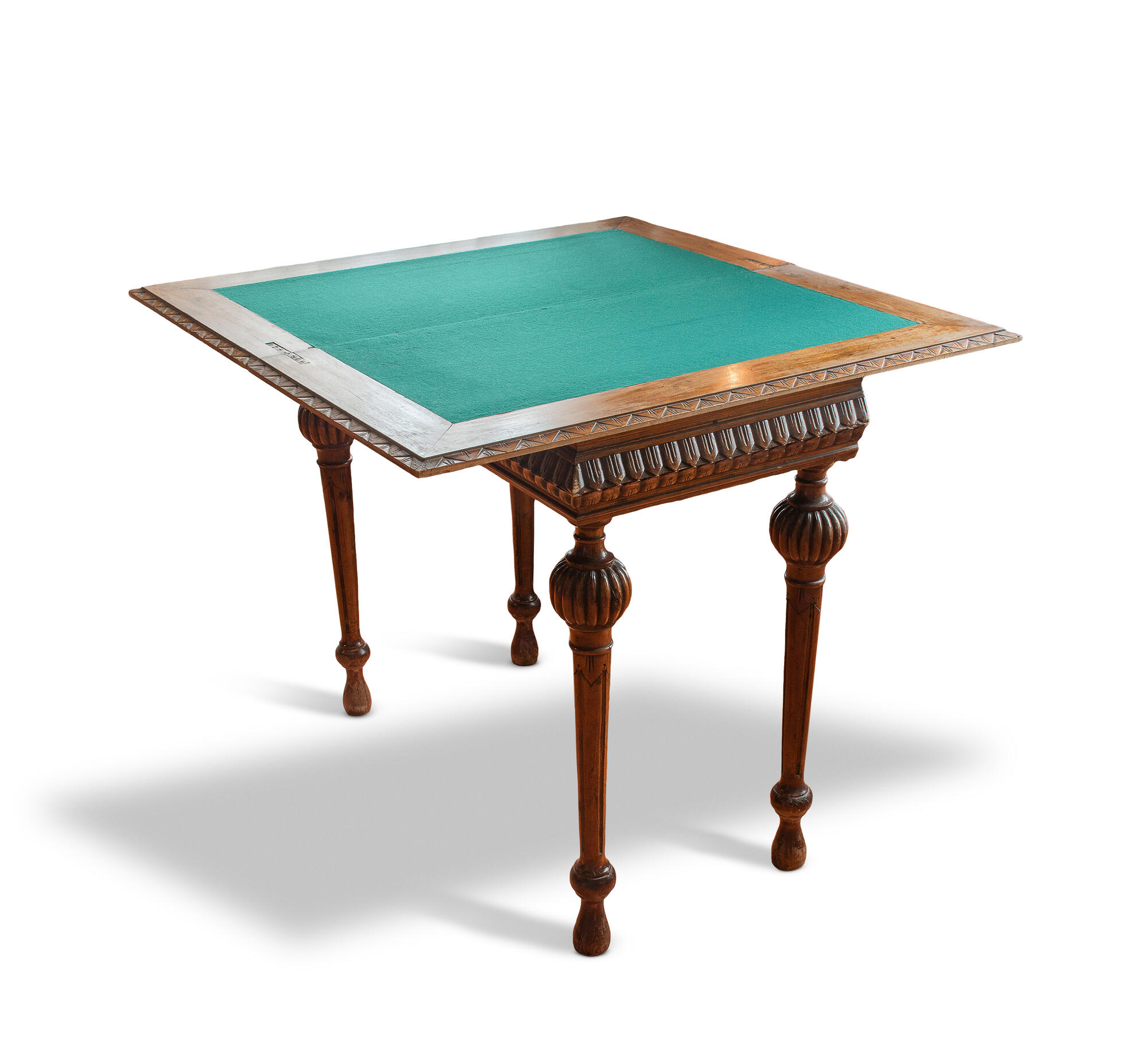


The collection features a card table. Its upper board is square in shape, covered with green cloth, profiled along the perimeter. It folds in the middle, hiding the side with the cloth and forming a console table. The frame of the table is rectangular, decorated with relief carvings. The table stands on four chiseled legs.
This table was designed for playing cards. In Russian it is also called a L’Hombre table after the game of the same name — L’Hombre. According to the rules, the game was intended for three to six players.
A card table often had a square or rectangular top, less often it was triangular or pentagonal. For ease of use and storage, its countertop was folded. There was no lower crossbar in the design of this piece of furniture so that nothing would interfere with the players’ legs.
The first folding table for playing cards was designed in Spain in the 16th century, then this furniture became popular in France and England. In Russia, card games were introduced in the middle of the 17th century, and at the same time the phrase “L’Hombre table” was also invented.
In pre-Petrine Russia, playing cards were banned because Peter the Great was against them. The cards gained popularity under Catherine II, including the game L’Hombre, which was originally called gomber.
Almost every noble house had card tables. During the day they served as pier tables, and in the evening they were placed in the living room.
The surface of the tabletop was upholstered with green cloth so that the cards would not slip. There was chalk and a brush next to each player. Calculations were written with chalk directly on the cloth, bets were fixed and parties were noted down. Special round brushes were used to clean the fabric from chalk.
For the houses of the aristocracy, card tables were custom-made. They were created of precious woods, inlaid with gold, ivory and precious stones.
Over the years of the card table’s existence, a
variety of designs have been developed, but two of them turned out to be the
most viable. In the first version, an additional support for the square
tabletop was a special leg that moved away when unfolding. In the second case,
there was a mechanism that rotated the countertop by 90 degrees. Both models became a rectangular table when folded.