#1
Mirror with engraving, casting horseman and bird
#2
#3
#4
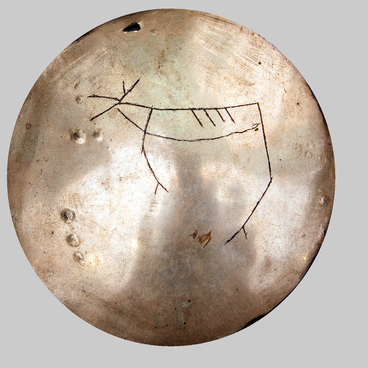
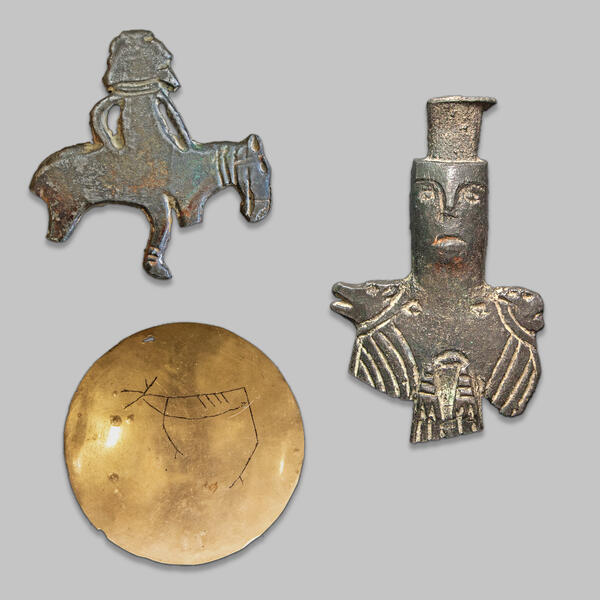
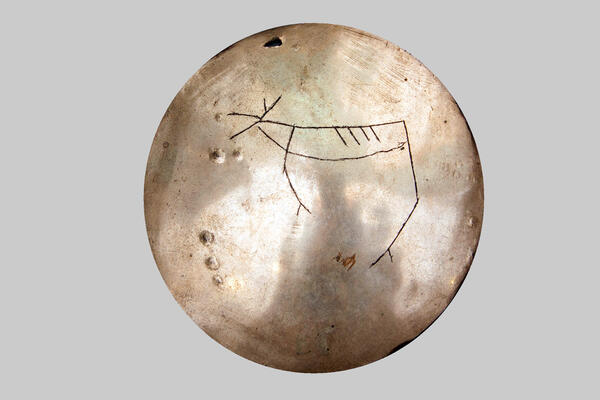
The bronze disk, or mirror, an engraved image of a deer got into the Tobolsk Provincial Museum along with other cult items from the Istyatskiy Trove, an archaeological monument related to the Kulay culture. Among the finds, there were 75 flat-curved plaques made of white bronze, two Chinese mirrors, five images of birds, five figures of horsemen, twelve wolf figures, and one openwork pendant with the image of a horned predator.
The oldest mirrors, such as polished bronze disks, were originally common in the Mediterranean. Mirror from the collection of the Tobolsk Museum was among the items of the Istyatskiy Trove found in 1886 by peasant Trifonov 10 kilometers from Istyatskiye Yurty in Tobolsk province. Later, when the curator of the museum Nikolai Lytkin returned to the site of the find, he did not find any additional items there. It was assumed that the territory of the Istyatskiy Trove is the remains of an ancient sacrificial site or sanctuary that belonged to one of the local ancient Ugric tribes.
Metal, mostly bronze mirrors in the culture of the population of the Eurasian steppes and forest steppes appeared long before the Iron Age. In Southern Siberia, the production of local mirrors began in the middle of the 2nd Millennium BC and continued on a large scale during the Karasuk (12th - 8th centuries BC) and Tagar (7th - 3rd centuries BC) periods.
Mirrors with a handle cast together with a disk were common in the East starting from the Bronze Age. The main part of the mirror, according to the terminology proposed by researcher Tatyana Kuznetsova, is characterized by the term ‘disk’, that is, a flat or convex-concave round plate. Many disks that were identified as mirrors or plaques have drawings that are characteristic of the local culture. Most often, these are engravings made with a sharp object, most likely with a knife.
A separate group is formed by engravings on mirrors and plaques of the Istyatskiy Trove, three of which depict horsemen not peculiar to the North of Western Siberia. The other six are engraved with birds of prey with open wings, as well as ‘beavers’, and elk. The iconography of zoomorphic characters is much simpler. Animals either do not lend themselves to identification, or depict conventional ‘beavers’ with a characteristic tail shaded with an oblique grid.
The oldest mirrors, such as polished bronze disks, were originally common in the Mediterranean. Mirror from the collection of the Tobolsk Museum was among the items of the Istyatskiy Trove found in 1886 by peasant Trifonov 10 kilometers from Istyatskiye Yurty in Tobolsk province. Later, when the curator of the museum Nikolai Lytkin returned to the site of the find, he did not find any additional items there. It was assumed that the territory of the Istyatskiy Trove is the remains of an ancient sacrificial site or sanctuary that belonged to one of the local ancient Ugric tribes.
Metal, mostly bronze mirrors in the culture of the population of the Eurasian steppes and forest steppes appeared long before the Iron Age. In Southern Siberia, the production of local mirrors began in the middle of the 2nd Millennium BC and continued on a large scale during the Karasuk (12th - 8th centuries BC) and Tagar (7th - 3rd centuries BC) periods.
Mirrors with a handle cast together with a disk were common in the East starting from the Bronze Age. The main part of the mirror, according to the terminology proposed by researcher Tatyana Kuznetsova, is characterized by the term ‘disk’, that is, a flat or convex-concave round plate. Many disks that were identified as mirrors or plaques have drawings that are characteristic of the local culture. Most often, these are engravings made with a sharp object, most likely with a knife.
A separate group is formed by engravings on mirrors and plaques of the Istyatskiy Trove, three of which depict horsemen not peculiar to the North of Western Siberia. The other six are engraved with birds of prey with open wings, as well as ‘beavers’, and elk. The iconography of zoomorphic characters is much simpler. Animals either do not lend themselves to identification, or depict conventional ‘beavers’ with a characteristic tail shaded with an oblique grid.
#5
Date: 5th century BC - 5th century AD
Technique: bronze, casting, forging
Dimensions: 8.9×9 cm
Collection: Archeology
Copyright: Tyumen Province State Autonomous Cultural Institution ‘Tyumen Museum and Educational Association’, Structural Division ‘Tobolsk Historical and Architectural Museum Reserve’
Goskatalog Number: 3466968
Technique: bronze, casting, forging
Dimensions: 8.9×9 cm
Collection: Archeology
Copyright: Tyumen Province State Autonomous Cultural Institution ‘Tyumen Museum and Educational Association’, Structural Division ‘Tobolsk Historical and Architectural Museum Reserve’
Goskatalog Number: 3466968
#6
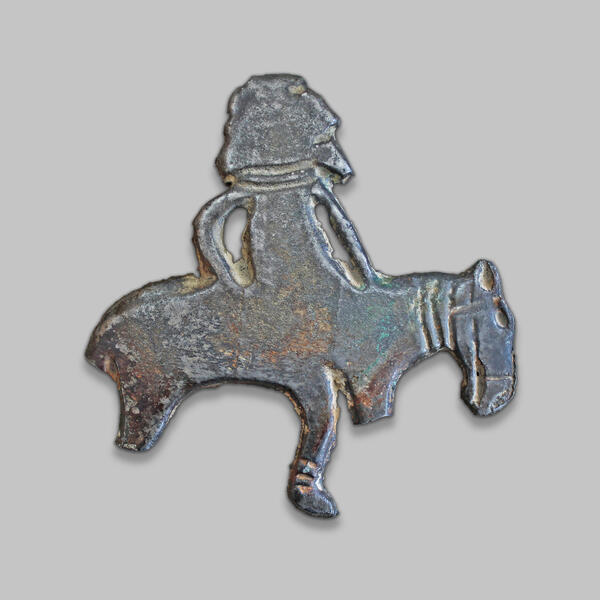
Flat casting in the form of a horseman
#7
#8
Flat casting in the form of a horseman belongs to the cult objects of the Istyatsky Trove. It was found during the clearing of the post road in 1886, presumably on the remains of a sacrificial sanctuary. This territory belonged to one of the ancient Ugric tribes that lived near the Istyatskiye Yurty in the Tobolsk province. The Istyatsky Trove belonged to the shaman of the tribe. In addition to the casting of a horseman, 75 plaques with drawings, figures of anthropomorphic birds, and broken bronze wolves were found in it. The hoards of people of the Kulai culture of the Early Iron Age, which are found in the taiga zone, were characterized by a variety of bronze images.
In the mythology of the Khanty and Mansi peoples, a horseman symbolizes Mir-Susne-Hum, i.e. ‘a man observing the world’, the seventh son of the God Numi-Torum, the mediator between heaven and people. On his white eight-winged horse, he rides the earth at the height of the clouds. He is the ‘King of the Walking Clouds’. When Mir-Susne-Hum descends to the ground, silver plates must be placed under the feet of his horse. Its zoomorphic appearance is a river goose.
Legend has it that Mir-Susne-Hum was born between heaven and earth when his mother Kaltasch-Ekva was lowered from the sky in a silver cradle. That is why similarly to Kaltash-Ekva, he is addressed with pleas for the protection of children. Mir-Susne-Hum wanted to see his father, and his clever mother arranged for Numi-Torum to see Mir-Susne-Hum before his older brothers. He was the first to tie his wonderful horse to the hitching post at his father’s house. In this way, he received a rank that did not belong to him, a heroic name, and defended his right to primacy among his brothers in the fight against Polum-Torum. It is said that when Polum-Torum refused to recognize the primacy of Mir-Susne-Hum, Numi-Torum ordered the hair of his rivals to be tied and the brothers placed on a winged horse. Who screams in pain first will lose the right to a heroic name. Polum-Torum did not pass the trial. He only got part of the name of the Supreme God.
At the behest of the father, Mir-Susne-Hum observes the lives of people, takes care of them, acts as an intermediary between people and the gods, and transmits the orders of his heavenly father. In the Northern Khanty and Mansi, he listens to the requests of shamans, provides strength and stability of the home and family, and helps people recover from diseases. Therefore, Mir-Susne-Hum was sacrificed at the birth of a child, at marriage, during illness, and before a long journey given the fact that he himself was the wandering god.
In the mythology of the Khanty and Mansi peoples, a horseman symbolizes Mir-Susne-Hum, i.e. ‘a man observing the world’, the seventh son of the God Numi-Torum, the mediator between heaven and people. On his white eight-winged horse, he rides the earth at the height of the clouds. He is the ‘King of the Walking Clouds’. When Mir-Susne-Hum descends to the ground, silver plates must be placed under the feet of his horse. Its zoomorphic appearance is a river goose.
Legend has it that Mir-Susne-Hum was born between heaven and earth when his mother Kaltasch-Ekva was lowered from the sky in a silver cradle. That is why similarly to Kaltash-Ekva, he is addressed with pleas for the protection of children. Mir-Susne-Hum wanted to see his father, and his clever mother arranged for Numi-Torum to see Mir-Susne-Hum before his older brothers. He was the first to tie his wonderful horse to the hitching post at his father’s house. In this way, he received a rank that did not belong to him, a heroic name, and defended his right to primacy among his brothers in the fight against Polum-Torum. It is said that when Polum-Torum refused to recognize the primacy of Mir-Susne-Hum, Numi-Torum ordered the hair of his rivals to be tied and the brothers placed on a winged horse. Who screams in pain first will lose the right to a heroic name. Polum-Torum did not pass the trial. He only got part of the name of the Supreme God.
At the behest of the father, Mir-Susne-Hum observes the lives of people, takes care of them, acts as an intermediary between people and the gods, and transmits the orders of his heavenly father. In the Northern Khanty and Mansi, he listens to the requests of shamans, provides strength and stability of the home and family, and helps people recover from diseases. Therefore, Mir-Susne-Hum was sacrificed at the birth of a child, at marriage, during illness, and before a long journey given the fact that he himself was the wandering god.
#9
Date: 5th century BC - 5th century AD
Technique: bronze, casting
Place: Middle Irtysh Region, Russia
Dimensions: 10.8×9.5 cm
Collection: Archeology
Copyright: Tyumen Province State Autonomous Cultural Institution “Tyumen Museum and Educational Association”, Structural Division “Tobolsk Historical and Architectural Museum Reserve”
Goskatalog Number: 3467261
Technique: bronze, casting
Place: Middle Irtysh Region, Russia
Dimensions: 10.8×9.5 cm
Collection: Archeology
Copyright: Tyumen Province State Autonomous Cultural Institution “Tyumen Museum and Educational Association”, Structural Division “Tobolsk Historical and Architectural Museum Reserve”
Goskatalog Number: 3467261
#10
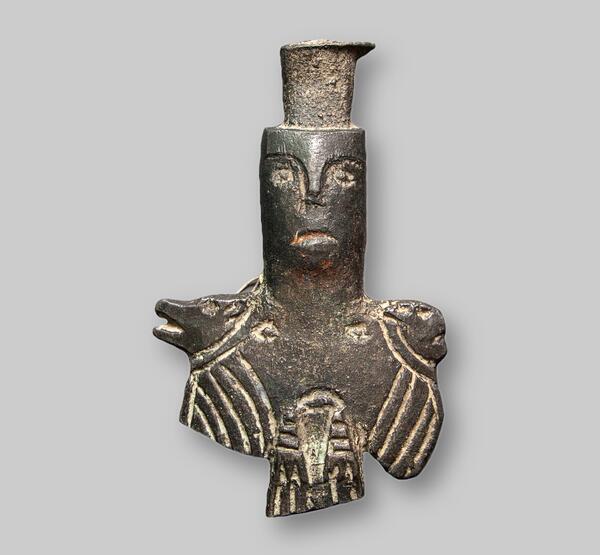
Bird casting
#11
#12
The collection of the Tobolsk Provincial Museum has a flat casting in the form of a bird with a human head. It is an element of an archaeological monument, the Istyatskiy Trove, containing cult objects of the Iron Age. It was found when clearing the ditch on post road near Istyatskiye Yurty in Tobolsk province.
The casting is made of bronze. The master cut the head straight. The contour of the face merges with the neck. On one shoulder of the bird, he cast a relief image of a bear, and an unknown animal on the other. On the chest, the master made a relief drawing, as well as stripes that imitate the wings and tail of a bird.
Researchers assumed that the Istyatskiy Trove, part of which is presented in the museum, was found on the remains of an ancient sacrificial site or sanctuary of one of the local Ugric tribes that lived in this territory. The items found were religious and most likely belonged to a shaman serving as the objects of sacrifice or intermediaries assisting in shamanic rites. The connection of birds with the spiritual world is characteristic of Finno-Ugric mythology.
Identification of the soul with the winged image of a bird can be traced in almost all aboriginal ethnic groups of Siberia and the Urals. Narym Selkups believed that there are four souls, and the main one, which represents the life principle, looks like a bird with a human face. The Khanty and Mansi assumed that a living person had five or four souls, while three souls had the appearance of birds. In other words, bird-shaped idols was the receptacle of souls of the dead people.
Bird-shaped idols made of copper and bronze were widely distributed in the Urals and in the West Siberian region. The image of a bird with a human face belongs to the Kulay culture of the early Iron Age. This is the most popular image of that time. The birthplace of the Kulay culture was the taiga territory stretching from the Ural Mountains to the East through the whole of Siberia. This is one of the most striking cultural and historical communities that existed from the middle of the first Millennium BC to the middle of the first Millennium AD. It was named after a treasure found on mount Kulayk in the Chayinskiy District of the Tomsk Region in 1922. It was a bronze cauldron, and small bronze and silver items.
Metal in the regions of Western Siberia and far to the North penetrated from the Urals, from places where the Itkul culture dating back to the first half of the early Iron Age (7th - 3rd centuries BC) was developed. Its territory occupied the areas of mountain-forest and forest-steppe Trans-Urals. Archaeologists point to its Ugric origin. The Itkul culture was named after the Lake Itkul where it was discovered.
The casting is made of bronze. The master cut the head straight. The contour of the face merges with the neck. On one shoulder of the bird, he cast a relief image of a bear, and an unknown animal on the other. On the chest, the master made a relief drawing, as well as stripes that imitate the wings and tail of a bird.
Researchers assumed that the Istyatskiy Trove, part of which is presented in the museum, was found on the remains of an ancient sacrificial site or sanctuary of one of the local Ugric tribes that lived in this territory. The items found were religious and most likely belonged to a shaman serving as the objects of sacrifice or intermediaries assisting in shamanic rites. The connection of birds with the spiritual world is characteristic of Finno-Ugric mythology.
Identification of the soul with the winged image of a bird can be traced in almost all aboriginal ethnic groups of Siberia and the Urals. Narym Selkups believed that there are four souls, and the main one, which represents the life principle, looks like a bird with a human face. The Khanty and Mansi assumed that a living person had five or four souls, while three souls had the appearance of birds. In other words, bird-shaped idols was the receptacle of souls of the dead people.
Bird-shaped idols made of copper and bronze were widely distributed in the Urals and in the West Siberian region. The image of a bird with a human face belongs to the Kulay culture of the early Iron Age. This is the most popular image of that time. The birthplace of the Kulay culture was the taiga territory stretching from the Ural Mountains to the East through the whole of Siberia. This is one of the most striking cultural and historical communities that existed from the middle of the first Millennium BC to the middle of the first Millennium AD. It was named after a treasure found on mount Kulayk in the Chayinskiy District of the Tomsk Region in 1922. It was a bronze cauldron, and small bronze and silver items.
Metal in the regions of Western Siberia and far to the North penetrated from the Urals, from places where the Itkul culture dating back to the first half of the early Iron Age (7th - 3rd centuries BC) was developed. Its territory occupied the areas of mountain-forest and forest-steppe Trans-Urals. Archaeologists point to its Ugric origin. The Itkul culture was named after the Lake Itkul where it was discovered.
#13
Date: 5th century BC - 5th century AD
Technique: bronze, cast
Place: Middle Irtysh Region, Russia
Dimensions: 12×7.4 cm
Collection: Archeology
Copyright: Tyumen Province State Autonomous Cultural Institution ‘Tyumen Museum and Educational Association’, Structural Division ‘Tobolsk Historical and Architectural Museum Reserve’
Goskatalog Number: 3455382
Technique: bronze, cast
Place: Middle Irtysh Region, Russia
Dimensions: 12×7.4 cm
Collection: Archeology
Copyright: Tyumen Province State Autonomous Cultural Institution ‘Tyumen Museum and Educational Association’, Structural Division ‘Tobolsk Historical and Architectural Museum Reserve’
Goskatalog Number: 3455382
read morehide
00:00
00:00
1x
Mirror with engraving, casting horseman and bird
Collection
Exhibition
0
 Point your smartphone camera to open in the app
Open in app
Share